


























Views
Downloads




Essential Derivative Sign Worksheet | Grade 12 Calculus
Paste this activity's link or code into your existing LMS (Google Classroom, Canvas, Teams, Schoology, Moodle, etc.).
Students can open and work on the activity right away, with no student login required.
You'll still be able to track student progress and results from your teacher account.
This Grade 12 Calculus worksheet develops student mastery of derivative sign analysis and local behavior across 16 structured problems. Students learn to determine intervals where functions increase or decrease, locate relative extrema, and apply rates of change to real-world contexts. It builds conceptual understanding and procedural fluency through targeted mathematical practice.
At a Glance
- Grade: 12 · Subject: Calculus
- Standard: Applications of Derivatives — Use derivative signs to determine intervals of increase and locate local extrema
- Skill Focus: Derivative Sign and Local Behavior
- Format: 5 pages · 16 problems · Answer key included · PDF
- Best For: Advanced calculus unit review and AP exam prep
- Time: 45–60 minutes
What's Inside
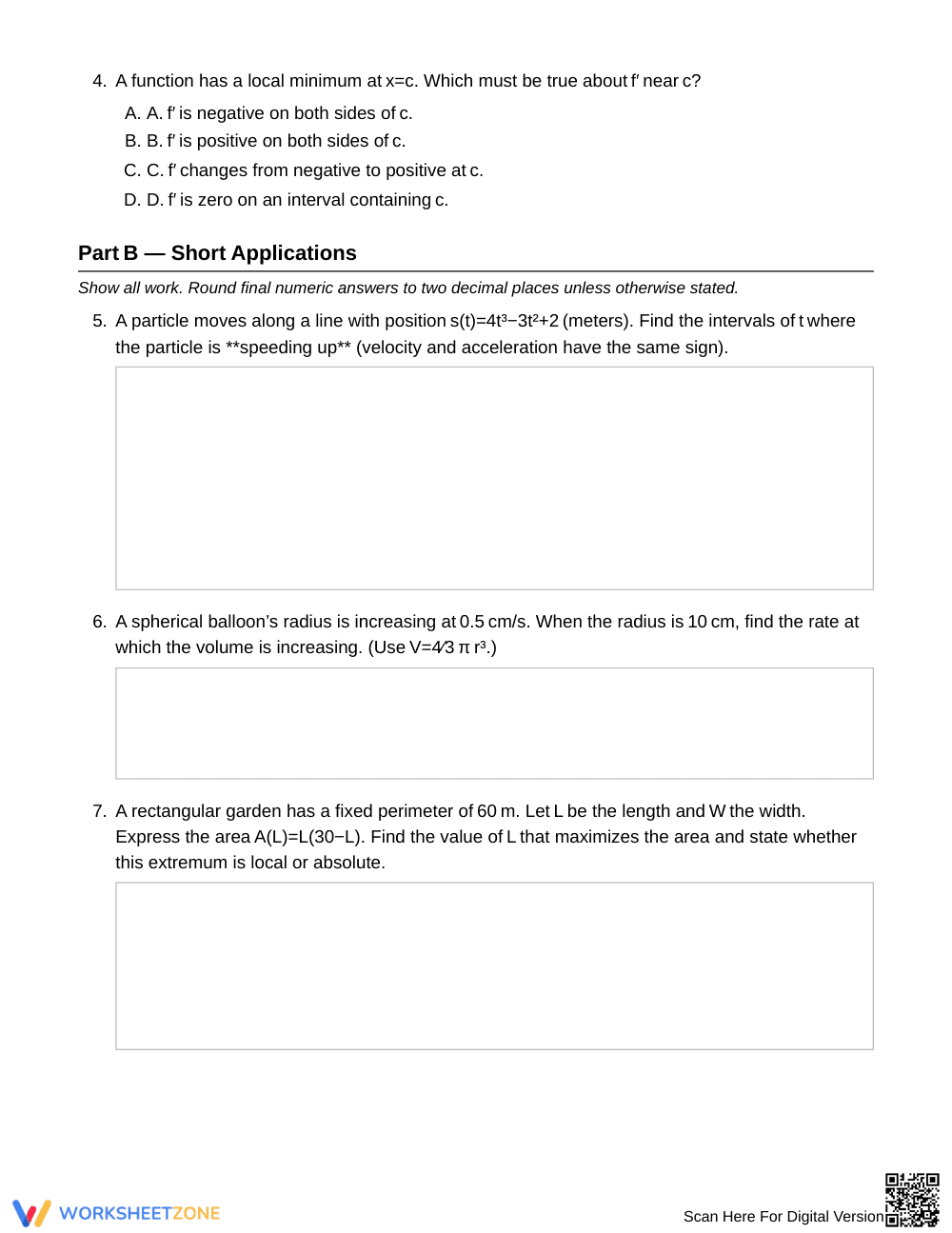
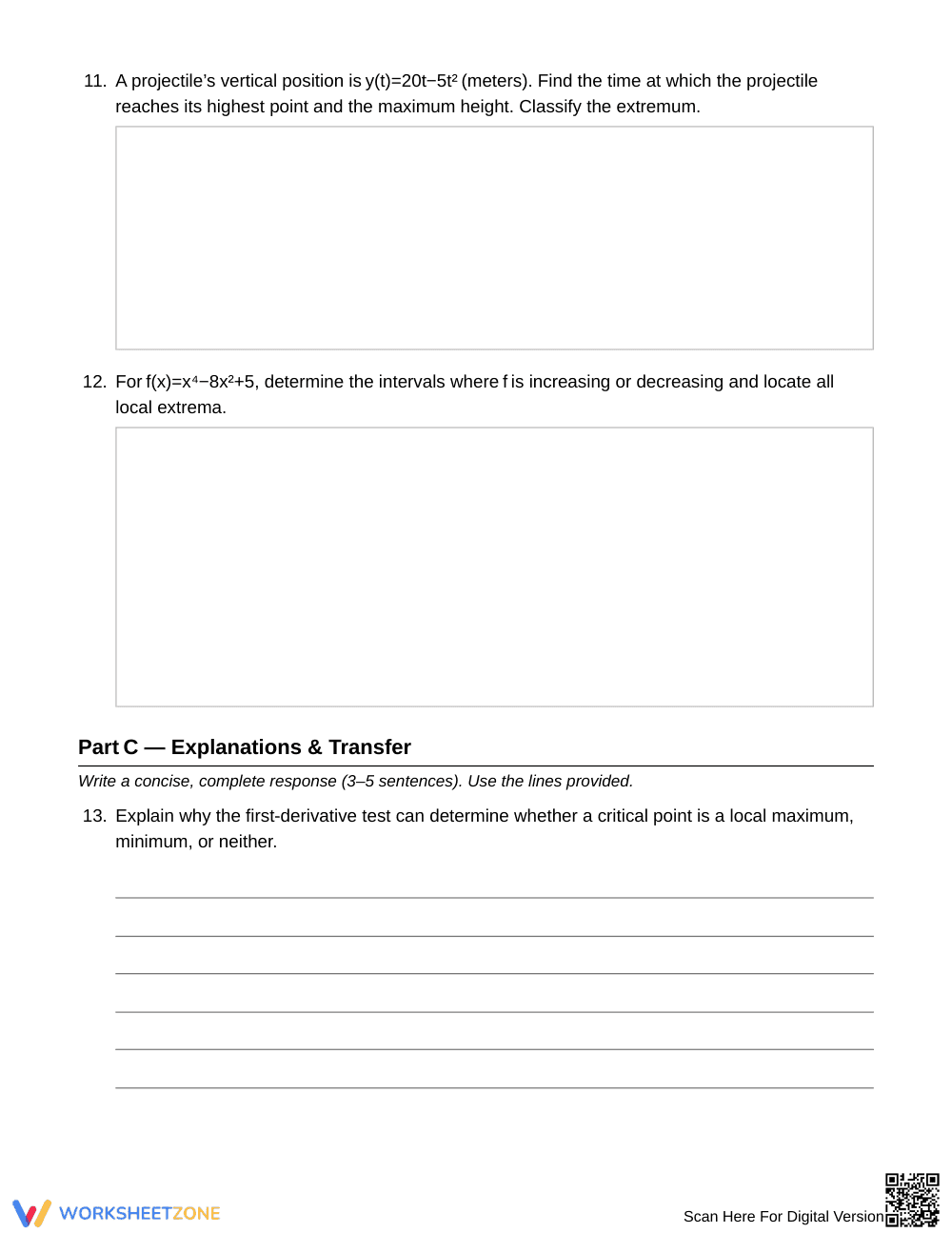
This five-page resource features a 16-task problem set paired with a three-page worked answer key. A reference box opens the worksheet, summarizing the First Derivative Test for student reference. Tasks include four conceptual multiple-choice items on extrema rules, eight applied problems involving motion and optimization, and four written explanation prompts requiring reasoned justifications.
Skill Progression
- Guided practice (Part A, Problems 1–4): Four conceptual multiple-choice questions establish core theorems on derivative signs and extrema criteria.
- Supported practice (Part B, Problems 5–12): Eight applied problems require students to calculate critical values and classify extrema in motion, rate, and geometry models.
- Independent practice (Part C, Problems 13–16): Four open-ended prompts challenge learners to write formal justifications and evaluate function behavior.
This sequence follows the gradual-release model, moving students from foundational theorem recognition to autonomous analysis.
Standards Alignment
This worksheet aligns with calculus standards on Applications of Derivatives, requiring students to analyze derivative signs to find intervals of increase or decrease and classify critical points. Supporting standards address optimization and rectilinear motion. Both standard codes can be copied directly into lesson plans, IEP goals, or district curriculum mapping tools.
How to Use It
Use this worksheet after direct instruction on the First Derivative Test for independent or partner practice. During the 45 to 60 minutes of completion time, circulate during Part B to verify that students check sign changes across critical points rather than only setting derivatives to zero. Part C functions effectively as a formative assessment check.
Who It's For
This resource serves Grade 12 Calculus and AP Calculus students preparing for application units. Structured cues assist emerging learners, while open-ended items challenge advanced students. Pair this worksheet with a curve-sketching anchor chart or graphing utility demonstration.
Mastering derivative sign analysis and local behavior empowers Grade 12 calculus students to deduce function characteristics, optimize geometric systems, and interpret rates of change across diverse physical models. Grounded in instructional design principles documented by Fisher & Frey (2014), this five-page mathematics resource implements an intentional gradual-release architecture spanning 16 progressively sequenced problems. Students begin by evaluating core calculus theorems, transition to intermediate multi-step calculations involving particle motion, related rates, and profit optimization, and culminate in rigorous written explanations that synthesize algebraic findings with clear verbal justifications. Complete worked answer keys spanning three dedicated pages facilitate precise teacher assessment, formative tracking, and targeted student remediation. By systematically connecting derivative signs to local function behaviors, this curricular guide bridges mechanical computation and conceptual fluency, directly equipping secondary students for collegiate mathematical modeling and advanced placement calculus examinations.


