





























Essential Derivative Rates Worksheet | Grade 12 Calculus
Paste this activity's link or code into your existing LMS (Google Classroom, Canvas, Teams, Schoology, Moodle, etc.).
Students can open and work on the activity right away, with no student login required.
You'll still be able to track student progress and results from your teacher account.
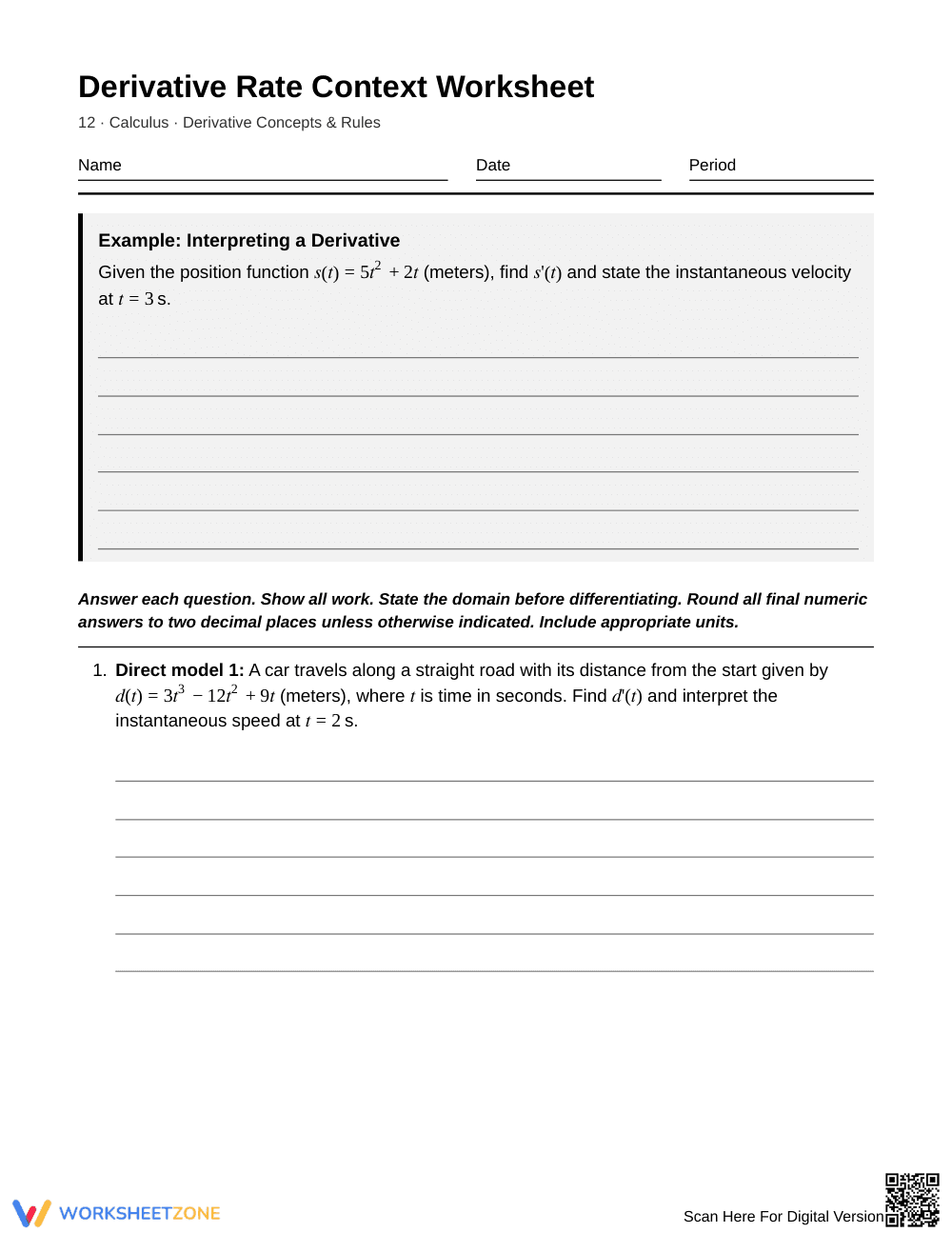
This calculus practice activity helps high school seniors master the practical meaning of derivatives across diverse real-world models. Students calculate instantaneous rates of change, state proper units of measurement, determine domain boundaries, and interpret functional behavior within scientific, engineering, and business scenarios to solidify conceptual comprehension.
At a Glance
- Grade: 12 · Subject: Calculus
- Standard: Interpret instantaneous rates of change and derivative values in applied contexts
- Skill Focus: Interpret a Derivative in a Rate Context
- Format: 5 pages · 10 problems · Answer key included · PDF
- Best For: Independent practice and contextual application
- Time: 45–60 minutes
What's Inside
This 5-page worksheet includes a worked reference example, 10 rigorous contextual word problems, and a comprehensive 3-page answer key showing step-by-step differentiation and interpretative statements. Tasks require students to specify functions, establish appropriate domains, compute first derivatives, evaluate them at specified values, and write contextual interpretations using correct compound units.
Skill Progression
- Guided practice (Problems 1–2): Direct modeling problems focusing on kinematic position and chemical temperature changes, providing structured prompts to identify units and evaluate basic quadratic and cubic derivatives.
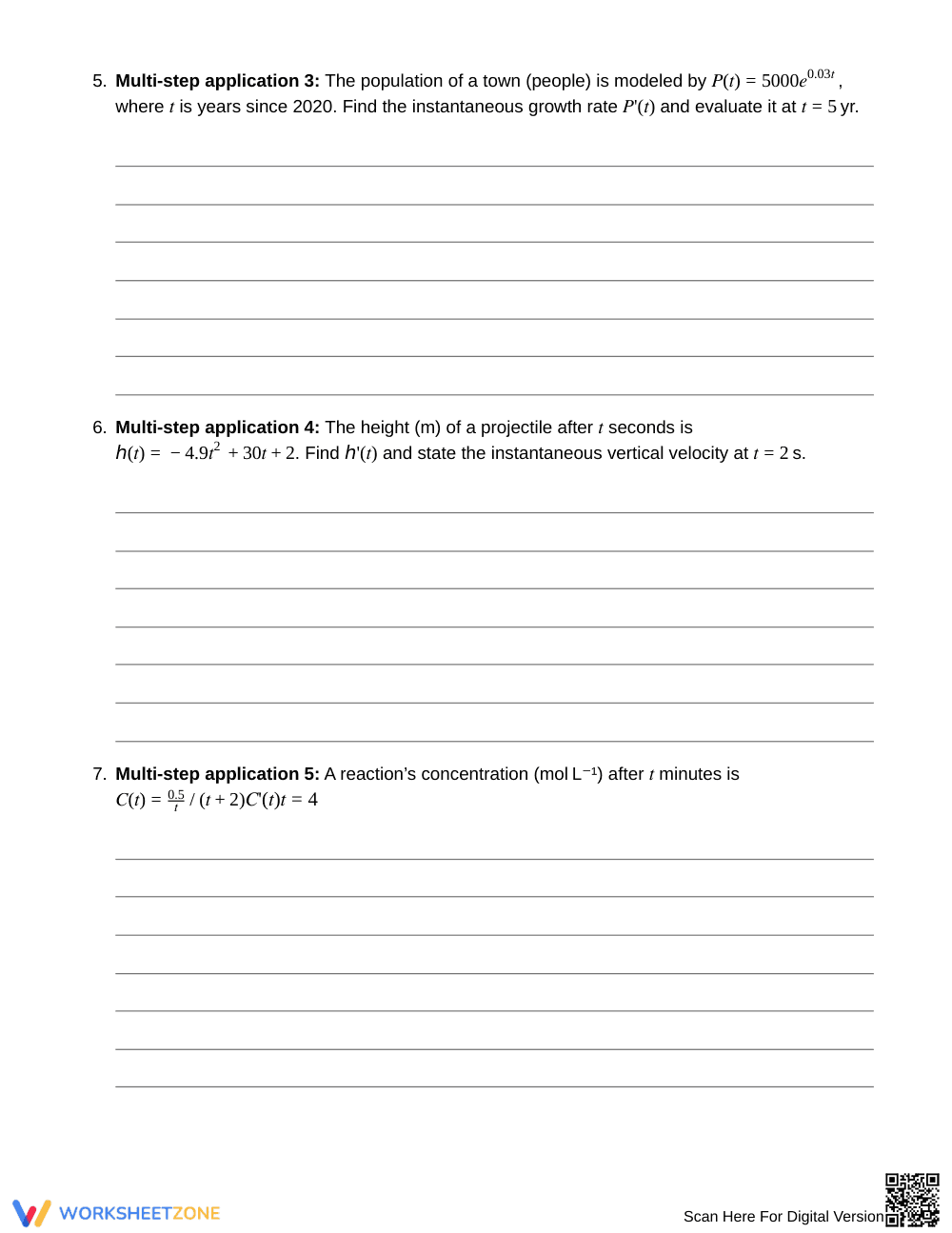
- Supported practice (Problems 3–8): Multi-step applications spanning draining tanks, marginal profit, exponential population growth, projectile motion, rational concentration curves, and automotive fuel efficiency.
- Independent practice (Problems 9–10): Complex constraint-based decision problems involving non-linear flow rates and continuous exponential medication dosing that demand interval analysis and midpoint derivative evaluation.
This deliberate sequence reflects the gradual-release framework, transitioning learners from standard calculation to multifaceted contextual interpretation.
Standards Alignment
This resource aligns with advanced calculus learning objectives requiring students to explain the meaning of a derivative within an applied modeling context. Students must calculate derivatives using power, product, quotient, and chain rules, interpret rate signs, and attach appropriate compound units to numerical solutions. Both standard codes can be copied directly into lesson plans, IEP goals, or district curriculum mapping tools.
How to Use It
Deploy this worksheet after direct instruction on differentiation rules and contextual interpretations. In an individual practice setting, allocate 45 to 60 minutes for students to complete the 10 problems. As a formative assessment observation tip, monitor how students articulate units on Problems 4 and 7; students frequently confuse amount units with rate-of-change units like dollars per unit or moles per liter per minute. Use these observations to conduct a targeted five-minute debrief before concluding class.
Who It's For
This activity is designed for Grade 12 Advanced Placement or honors calculus students who have mastered mechanical derivative formulas but need targeted practice connecting algebraic results to physical situations. Provide struggling students with an anchor chart summarizing common unit conversions, while challenging advanced students to explain second derivative implications for concavity on Problems 8 and 10.
According to Fisher & Frey (2014), structured instructional progressions that guide students from modeled exemplars to independent problem solving significantly strengthen conceptual transfer in secondary mathematics. This 5-page, 10-task worksheet reinforces how to interpret instantaneous rates of change across diverse physical and economic scenarios. By requiring learners to state functional domains, perform symbolic differentiation, and craft verbal explanations incorporating explicit units of measure, the resource ensures students move past rote calculation. The accompanying 3-page answer key provides complete analytical derivations and model interpretive sentences, allowing educators to evaluate mathematical accuracy and conceptual clarity. Implementing this rigorous practice sequence helps Grade 12 calculus learners develop reliable problem-solving autonomy across both polynomial and non-linear contextual applications.


