




























Essential Derivative Behavior Worksheet | Grade 12 Calculus
Paste this activity's link or code into your existing LMS (Google Classroom, Canvas, Teams, Schoology, Moodle, etc.).
Students can open and work on the activity right away, with no student login required.
You'll still be able to track student progress and results from your teacher account.
This comprehensive calculus worksheet strengthens student ability to connect algebraic derivative expressions with local function behavior. High school seniors analyze symbolic rules, verify calculated derivatives, and evaluate local increasing, decreasing, or extremum claims across 12 rigorous analytical problems. Students develop deep conceptual fluency connecting formal differentiation mechanics with qualitative function properties.
At a Glance
- Grade: 12 · Subject: Calculus
- Standard: Advanced Calculus — Analyze functions and derivatives to determine local behavior
- Skill Focus: Compare Algebraic Derivatives and Local Behavior
- Format: 4 pages · 12 problems · Answer key included · PDF
- Best For: Calculus derivative review and analysis
- Time: 40–50 minutes
This 4-page student activity features a quick-reference reminder box reviewing standard differentiation rules—including power, product, quotient, and chain rules. The practice set contains 12 multi-step items organized into three targeted sections, supported by a 2-page detailed answer key with complete algebraic solutions and analytical justifications.
Skill Progression
- Guided practice (Part A, Problems 1–3): Students read given derivative expressions and recover primitive antiderivative forms F(x) with the constant of integration C, reinforcing fundamental inverse operations and symbolic structure.
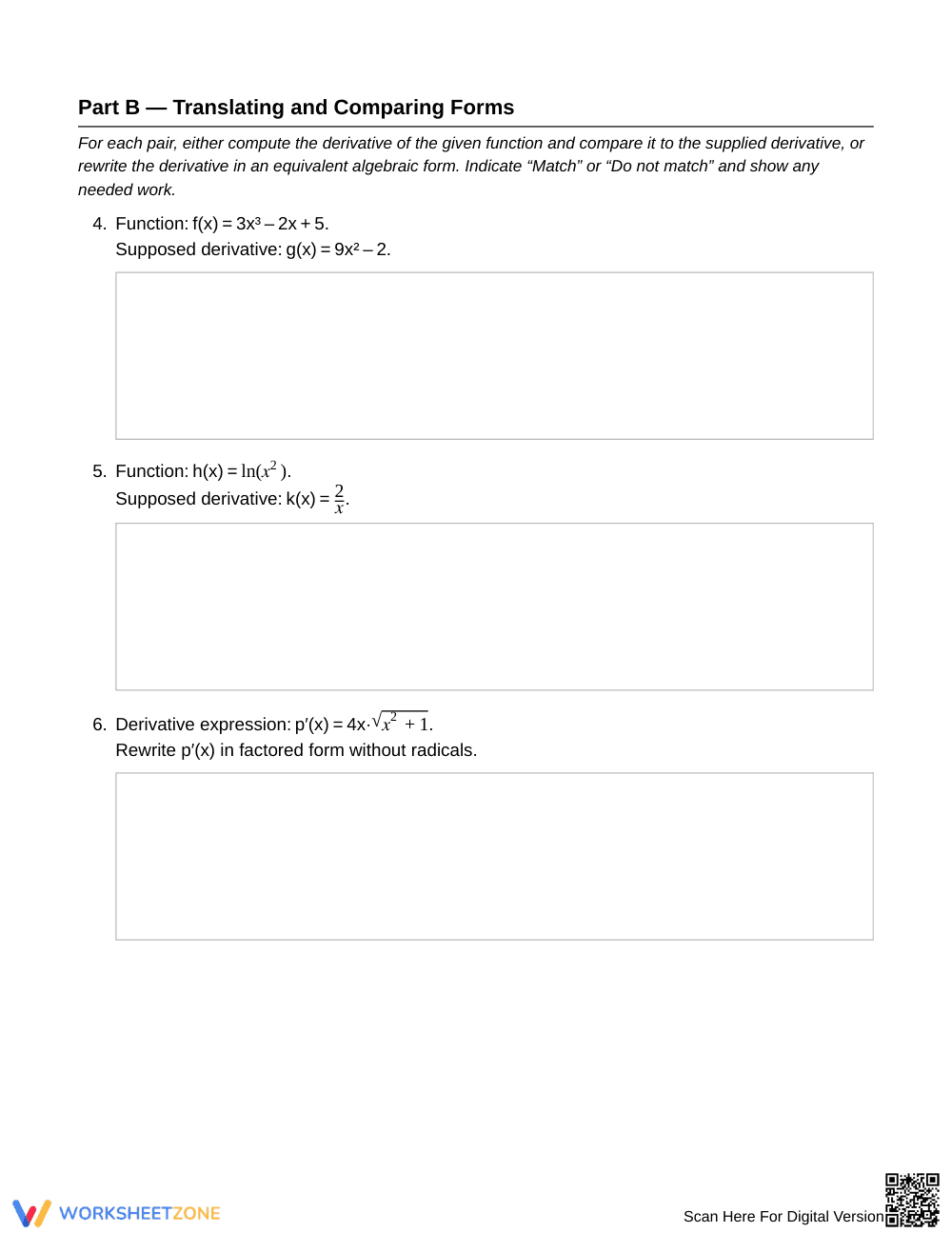
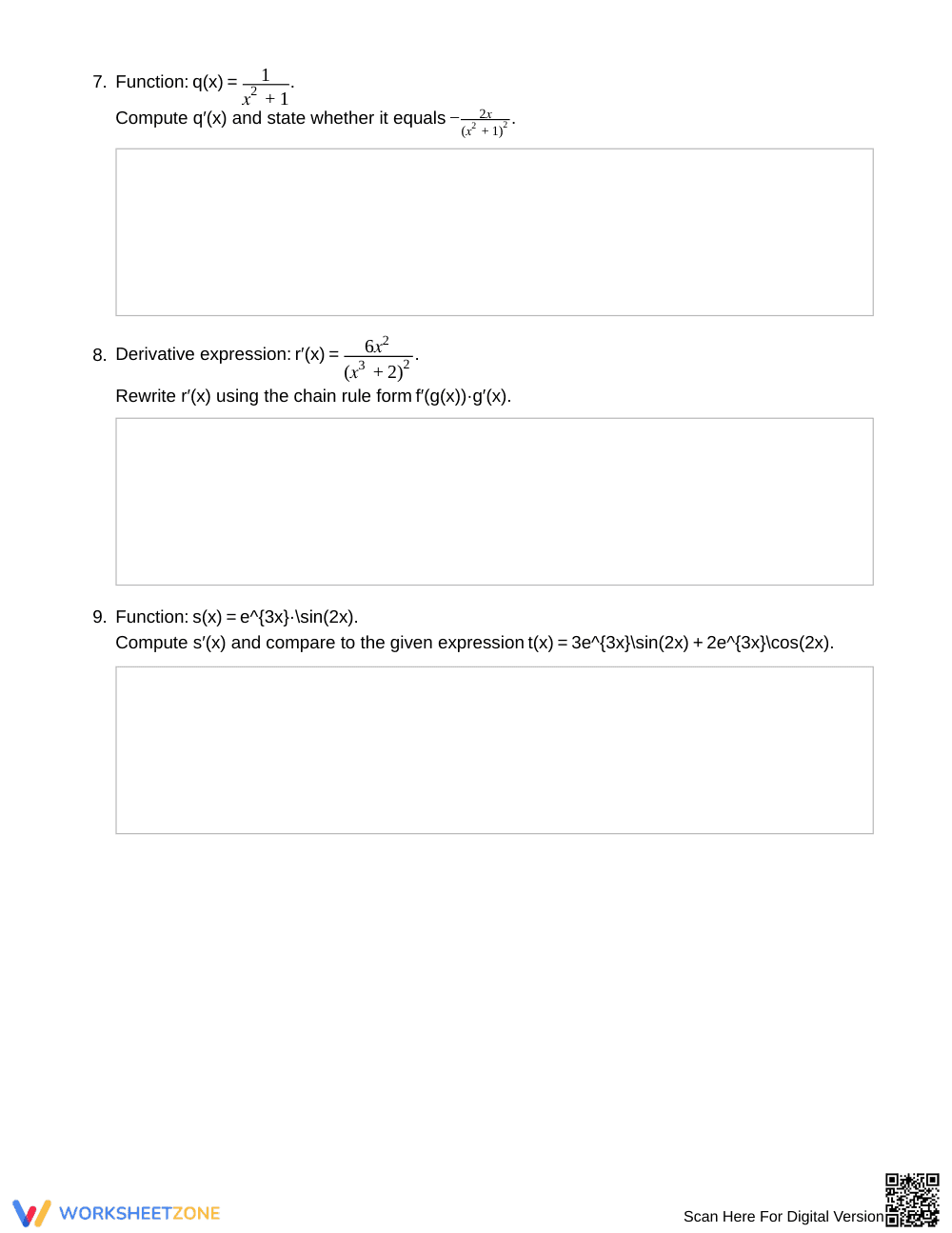
- Supported practice (Part B, Problems 4–9): Learners differentiate functions, verify matching derivative expressions, and rewrite composite forms using chain rule relationships across exponential, logarithmic, and trigonometric functions.
- Independent practice (Part C, Problems 10–12): Students interpret derivative signs at specific points to confirm or refute statements about local behavior, including monotonicity and local extrema.
This structured progression leverages an intentional gradual-release model, transitioning students from mechanical formula recognition to complex qualitative analysis.
Standards Alignment
Aligned with Advanced Placement and college calculus benchmarks, this worksheet targets competencies in calculating derivatives and interpreting their signs to determine local curve behavior. Both standard objectives can be copied directly into lesson plans, IEP goals, or district curriculum mapping tools.
How to Use It
Deploy this resource after direct instruction on derivative rules. In small-group workshops, have pairs complete Part B to verify symbolic work before tackling Part C. Formatively assess Part C to detect sign errors versus function values. Expect completion in 40 to 50 minutes.
Who It's For
Designed for Grade 12 AP Calculus AB/BC and college calculus students. Provide the rule box for scaffolding or assign Part C as an extension challenge. Pair this resource with graphing software demonstrations or tangent slope anchor charts.
High school calculus mastery requires systematic coordination between symbolic differentiation rules and qualitative interpretations of local curve behavior. According to Fisher & Frey (2014), structured instructional progressions that advance from guided procedural practice to independent conceptual justification significantly strengthen mathematical reasoning and long-term retention. This Grade 12 Calculus worksheet develops core analytical competencies in comparing algebraic derivatives and local function behavior across 12 scaffolded tasks presented on 4 comprehensive pages. By prompting learners to invert basic derivative forms, verify multi-step calculus expressions, and rigorously defend monotonicity or extrema claims using derivative signs, this resource effectively bridges mechanical computation and conceptual understanding. The included differentiation rule reference box and complete 2-page answer key supply immediate feedback mechanisms that support diagnostic precision, self-directed error analysis, and learner autonomy in advanced secondary mathematics courses and AP exam preparation.


