




























Views
Downloads



Essential Density Variation Worksheet | Grade 8 Science

Paste this activity's link or code into your existing LMS (Google Classroom, Canvas, Teams, Schoology, Moodle, etc.).
Students can open and work on the activity right away, with no student login required.
You'll still be able to track student progress and results from your teacher account.
This Grade 8 physical science worksheet trains students to analyze density variation, fluid layering, and measurement uncertainty across experimental trials. Students calculate densities from synthetic data, predict buoyancy across immiscible liquids, and evaluate error bounds to determine how measurement precision influences laboratory findings.
At a Glance
- Grade: 8 · Subject: Physical Science
- Standard: Analyze data on characteristic physical properties to determine densities, layering sequences, and measurement uncertainty
- Skill Focus: Analyze Density Variation Across Measurements
- Format: 5 pages · 10 problems · Answer key included · PDF
- Best For: Rigorous post-lab physical science data analysis practice
- Time: 40–50 minutes
What's Inside
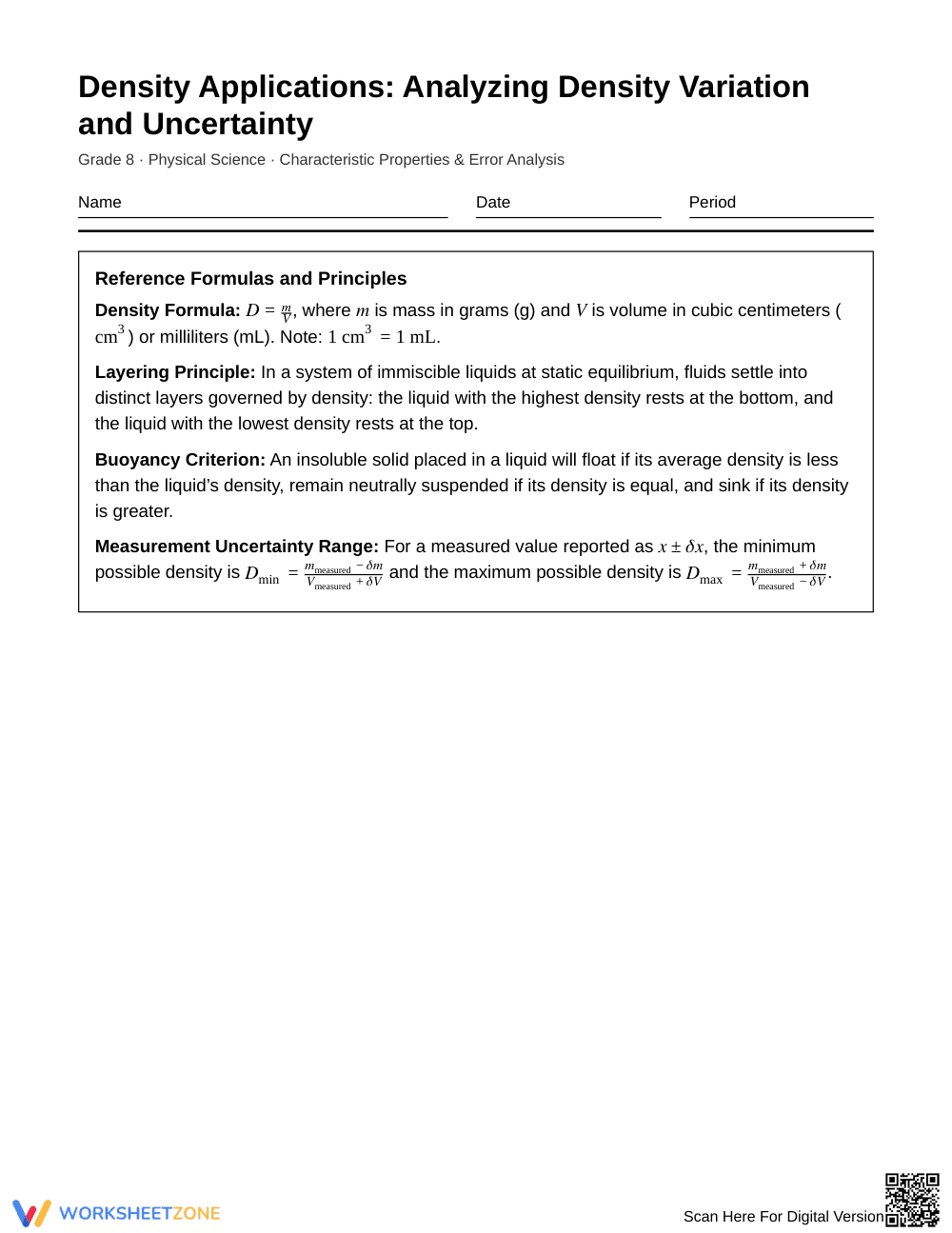
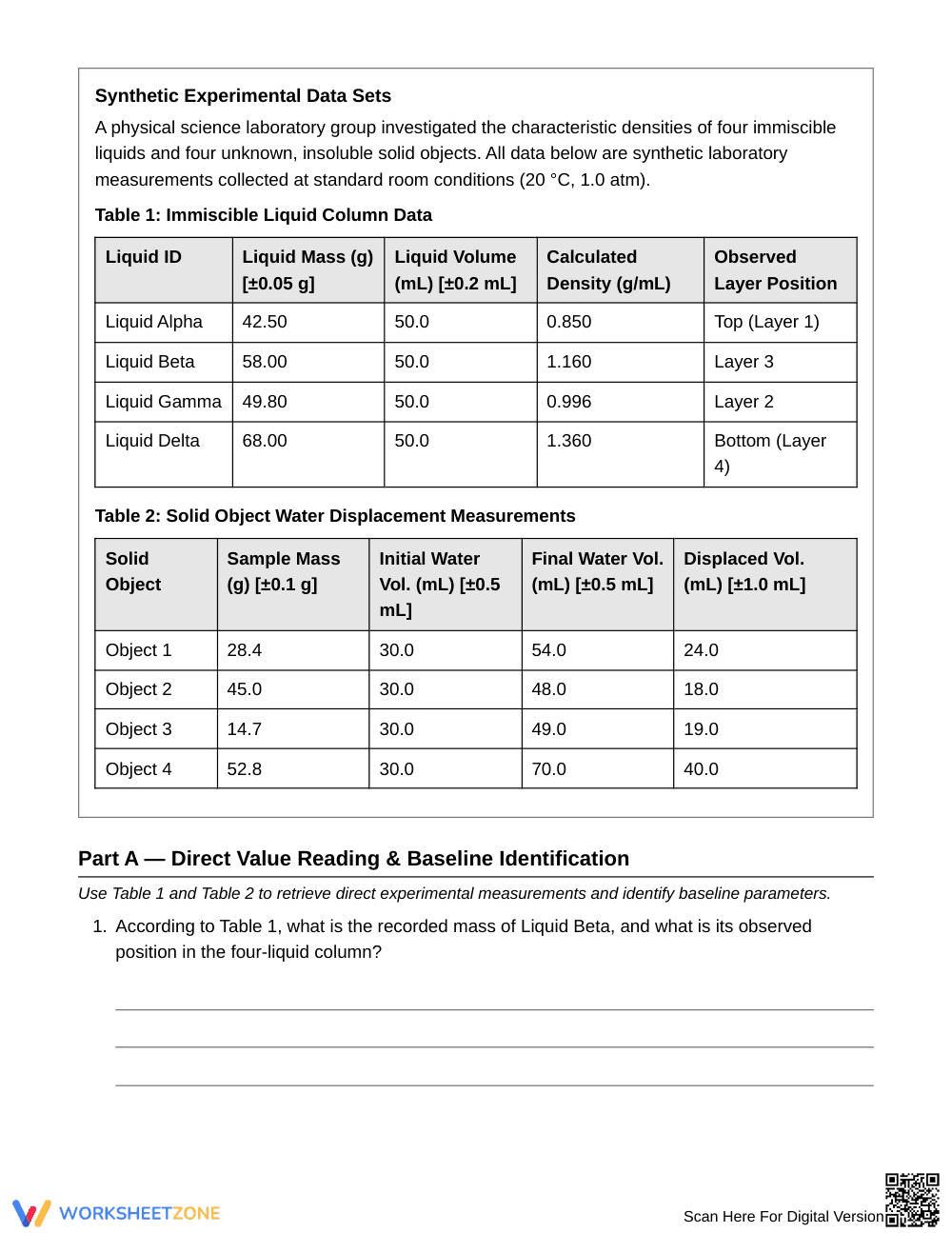
This 5-page packet features 10 structured analytical questions across three sections, supported by a 3-page complete answer key with mathematical solutions. Students analyze synthetic laboratory data across two structured tables detailing liquid columns and water displacement. The worksheet provides reference formulas for density, fluid stratification, solid buoyancy criteria, and extreme uncertainty bounds.
Skill Progression
- Guided Practice: Tasks 1–2 establish foundational literacy through direct table retrieval, reading initial volumes and baseline masses with stated instrument tolerances.
- Supported Practice: Tasks 3–8 guide multi-step calculations and conceptual reasoning, prompting students to calculate nominal densities, predict buoyancy across layered fluids, and compute minimum and maximum uncertainty limits.
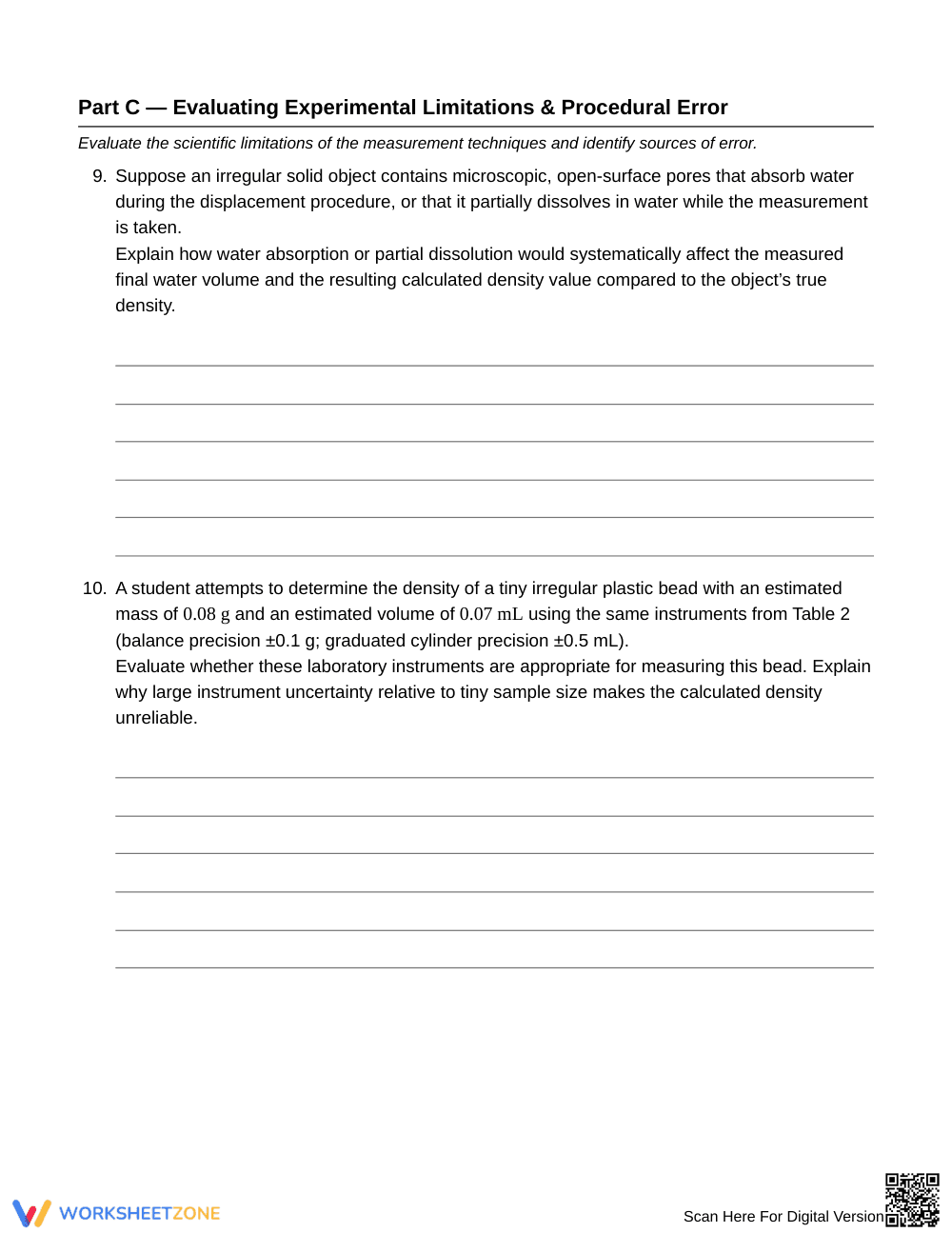
- Independent Practice: Tasks 9–10 require critical experimental evaluation, challenging students to assess how water absorption alters calculated density and evaluate instrument sensitivity limits for micro-scale samples.
This sequence follows a gradual-release model, advancing from direct data reading to multi-step quantitative calculation and independent experimental critique.
Standards Alignment
This worksheet aligns directly with middle school physical science standards addressing characteristic properties of matter, mass-to-volume relationships, and scientific measurement error. Students analyze quantitative evidence to demonstrate that density remains an intrinsic material property. Both standard codes can be copied directly into lesson plans, IEP goals, or district curriculum mapping tools.
How to Use It
Assign this worksheet after direct instruction on displacement calculations or following a physical density lab. During independent work, conduct formative assessment checks on Task 6 to ensure students place Object 1 at the liquid interface rather than assuming simple binary buoyancy. Expected completion time is 40 to 50 minutes.
Who It's For
This resource serves Grade 8 physical science students developing data literacy and quantitative reasoning skills. Scaffolds support struggling learners through provided formulas, while uncertainty calculations challenge advanced students. Pair this activity with a physical water displacement lab or fluid density column demonstration.
Mastering the skill to analyze density variation across measurements bridges conceptual physical science and authentic scientific inquiry. According to Fisher & Frey (2014), structuring complex science tasks through gradual release enables students to transition successfully from foundational data retrieval to sophisticated error evaluation. Middle school learners frequently struggle to connect mathematical ratios with observable physical phenomena, often viewing experimental measurements as absolute numbers rather than ranges governed by instrumental tolerance. This resource directly resolves that misconception by integrating synthetic lab data, buoyancy predictions, and formal uncertainty bounds into a cohesive problem set. By requiring students to calculate minimum and maximum densities and critique procedural limitations such as sample absorption, the worksheet fosters deep quantitative reasoning. Educators can reliably utilize this structured sequence to prepare eighth-grade students for high school laboratory science, data-driven standardized testing, and genuine scientific discourse.


