




























Views
Downloads



Essential Density Predictions Worksheet | Grade 8 Science

Paste this activity's link or code into your existing LMS (Google Classroom, Canvas, Teams, Schoology, Moodle, etc.).
Students can open and work on the activity right away, with no student login required.
You'll still be able to track student progress and results from your teacher account.
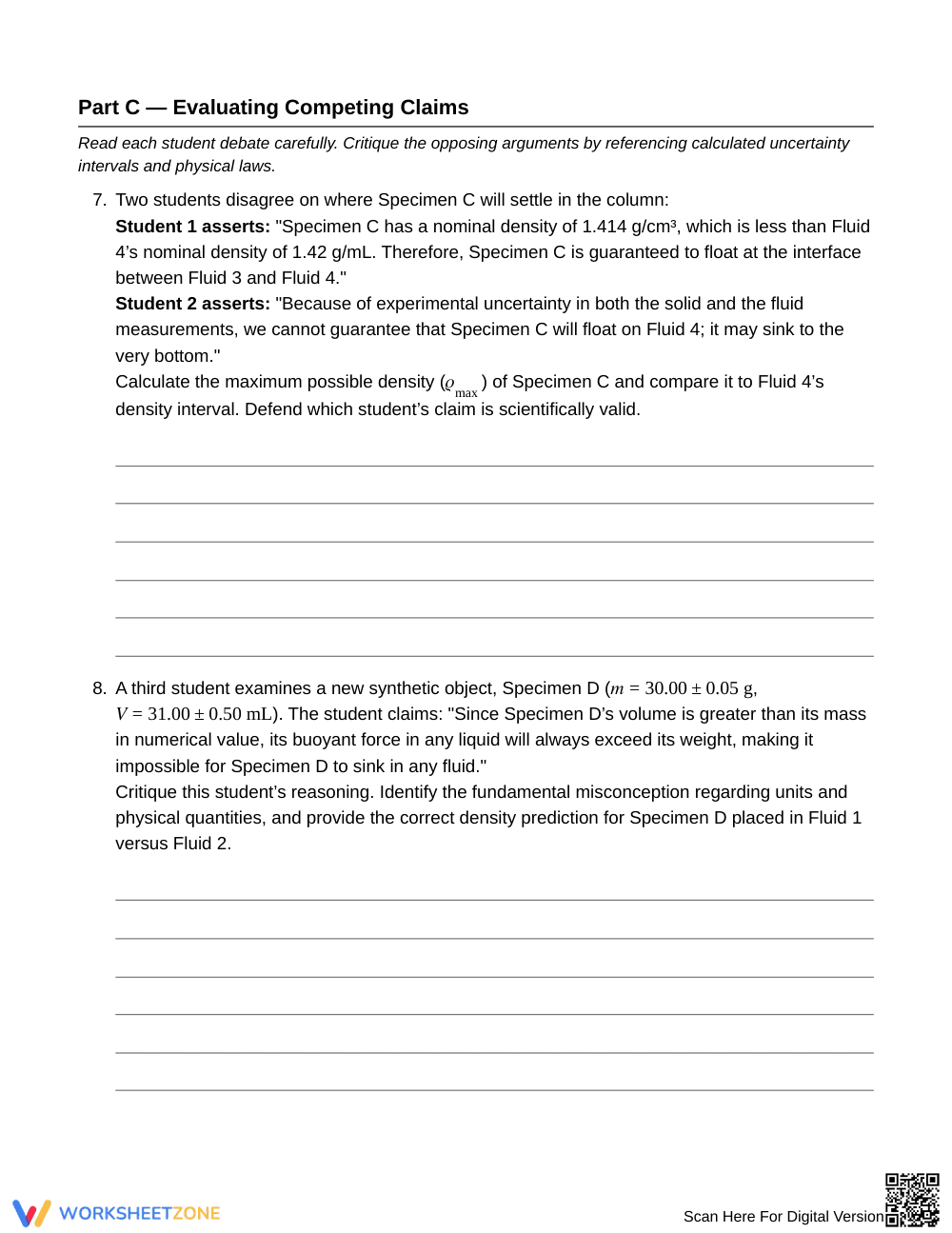
This physical science worksheet equips Grade 8 students to defend density-based predictions in multi-layer fluid systems using data and measurement uncertainty. Students calculate density intervals, analyze buoyant forces, and construct evidence-based arguments explaining equilibrium settling positions across immiscible liquid columns.
At a Glance
- Grade: 8 · Subject: Science
- Standard: Density and Properties of Matter — Defend predictions of object settling position using density calculations and error intervals
- Skill Focus: Defend a Density-Based Prediction
- Format: 5 pages · 8 problems · Answer key included · PDF
- Best For: Lab analysis or unit review
- Time: 45–60 minutes
Spanning 5 printable pages, this resource features 8 analytical problems alongside data tables for fluid layers and solid specimens. The worksheet opens with a core principles reference box containing density formulas and uncertainty propagation rules. A comprehensive 4-page answer key provides step-by-step mathematical calculations and complete sample explanations.
Skill Progression
- Guided practice (Part A, 2 items): Students extract boundary values from data tables and calculate minimum and maximum density extremes using uncertainty intervals.
- Supported practice (Part B, 4 items): Students construct scientific explanations linking density intervals to buoyant force, intensive properties, thermal expansion, and Archimedes' principle.
- Independent practice (Part C, 2 items): Students critique competing scientific claims and resolve measurement uncertainty debates without scaffolding.
This structured progression uses a gradual-release model to build student competence in rigorous scientific argumentation.
Standards Alignment
This resource aligns with middle school physical science standards for matter and its interactions, requiring students to analyze data to determine characteristic properties and support claims about physical systems. The problems also reinforce crosscutting concepts regarding stability and change in multi-fluid columns.
How to Use It
Implement this worksheet after direct instruction on density and Archimedes' principle. It works well for post-lab synthesis or summative review. During class, formatively check whether students evaluate overlapping uncertainty intervals in Part C rather than relying only on nominal densities. Expected completion time is 45 to 60 minutes.
Who It's For
This worksheet is ideal for Grade 8 physical science and introductory physics students developing quantitative reasoning skills. For differentiated support, pair this activity with a physical density column demonstration or anchor chart before students complete the uncertainty calculations.
Defending density-based predictions using empirical data and uncertainty intervals requires middle school students to integrate quantitative calculations with scientific reasoning. Research highlighted in Fisher & Frey (2014) demonstrates that structured gradual-release frameworks significantly improve student proficiency in constructing scientific explanations and evaluating competing claims. When learners move systematically from identifying data boundaries to resolving conceptual misconceptions, their ability to apply physical laws such as buoyant force equilibrium increases substantially. This Grade 8 physical science practice set reinforces measurement principles by requiring students to compute density intervals under instrument uncertainty and defend specimen settling depths across layered fluid columns. The included 8 targeted tasks and detailed 4-page answer key equip educators to foster rigorous analytical discourse during physical science instruction.


