































Essential Dalton's Law Worksheet | Grades 9-12 Science

Paste this activity's link or code into your existing LMS (Google Classroom, Canvas, Teams, Schoology, Moodle, etc.).
Students can open and work on the activity right away, with no student login required.
You'll still be able to track student progress and results from your teacher account.
This high school science worksheet equips students to construct, analyze, and revise particle-level models that illustrate Dalton's Law of Partial Pressure. Through structured gas mixture representations, learners connect particle collisions and mole fractions directly to macroscopic pressure readings and experimental gas collection calculations.
At a Glance
- Grade: Grades 9–12 · Subject: Science
- Standard: Science and Engineering Practices — Construct and revise models to explain particle collisions and partial pressures
- Skill Focus: Construct and revise models of partial pressure
- Format: 4 pages · 31 problems · Answer key included · PDF
- Best For: Gas laws modeling and lab preparation
- Time: 45–60 minutes
What's Inside
This 4-page instructional resource contains 31 scaffolded tasks arranged across three core sections. Students work with particle diagram tables, collision explanations, conceptual error-analysis models, and stoichiometric gas collection calculations involving water vapor pressure. A complete 4-page answer key provides worked-out mathematical steps and detailed conceptual explanations for immediate feedback.
Skill Progression
- Guided practice (Part A): Students examine an air mixture particle diagram to tabulate mole fractions, calculate individual partial pressures, and explain how wall collisions generate pressure proportional to particle counts.
- Supported practice (Part B): Learners critique a common misconception model regarding atomic mass versus collision frequency, rewriting the scientific explanation using kinetic energy and particle speed.
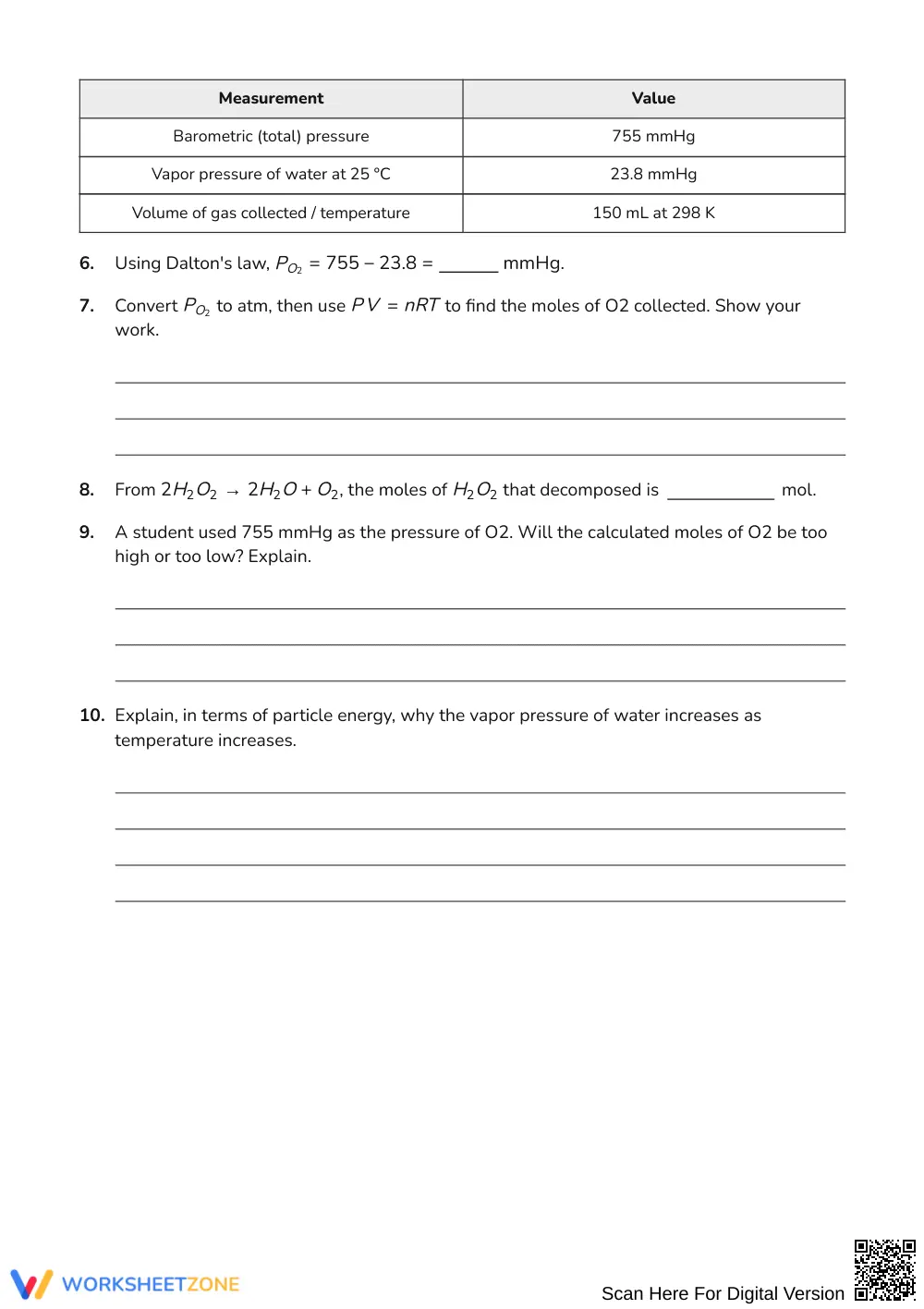
- Independent practice (Part C): Students apply Dalton's law to authentic laboratory data by subtracting water vapor pressure from atmospheric barometric readings and calculating collected gas moles with the ideal gas law.
This progression mirrors the gradual-release framework, guiding students from direct model interpretation to independent experimental problem-solving.
Standards Alignment
This resource aligns with high school physical science standards for developing and using models. Students construct and revise models based on evidence to illustrate the relationships between systems and macroscopic pressure outcomes. These standards can be integrated directly into chemistry lesson plans, IEP goals, or district science curriculum mapping tools.
How to Use It
Deploy this worksheet after direct instruction on the kinetic molecular theory and Dalton's law. In a guided lab setting, have students complete Part A and Part B collaboratively before conducting a hydrogen peroxide gas collection experiment, using Part C as post-lab data analysis. During work time, formatively check student reasoning in Part B: verify that students recognize light and heavy particles share identical average kinetic energy at the same temperature. Typical completion time spans 45 to 60 minutes.
Who It's For
Designed for general chemistry and honors chemistry students in Grades 9–12, this practice supports visual learners transitioning from qualitative particle models to quantitative algebra. Pair this worksheet directly with an anchor chart comparing root-mean-square speed to kinetic energy or an experimental pneumatic gas collection demonstration.
According to Fisher & Frey (2014), modeling complex physical interactions requires intentional instructional scaffolding that bridges qualitative particle behavior with quantitative algebraic laws. Dalton's Law of Partial Pressure presents a common stumbling block in high school chemistry when students erroneously equate atomic mass with pressure contribution rather than particle frequency and thermal kinetic energy. This 4-page modeling worksheet targets that exact conceptual obstacle through structured model critique and gas stoichiometry data sets. By progressing from rigid container particle counts to water vapor corrections using barometric data, students translate abstract kinetic molecular theory into durable problem-solving schemas. The included 31 focused tasks ensure teachers can systematically monitor student understanding during active chemistry instruction.


