































Essential Dalton's Law Worksheet | Grades 9–12 Science

Paste this activity's link or code into your existing LMS (Google Classroom, Canvas, Teams, Schoology, Moodle, etc.).
Students can open and work on the activity right away, with no student login required.
You'll still be able to track student progress and results from your teacher account.
This Dalton's Law of Partial Pressure worksheet guides high school science students through interpreting particle models, laboratory data, and vapor pressure trends. Students develop quantitative mastery by calculating mole fractions, determining dry gas pressures from water displacement, and writing evidence-based scientific arguments.
At a Glance
- Grade: Grades 9–12 · Subject: Science
- Standard: High School Physical Science — Analyze evidence, interpret data tables, and calculate partial pressures in gas mixtures
- Skill Focus: Graph or Evidence Interpretation
- Format: 4 pages · 21 problems · Answer key included · PDF
- Best For: Chemistry gas laws units and post-lab experimental analysis
- Time: 45–60 minutes
What's Inside
Spanning 4 pages, this 21-task resource features three targeted investigation sections. Part A introduces a visual particle model where students calculate mole fractions. Part B provides experimental data for collecting hydrogen over water with vapor pressure tables. Part C guides students through multi-trial flask data and a Claim-Evidence-Reasoning response. A complete 4-page answer key provides full solutions.
Skill Progression
- Guided Practice (Part A, 6 tasks): Students examine a particle model of nitrogen, oxygen, and argon to define Dalton's law and determine mole fractions.
- Supported Practice (Part B, 7 tasks): Students analyze eudiometer lab data, read water vapor pressure tables, and calculate dry hydrogen pressure.
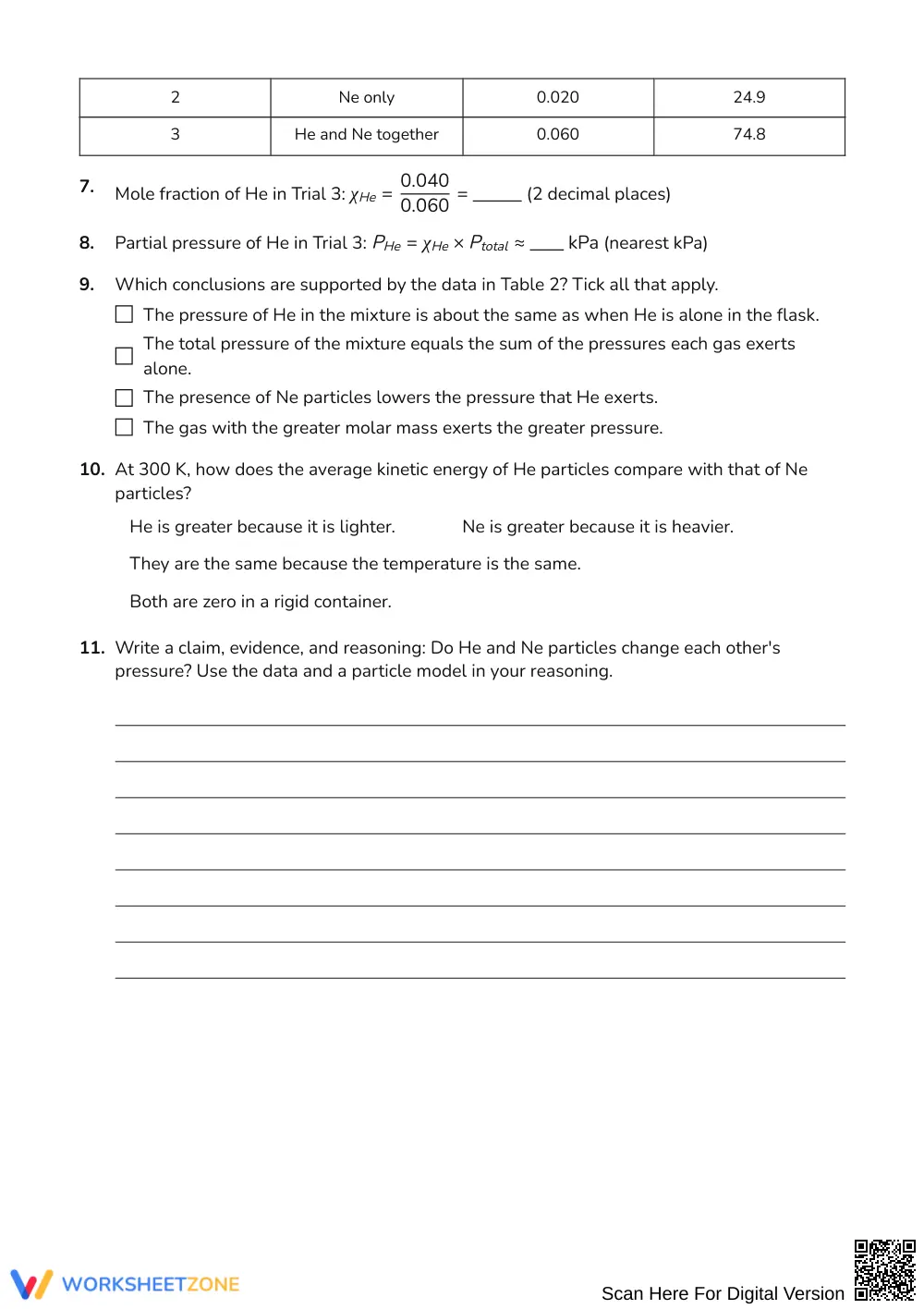
- Independent Practice (Part C, 8 tasks): Students evaluate multi-gas trial data in a rigid flask, deduce particle independence, and synthesize findings in an unassisted CER response.
This systematic progression embodies the gradual release model, moving students from scaffolded visual models to independent data analysis.
Standards Alignment
This resource aligns with High School Physical Science standards focusing on gas behavior, kinetic molecular theory, and quantitative relationships in mixtures. Students analyze empirical data to show that total gas pressure equals the sum of component pressures. Both standard codes can be copied directly into lesson plans, IEP goals, or district curriculum mapping tools.
How to Use It
Use this worksheet after direct instruction on gas laws or as a follow-up analysis for a gas collection lab. During guided work, check whether students subtract vapor pressure when finding dry gas values rather than adding it. Expected completion time is 45 to 60 minutes.
Who It's For
This printable activity is designed for high school chemistry students needing targeted practice with gas calculations and graphical analysis. Teachers can differentiate by providing the particle table as a visual reference for struggling learners. Pair this assignment with a direct instruction lesson on kinetic molecular theory.
According to research by Fisher & Frey (2014) on effective instructional scaffolding, structured task sequences that bridge visual models, quantitative data tables, and written explanations significantly enhance student conceptual retention in secondary science. This Grades 9–12 Dalton's law worksheet operationalizes evidence interpretation by guiding students through 21 carefully sequenced tasks. Learners examine particle diagrams, calculate mole fractions, interpret vapor pressure curves, and evaluate independent gas behavior in mixtures. Rather than relying on rote algorithmic substitution, students apply kinetic molecular principles to explain why water vapor pressure alters collected gas volumes at varying temperatures. The inclusion of a formal Claim-Evidence-Reasoning task solidifies scientific argumentation skills by requiring students to justify that gas particles exert independent pressures against container walls. This multifaceted approach ensures that learners build both procedural fluency and deep conceptual understanding of gas behavior in accordance with national science education benchmarks.


