































Essential Dalton's Law Worksheet | Grades 9-12 Science

Paste this activity's link or code into your existing LMS (Google Classroom, Canvas, Teams, Schoology, Moodle, etc.).
Students can open and work on the activity right away, with no student login required.
You'll still be able to track student progress and results from your teacher account.
This high school chemistry worksheet develops conceptual understanding and quantitative mastery of Dalton's Law of Partial Pressure. Students examine particle diagrams, calculate mole fractions, predict how system shifts alter partial and total pressures, and analyze real laboratory data from gas collection over water across 24 scaffolded questions.
At a Glance
- Grade: Grades 9–12 · Subject: Science
- Standard: High School Physical Science — Model gas behavior and partial pressure changes during chemical and physical processes
- Skill Focus: Dalton's Law cause-and-effect predictions and calculations
- Format: 4 pages · 24 problems · Answer key included · PDF
- Best For: Guided chemistry instruction and practice
- Time: 45–60 minutes
What's Inside
The four-page printable worksheet includes particle model interpretations, cause-and-effect prediction tables, water vapor pressure corrections, and conceptual evaluation prompts. Scaffolded problem sets integrate worked formulas (P_B = X_B × P_total) alongside structured qualitative explanations. A comprehensive four-page answer key provides complete calculations and particle-level rationales for every item.
Skill Progression
- Guided practice (Part A, 6 items): Students analyze a visual 12-particle container model to compute mole fractions and partial pressures while explaining why independent particle collisions produce additive pressure.
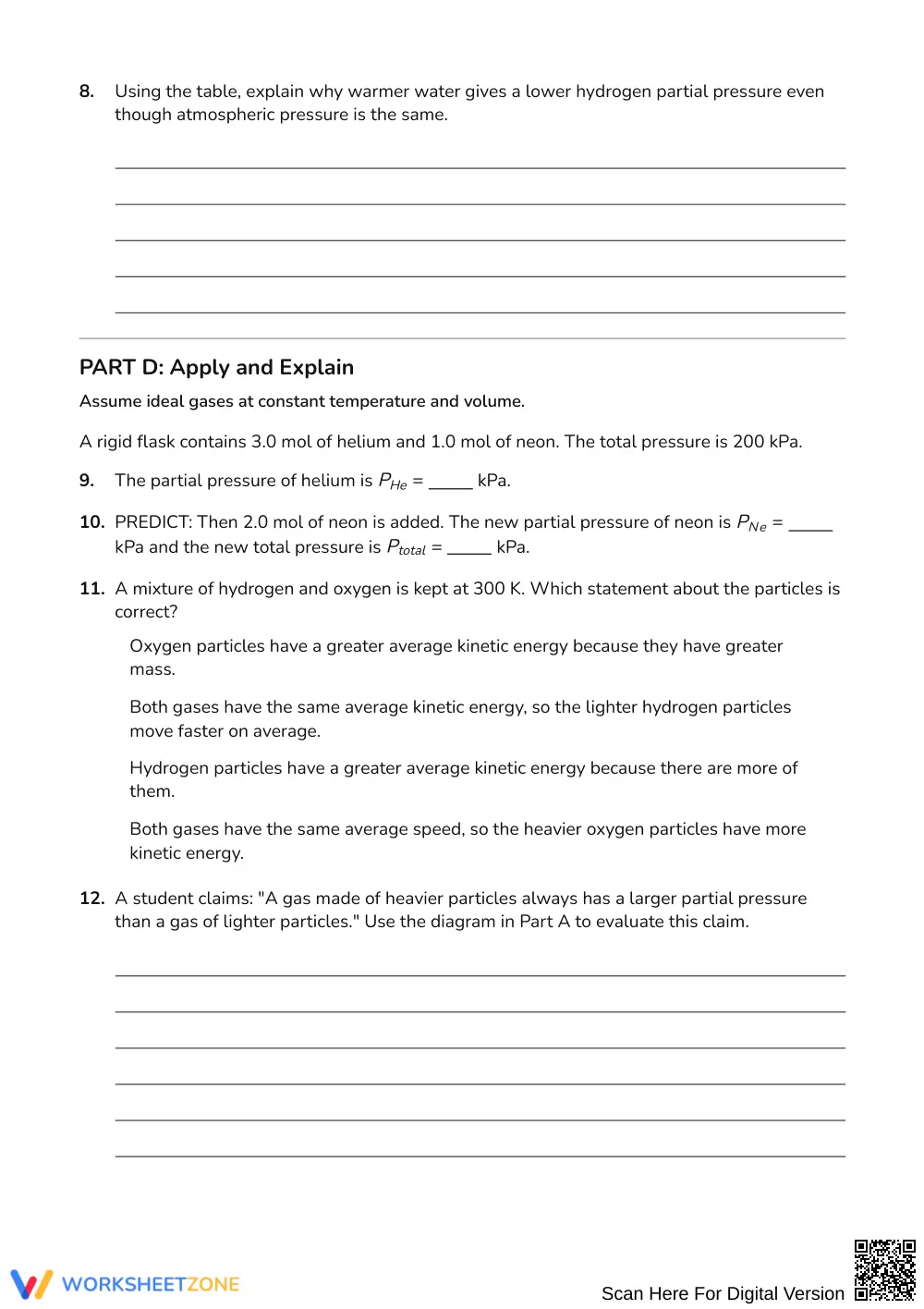
- Supported practice (Parts B & C, 11 items): Learners complete cause-and-effect chains, evaluate volume and temperature shifts, and use reference tables to subtract water vapor pressure from atmospheric gas samples.
- Independent practice (Part D, 7 items): Students solve multi-step partial pressure problems, compare kinetic energies across different molecular masses, and critique common student misconceptions using kinetic molecular theory.
This structure follows an explicit gradual-release framework, guiding students from visual counting to independent quantitative reasoning.
Standards Alignment
This resource aligns with high school physical science standards addressing the kinetic molecular theory and gas laws. Students apply mathematical representations and particle models to predict macroscopic properties of gas mixtures under changing physical conditions. Both standard descriptions can be copied directly into lesson plans, IEP goals, or district curriculum mapping tools.
How to Use It
Implement this worksheet during or immediately after direct instruction on gas mixtures and kinetic molecular theory. For formative assessment, examine student responses to the Part B table: observe whether learners recognize that adding an unreactive gas increases total pressure without altering the partial pressure of existing gases. Expected completion time is 45 to 60 minutes.
Who It's For
Designed for on-level and honors high school chemistry students, this packet provides visual particle scaffolds that support emerging bilingual students and learners needing concrete representations. Pair this activity with a laboratory demonstration of gas collection via water displacement or a kinetic molecular simulation.
According to Fisher & Frey (2014), structured cause-and-effect stems paired with visual representations significantly deepen conceptual retention during complex physical science tasks. This Dalton's Law worksheet operationalizes that instructional model through 24 systematically sequenced problems. High school students often struggle to differentiate between particle mass and particle count when calculating partial pressures. By grounding calculations in concrete 12-particle diagrams before transitioning to multi-gas calculations and vapor pressure subtraction tables, the worksheet ensures students reconcile macroscopic measurements with particulate motion. When students actively evaluate common misconceptions, such as whether heavier gas particles exert greater pressure at equal temperatures, they build durable mental models aligned with kinetic molecular theory. Chemistry educators can use these diagnostic tasks to systematically identify and correct faulty conceptual reasoning prior to summative assessments.


