
































Essential Dalton's Law Worksheet | Grade 9‑12 Science

Paste this activity's link or code into your existing LMS (Google Classroom, Canvas, Teams, Schoology, Moodle, etc.).
Students can open and work on the activity right away, with no student login required.
You'll still be able to track student progress and results from your teacher account.
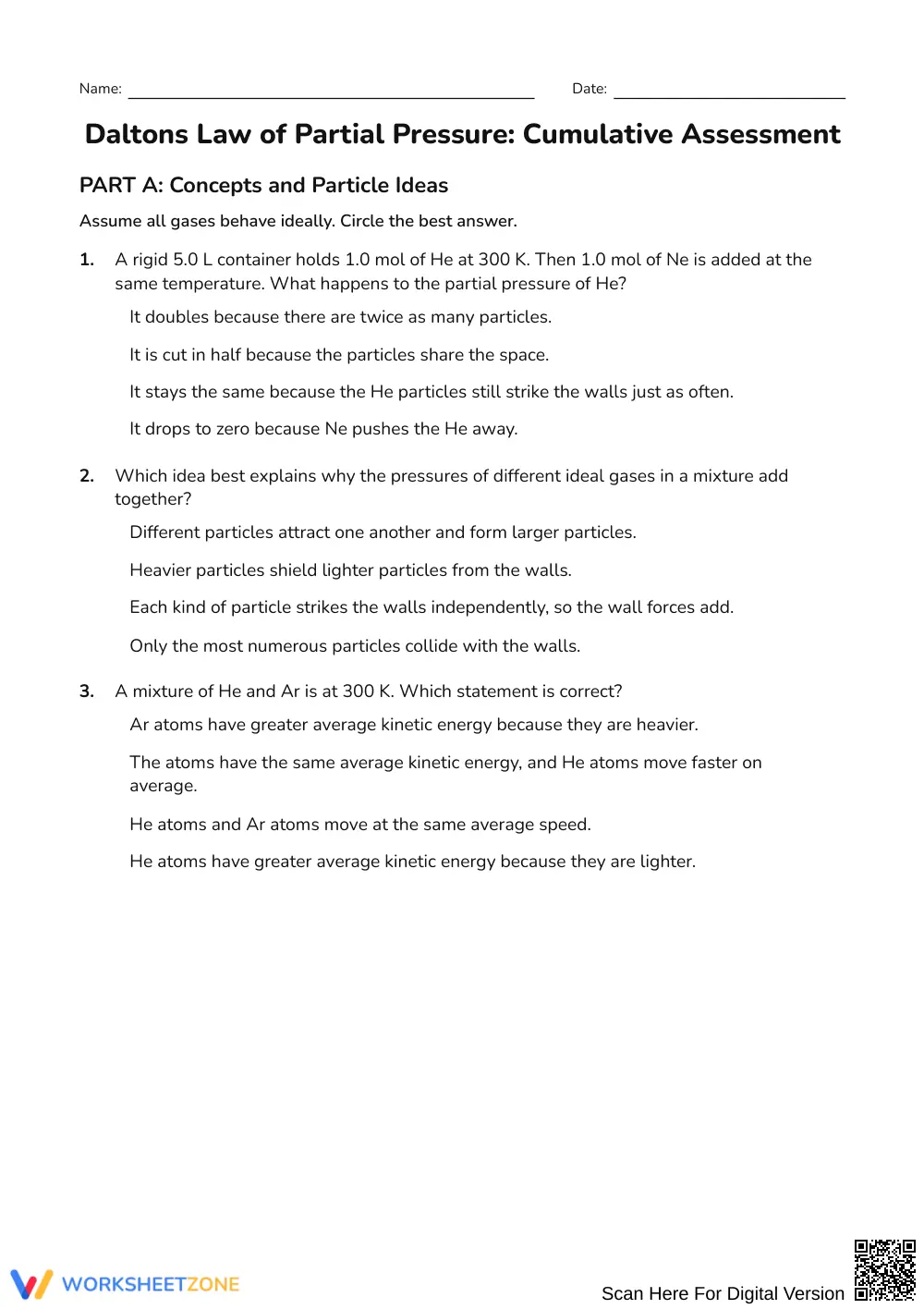
This worksheet lets high‑school students demonstrate mastery of Dalton’s Law of Partial Pressures through 22 carefully sequenced problems that require conceptual reasoning, particle‑model interpretation, calculations, and evidence‑based explanations.
At a Glance
- Grade: 9‑12 · Subject: Science
- Standard: — Students calculate and explain partial pressures using Dalton’s law (up to 15 words)
- Skill Focus: Cumulative Assessment of Dalton's Law of Partial Pressure
- Format: 4 pages · 22 problems · Answer key included · PDF
- Best For: End‑of‑unit review, formative assessment, test prep
- Time: 30–45 minutes
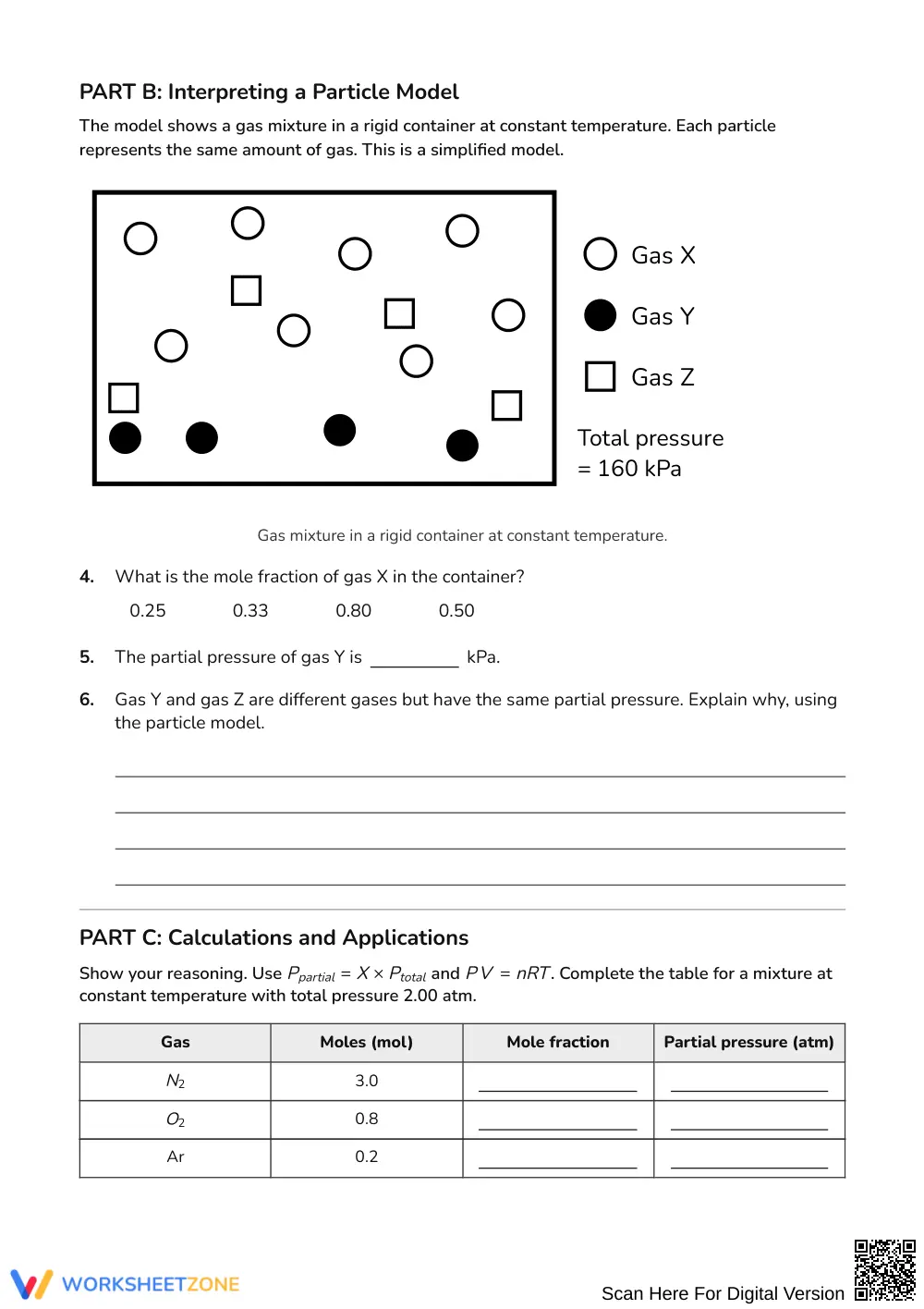
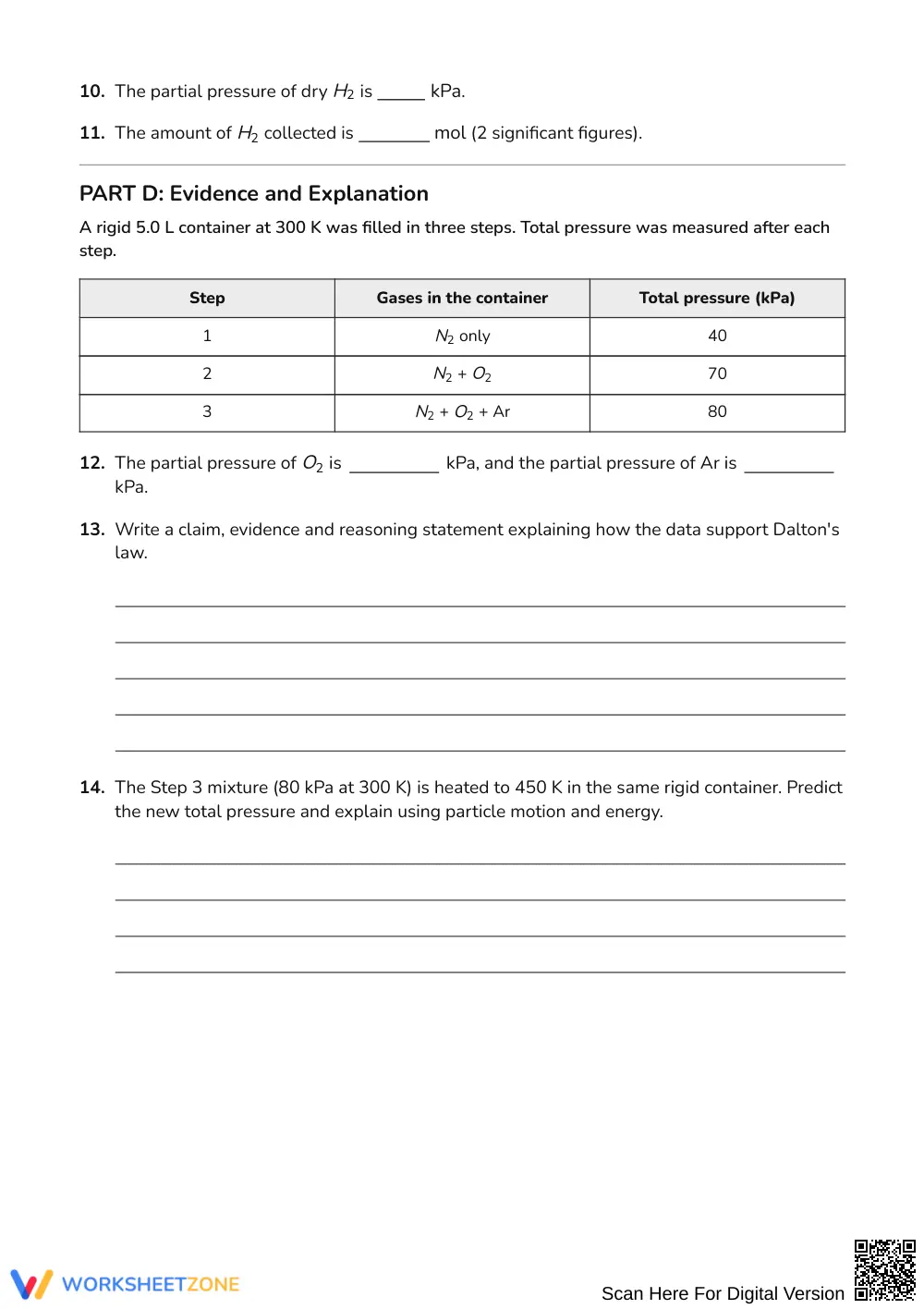
Inside you’ll find multiple‑choice concept checks, particle‑model interpretation prompts, calculation tables, and a claim‑evidence‑reasoning section. The four‑page PDF includes a separate answer key, a worked example for the calculation table, and clear headings that guide students through each part.
- Guided practice – 6 multiple‑choice and short‑answer items with sentence frames and a word bank.
- Supported practice – 8 calculation and model‑interpretation tasks that build on the guided items.
- Independent practice – 8 open‑ended claim‑evidence‑reasoning and extension problems.
This progression follows the classic I Do, We Do, You Do release, moving students from teacher‑led examples to autonomous scientific argumentation.
This worksheet aligns with the high‑school science curriculum expectation for Dalton’s Law of Partial Pressures. It also supports broader standards on gas laws and kinetic‑molecular theory. Both standard references can be copied directly into lesson plans, IEP goals, or district curriculum mapping tools.
How to Use It
• Before a unit test: have students complete the worksheet as a timed practice; observe accuracy on the claim‑evidence‑reasoning items to gauge readiness.
• After direct instruction: use the multiple‑choice section for quick formative checks; discuss common misconceptions revealed by the particle‑model questions.
Who It's For
Designed for 9‑12 science learners who need a concise, high‑stakes review. The built‑in sentence frames and word bank support emerging writers, while the extension problems challenge advanced students. Pair it with a classroom anchor chart on gas laws for seamless integration.
Research shows that focused, cumulative assessments improve retention of complex scientific concepts (Fisher & Frey, 2014). This worksheet gives students 22 opportunities to apply Dalton’s Law, reinforcing both conceptual understanding and procedural fluency. By requiring students to justify claims with evidence, it mirrors authentic scientific practice and prepares them for higher‑order thinking tasks on state assessments. The inclusion of an answer key enables immediate feedback, a key factor in closing learning gaps. Use this resource to streamline review, boost confidence, and raise performance on upcoming exams.


