































Essential Coordinate Distance Worksheet | Grade 8 Math

Paste this activity's link or code into your existing LMS (Google Classroom, Canvas, Teams, Schoology, Moodle, etc.).
Students can open and work on the activity right away, with no student login required.
You'll still be able to track student progress and results from your teacher account.
This coordinate geometry worksheet helps Grade 8 students connect horizontal and vertical coordinate differences to right-triangle legs and the Pythagorean Theorem. Through 12 structured problems, learners determine distances between points, evaluate geometric models, and analyze student claims to build conceptual understanding before using the distance formula.
At a Glance
- Grade: 8 · Subject: Math
- Standard: Find distance between two coordinate points by constructing right triangles
- Skill Focus: Connect Coordinate Differences and Triangle Sides
- Format: 5 pages · 12 problems · Answer key included · PDF
- Best For: Core instruction and targeted practice
- Time: 35–45 minutes
What's Inside
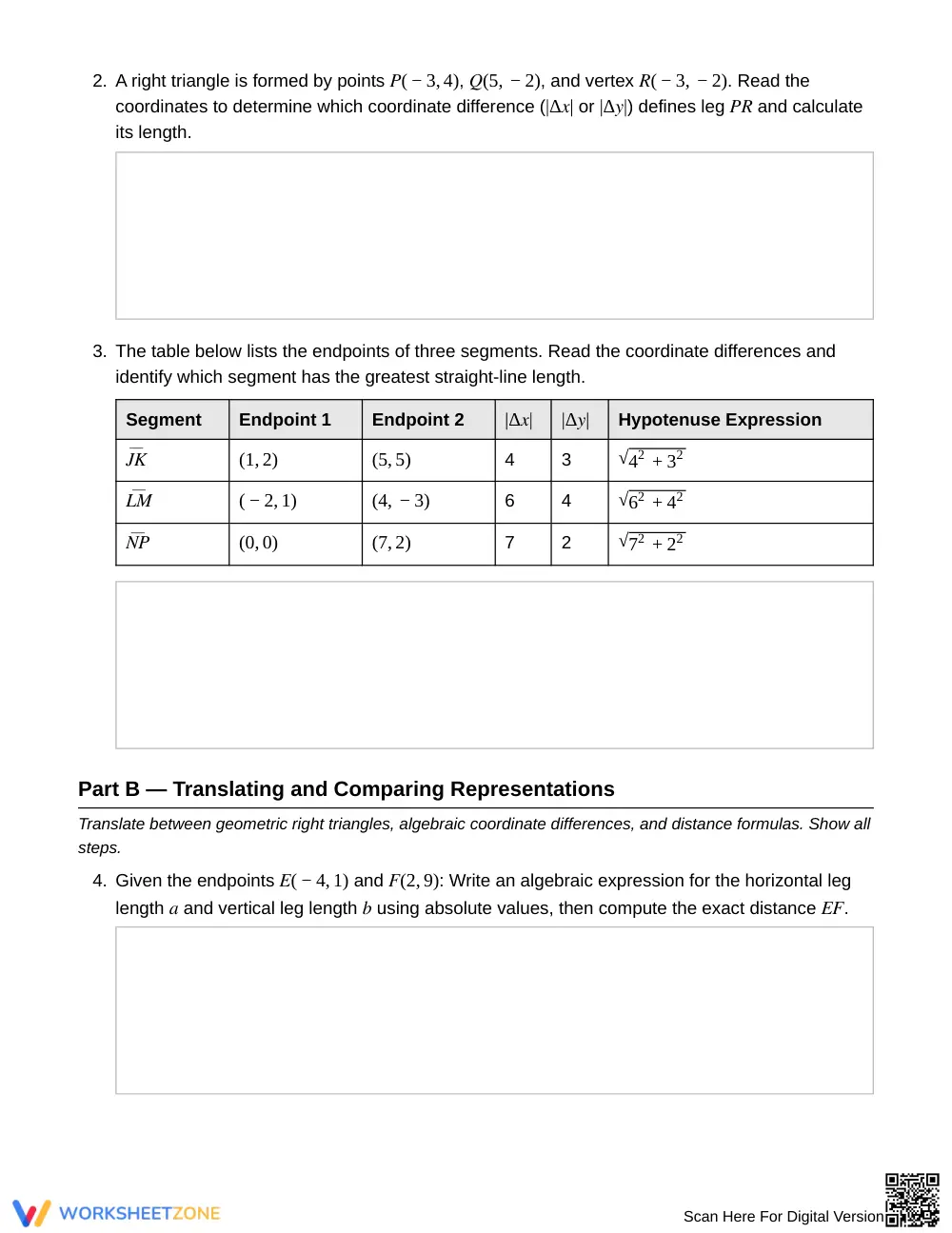
This 5-page PDF includes a 2-page student worksheet and a 3-page answer key with complete algebraic steps. Students utilize an introductory reference box defining run and rise with absolute values, solve grid-based segment problems, evaluate coordinate comparison tables, and complete targeted error analysis tasks.
Skill Progression
- Guided practice (Problems 1–3): Students read coordinate grids, identify run and rise from endpoints, and extract leg values using comparison tables.
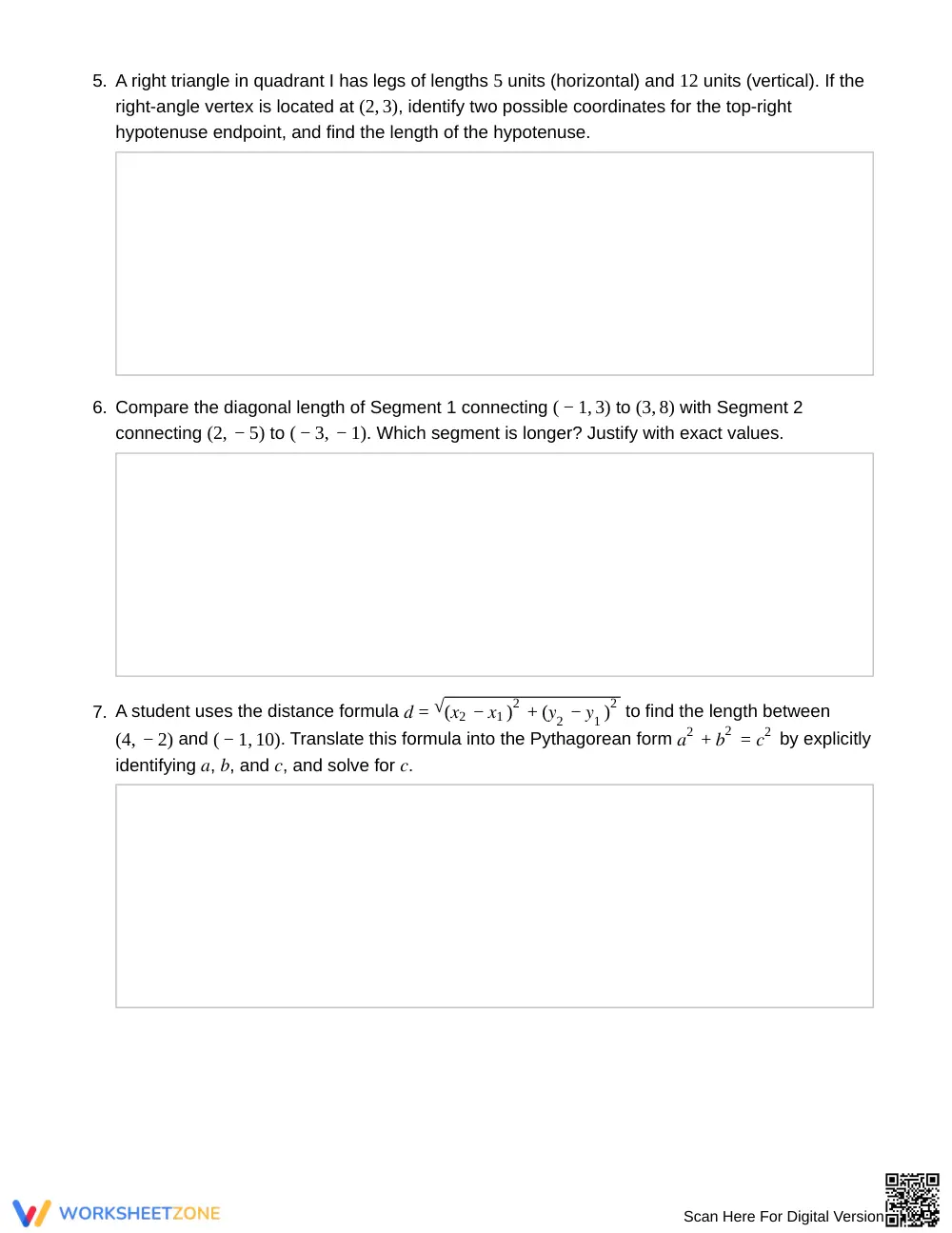
- Supported practice (Problems 4–9): Learners translate coordinate pairs into absolute-value expressions, calculate hypotenuse lengths, and compare diagonal segments.
- Independent practice (Problems 10–12): Students evaluate subtraction order arguments, correct coordinate sign errors, and explain distance formula connections.
This sequence follows a gradual-release framework, moving students from visual observation to independent mathematical analysis.
Standards Alignment
This worksheet guides students to apply the Pythagorean Theorem to find distances between coordinate points. Learners derive segment lengths geometrically through right-triangle legs rather than relying on memorization. Both standard codes can be copied directly into lesson plans, IEP goals, or district curriculum mapping tools.
How to Use It
Implement this worksheet following direct instruction on coordinate graphing and the Pythagorean Theorem. During small-group work, have students highlight horizontal and vertical distance legs to reinforce absolute values. Check Part C formatively to assess student understanding of negative coordinates. Completion takes 35 to 45 minutes.
Who It's For
This printable is designed for eighth-grade math classes, pre-algebra support groups, and introductory geometry students. Scaffolded visual grids support struggling learners, while theoretical justification items challenge advanced thinkers. Pair this resource with a graphing anchor chart or coordinate plane practice.
Developing spatial reasoning in coordinate geometry requires bridging visual representations and algebraic operations. According to Fisher & Frey (2014), structured instructional progressions that guide students from visual modeling to analytical error hunts solidify conceptual mastery and retention. This 5-page worksheet provides eighth-grade students with 12 targeted geometry tasks connecting horizontal and vertical coordinate differences, absolute value lengths, and hypotenuse calculations via the Pythagorean Theorem. By examining grid-based right triangles, translating coordinate endpoints into distance expressions, and resolving algebraic misconceptions, learners build durable foundations for high school analytic geometry. Research confirms that when middle school students explicitly derive geometric properties through visual and algebraic comparisons, their transfer of distance concepts to composite figures improves significantly. Educators can deploy this resource for initial skill acquisition, targeted remediation, or standards-based formative assessment.


