































Essential Constraint Inequalities Worksheet | Grade 7 Math

Paste this activity's link or code into your existing LMS (Google Classroom, Canvas, Teams, Schoology, Moodle, etc.).
Students can open and work on the activity right away, with no student login required.
You'll still be able to track student progress and results from your teacher account.
This Grade 7 inequalities worksheet helps students master working backward from target solution sets to determine unknown constraint parameters in linear inequality models. Learners substitute boundary values, calculate missing thresholds, and justify solution intervals through rigorous algebraic verification and real-world contextual reasoning across 6 multi-step problems.
At a Glance
- Grade: 7 · Subject: Math
- Standard:
7.EE.B.4— Solve multi-step real-world problems using linear equations and inequalities- Skill Focus: Finding unknown constraint thresholds from target solution intervals
- Format: 4 pages · 6 problems · Answer key included · PDF
- Best For: Targeted inequality practice and algebraic modeling
- Time: 40–50 minutes
What's Inside
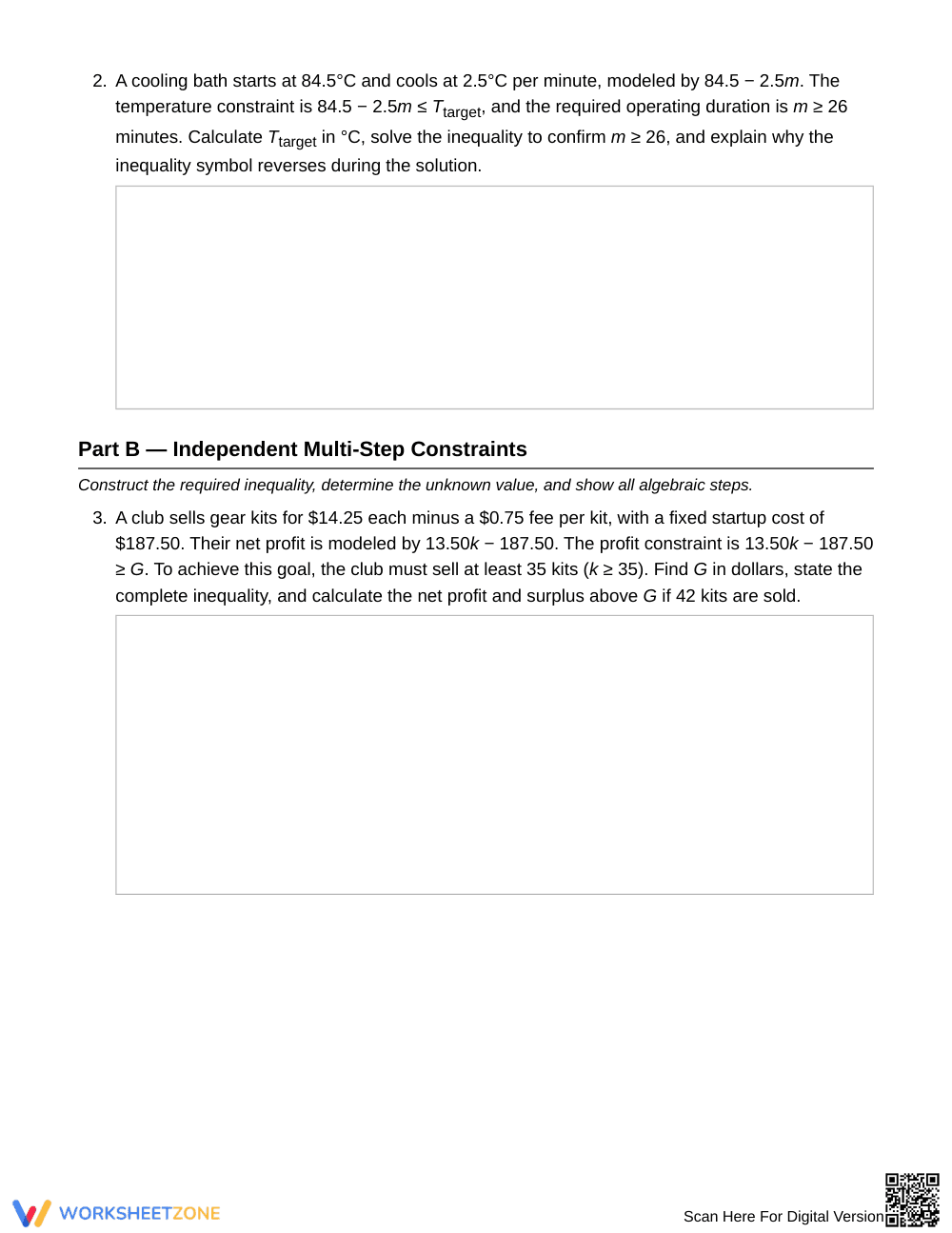
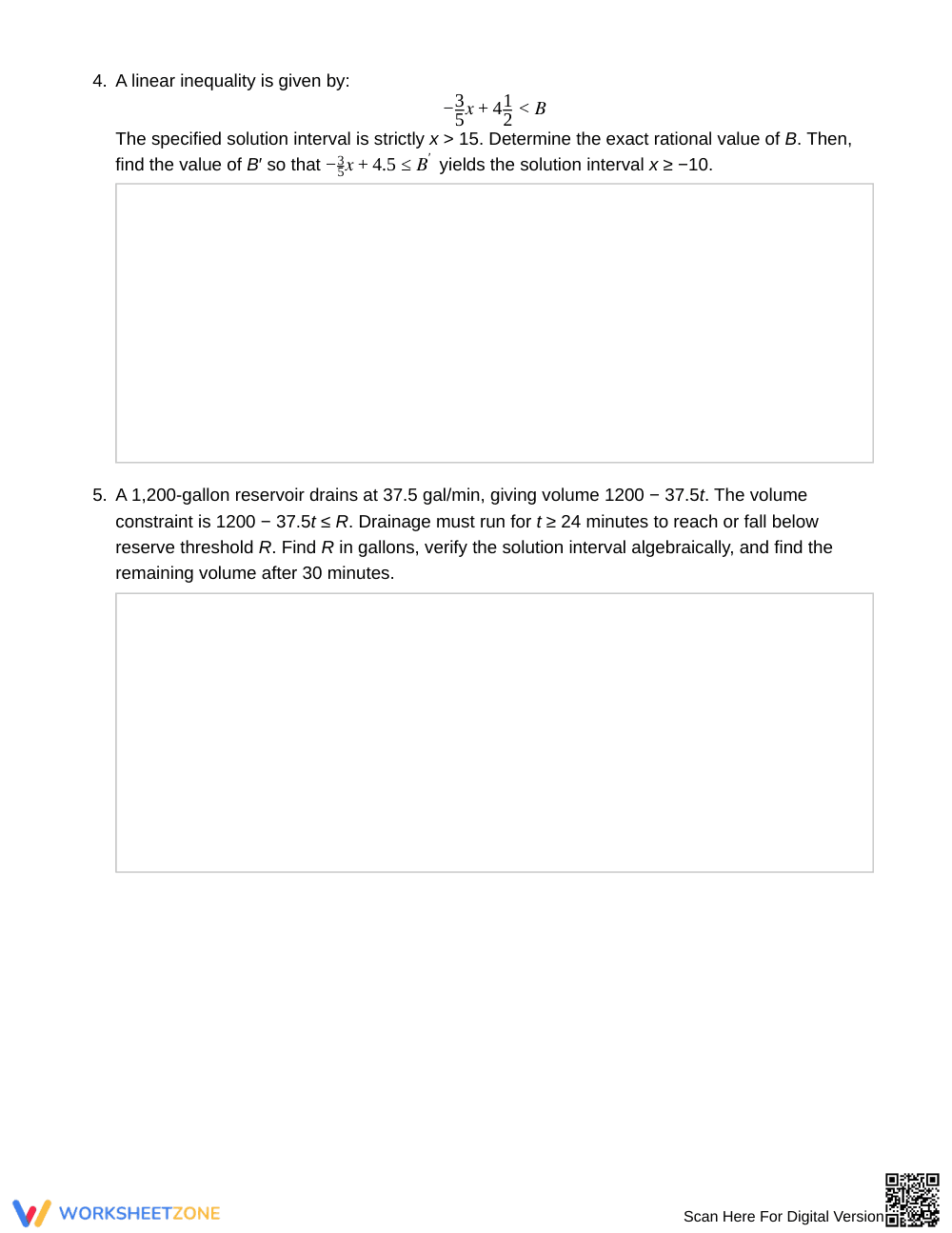
The 4-page student worksheet features 6 in-depth multi-part problems incorporating real-world modeling scenarios, including cargo payloads, temperature cooling rates, fundraising profit goals, and reservoir drainage. The resource includes a foundational core concept reference box outlining boundary evaluation and inequality sign reversal rules, followed by a complete 2-page worked answer key.
Skill Progression
- Guided Practice (Part A, 2 problems): Scaffolded real-world models provide visual graphs and partially structured inequalities to help students calculate target parameters and articulate why negative rate coefficients reverse the inequality symbol.
- Supported Practice (Part B, 3 problems): Multi-step independent applications require learners to construct algebraic models from word problems, isolate rational variables, and compute surplus quantities beyond target thresholds.
- Independent Practice (Part C, 1 problem): An advanced constraint formulation task demanding multi-step algebraic proof, parameter determination, and written justification analyzing why alternative threshold values fail benchmark targets.
This structured progression follows the gradual-release framework, moving students from guided boundary evaluation to autonomous constraint modeling.
Standards Alignment
Primary Standard: 7.EE.B.4 — Use variables to represent quantities in a real-world or mathematical problem, and construct simple equations and inequalities to solve problems by reasoning about the quantities. Both standard codes can be copied directly into lesson plans, IEP goals, or district curriculum mapping tools.
How to Use It
Implement this resource during the mid-unit or summative phase of an inequalities unit after students have mastered solving basic two-step inequalities. For formative assessment, observe whether students correctly reverse inequality signs when multiplying or dividing by negative coefficients during boundary substitution. Typical student completion time ranges between 40 and 50 minutes.
Who It's For
This activity is designed for Grade 7 general mathematics students, advanced Grade 6 learners, or Grade 8 students needing targeted algebraic remediation. It pairs naturally with linear inequality anchor charts, number line graphing mini-lessons, and direct modeling instruction on real-world rate problems.
According to research by Fisher & Frey (2014), purposeful instructional design that couples structured boundary evaluation with explicit written justification significantly deepens conceptual understanding in middle school mathematics. This 4-page worksheet aligns directly with standard 7.EE.B.4, requiring Grade 7 students to find unknown constraint thresholds from specified solution intervals and verify algebraic boundaries. By working through 6 targeted multi-step contextual problems, learners transition from evaluating single-variable inequalities to formulating complete algebraic constraint models. The resource includes a full 2-page answer key detailing algebraic steps and sign reversal rules, providing educators with an efficient tool for formative assessment, small group intervention, or independent mastery checks.


