




























Views
Downloads



Essential Conservation of Mass Worksheet | Grade 7 Science

Paste this activity's link or code into your existing LMS (Google Classroom, Canvas, Teams, Schoology, Moodle, etc.).
Students can open and work on the activity right away, with no student login required.
You'll still be able to track student progress and results from your teacher account.
This physical science worksheet equips Grade 7 students to defend the law of conservation of mass using system boundary evidence. Learners analyze synthetic laboratory data from open and closed systems to explain apparent mass changes at the molecular level, debunking common misconceptions about mass destruction and spontaneous matter creation.
At a Glance
- Grade: 7 · Subject: Science
- Standard: Explain how matter is conserved during physical and chemical changes across system boundaries
- Skill Focus: Defending Conservation Using Boundary Evidence
- Format: 5 pages · 8 problems · Answer key included · PDF
- Best For: Data analysis and claim evaluation
- Time: 40–50 minutes
What's Inside: This 5-page printable resource includes a concise reference box defining system boundaries and mass conservation, followed by a multi-reaction synthetic lab data table. Across 8 rigorous tasks, students evaluate open and closed reaction setups involving gases, precipitates, and oxidation. A detailed 3-page teacher answer key provides full mechanistic explanations and model student claim critiques.
Skill Progression
- Guided Practice (Part A, 2 tasks): Students extract numerical data and boundary conditions to pinpoint evidence supporting mass conservation across sealed and unsealed systems.
- Supported Practice (Part B, 4 tasks): Students write mechanistic explanations tracking atom reorganization across phase changes, precipitation, and gas-producing reactions.
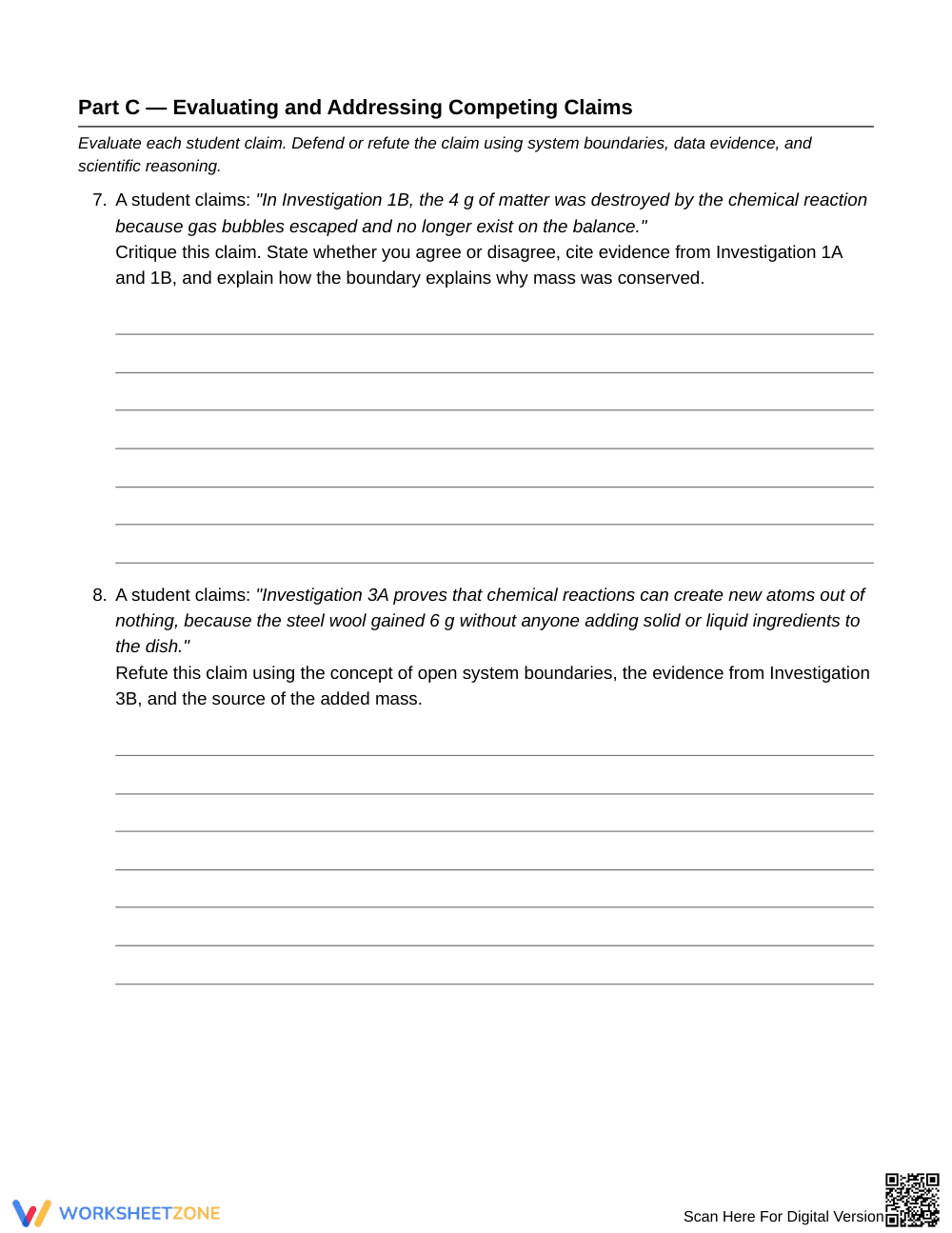
- Independent Practice (Part C, 2 tasks): Students evaluate and refute authentic student misconceptions regarding mass loss in open beakers and mass gain during steel wool oxidation.
This structured progression follows a gradual-release instructional model that transitions learners from identifying concrete data points to independently constructing rigorous scientific arguments.
Standards Alignment
This activity targets core middle school physical science standards focused on developing and using models to describe how the total number of atoms is conserved in chemical reactions. Students demonstrate that whether matter is trapped in a closed vessel or released as an invisible gas into the surrounding environment, total mass remains unchanged. Both standard codes can be copied directly into lesson plans, IEP goals, or district curriculum mapping tools.
How to Use It
Deploy this worksheet after direct instruction on chemical reactions or as an evidence-based lab follow-up. During small-group analysis, observe whether students identify invisible gases entering or escaping open boundaries when explaining mass shifts. The resource requires approximately 40 to 50 minutes of instructional time.
Who It's For
Designed for Grade 7 general science and physical science classrooms, this worksheet supports diverse learners through structured data tables and explicit conceptual review prompts. Pair this printable activity with an introductory physical change demonstration or an interactive molecular modeling kit to reinforce conservation principles.
According to research in science pedagogy documented by Fisher & Frey (2014), guiding middle school students through structured evidence-to-mechanism explanations substantially deepens conceptual mastery of abstract scientific principles. Middle school physical science students often struggle with the conservation of mass when reactions involve invisible gases or open system boundaries, frequently attributing measured mass differences to the spontaneous creation or destruction of atoms. This Grade 7 science worksheet directly confronts these intuitive misconceptions by providing structured laboratory data across open and closed systems. Students systematically analyze quantitative measurements, trace molecular arrangements, and evaluate competing scientific claims to prove that total mass is always conserved. The scaffolded 8-task progression equips learners to distinguish between closed boundaries and open environmental exchanges, providing educators with concrete diagnostic data on student argumentation skills.


