




























Views
Downloads




Essential Comparative Density Worksheet | Grade 8 Science

Paste this activity's link or code into your existing LMS (Google Classroom, Canvas, Teams, Schoology, Moodle, etc.).
Students can open and work on the activity right away, with no student login required.
You'll still be able to track student progress and results from your teacher account.
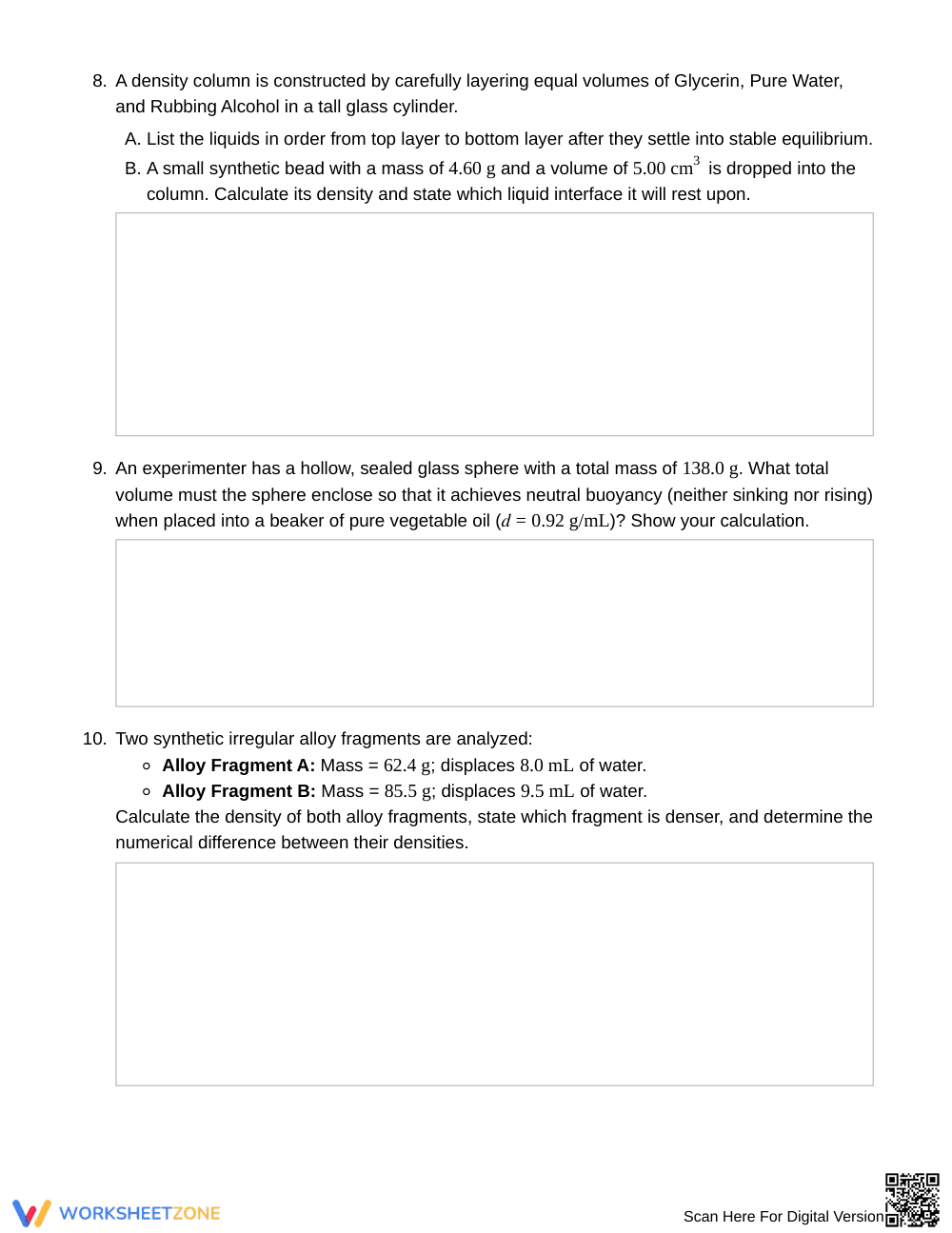
This Grade 8 physical science resource helps students master density as an intensive characteristic property of matter through rigorous quantitative problem-solving and conceptual inquiry. Learners calculate densities from mass and volume displacement data, predict multi-layer column resting positions, and evaluate experimental measurement uncertainties across real-world laboratory scenarios.
At a Glance
- Grade: 8 · Subject: Science
- Standard: Physical Properties — Calculate and compare characteristic density to predict whether substances float or sink
- Skill Focus: Density as a Comparative Property
- Format: 5 pages · 12 problems · Answer key included · PDF
- Best For: Lab follow-up and independent practice
- Time: 45–60 minutes
The 5-page worksheet includes a reference table of densities for six substances, 12 multi-part items, and a complete 3-page answer key with step-by-step solutions. Students analyze extensive versus intensive properties, solve displacement problems requiring unit conversions, calculate densities using uncertainty ranges, and evaluate experimental errors from air bubbles and tool precision limits.
Skill Progression
- Guided practice (Part A, Problems 1–4): Scaffolds core concepts by contrasting extensive mass and volume with intensive density, examining divided objects, and analyzing measurement uncertainty.
- Supported practice (Part B, Problems 5–10): Guides students through multi-step displacement calculations, layered column predictions, neutral buoyancy problems, and comparative alloy analyses.
- Independent practice (Part C, Problems 11–12): Challenges learners to evaluate systematic errors from trapped air bubbles and critique unreasonable precision reporting based on instrument tolerances.
This structured sequence follows a gradual-release model, shifting students from conceptual definitions to complex quantitative evaluation.
Standards Alignment
This activity aligns with physical science standards requiring students to analyze and interpret property data to distinguish between materials. A supporting standard involves mathematical modeling of mass, volume, and density relationships. Both standard concepts can be copied directly into lesson plans, IEP goals, or district curriculum mapping tools.
How to Use It
Implement this worksheet after direct instruction on the density formula or following a displacement lab. Circulate during Part B to check that students correctly subtract initial water volumes before calculating density. The worksheet requires 45 to 60 minutes, making it suitable for partner problem-solving or a summative post-lab assessment.
Who It's For
This resource is designed for Grade 8 physical science students developing data analysis and lab numeracy skills. Built-in reference values assist developing learners, while uncertainty calculations challenge advanced students. Pair this worksheet with a density column demonstration or a measurement anchor chart to reinforce key concepts.
According to research on structured science instruction by Fisher & Frey (2014), purposeful gradual-release frameworks significantly improve student retention of quantitative physical science concepts and laboratory procedures. Middle school physical science standards require learners to analyze characteristic properties, such as density, to identify substances and accurately predict buoyancy interactions in layered fluids. This 5-page instructional resource provides 12 rigorous tasks spanning conceptual distinctions, multi-step displacement calculations, and experimental uncertainty evaluations. By progressing systematically from core reference comparisons to independent laboratory error analysis, students build robust scientific literacy and computational precision. The deliberate inclusion of measurement tolerance calculations and layered column scenarios reinforces deep conceptual understanding over rote memorization. Educators can deploy this resource during targeted post-lab practice, guided science intervention, or formal standards-based progress monitoring across secondary classrooms.


