































Essential Collision Cushioning Worksheet | Grade 12 Physics

Paste this activity's link or code into your existing LMS (Google Classroom, Canvas, Teams, Schoology, Moodle, etc.).
Students can open and work on the activity right away, with no student login required.
You'll still be able to track student progress and results from your teacher account.
This physics worksheet equips Grade 12 students to analyze and evaluate collision-cushioning scenarios using impulse, momentum, and work-energy principles. Students analyze synthetic crash-test data across two barrier designs, compute peak impact forces, and calculate deceleration g-loads to reach sound engineering conclusions regarding passenger safety.
At a Glance
- Grade: 12 · Subject: Physics
- Skill Focus: Evaluate a Collision-Cushioning Scenario
- Format: 4 pages · 10 problems · Answer key included · PDF
- Best For: Advanced mechanics analysis and test prep
- Time: 45–60 minutes
What's Inside
This 4-page worksheet guides students through synthetic crash-test sled data. It provides core governing equations, test parameters for hydraulic damper and honeycomb matrix barriers, 10 calculation and evaluation tasks, and a full 2-page answer key with step-by-step solutions.
Skill Progression
- Guided practice (Part A, 2 tasks): Students identify physical system boundaries, isolate external impulses, and contrast deceleration safety thresholds with spatial stopping distance limits.
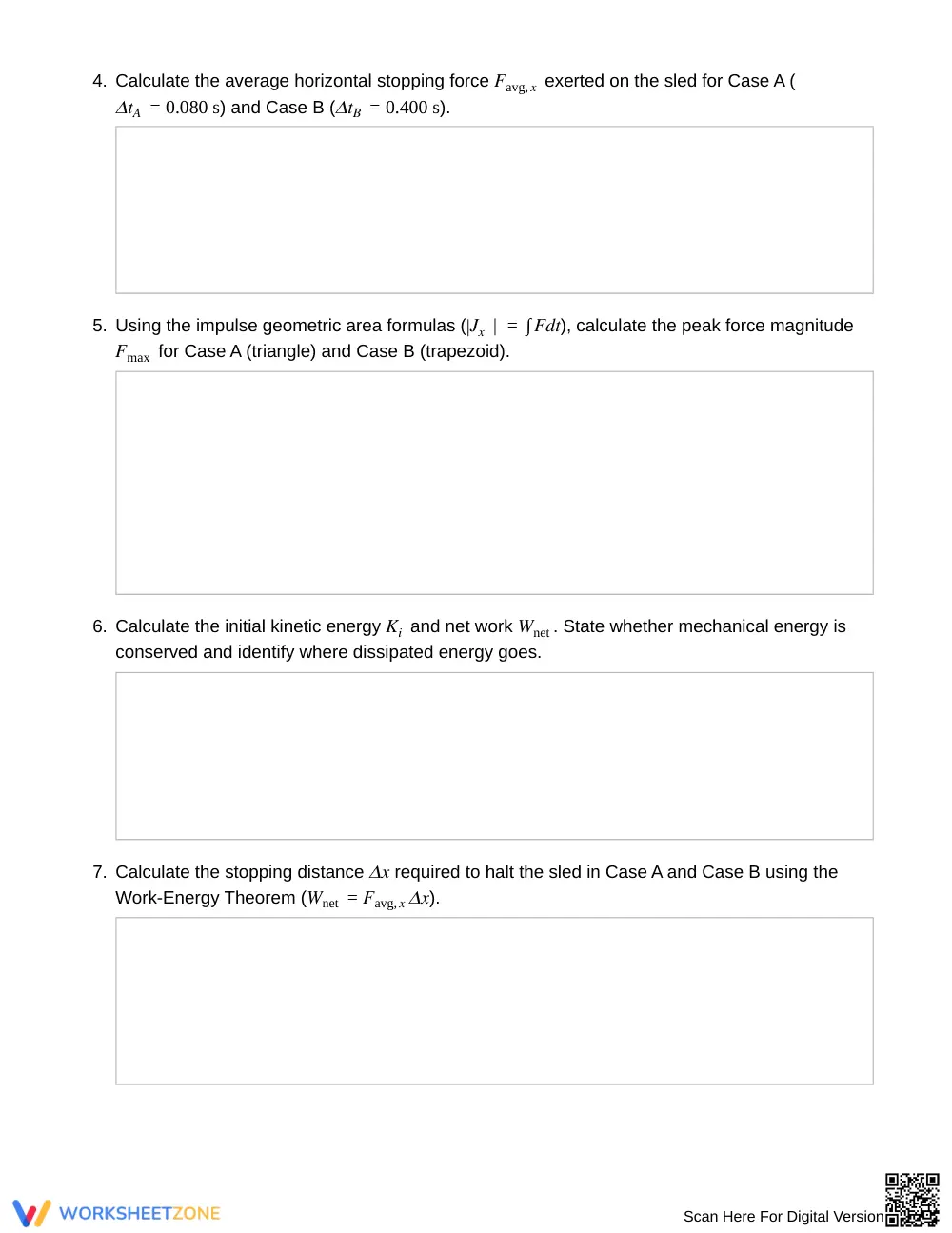
- Supported practice (Part B, 6 tasks): Students compute initial momentum, net impulse, average force, peak force from pulse profiles, net work, stopping distance, and peak g-load deceleration.
- Independent practice (Part C, 2 tasks): Students refute an engineering claim regarding equal injury risk and evaluate safety hazards of an elastic rebound proposal.
This progression uses a gradual-release model, moving from qualitative boundary framing to computational analysis and engineering evaluation.
Standards Alignment
This worksheet aligns with high school physics standards requiring students to evaluate and refine collision-cushioning devices using the Impulse-Momentum Theorem and Work-Energy Theorem. These learning objectives can be integrated directly into lesson plans, IEP goals, or district curriculum mapping documents.
How to Use It
Assign this activity after direct instruction on the Impulse-Momentum Theorem and force-time graph integration. It serves well as paired problem-solving or a summative unit task. Observe whether students distinguish average force from peak geometric force when comparing triangular and trapezoidal pulse profiles. Expected completion time is 45 to 60 minutes.
Who It's For
Designed for Grade 12 Physics and AP Mechanics students ready for rigorous calculus- or algebra-based collision modeling. Pair with a force-time graph reference sheet or anchor chart for scaffolding before Part C.
According to Fisher & Frey (2014), structured instructional design that scaffolds complex analytical problem-solving through a gradual-release model significantly deepens secondary students' conceptual retention and mathematical transfer. This Grade 12 physics worksheet operationalizes that research by guiding students through 10 targeted tasks focused on evaluating collision-cushioning scenarios and impact dynamics. Learners apply the impulse-momentum theorem and energy conservation principles to examine force-time pulse profiles, calculate peak deceleration g-forces, and evaluate engineering safety constraints. By contrasting hydraulic damper pulses with honeycomb crush matrices, students link mathematical computations directly to physical safety criteria. The progression transitions systematically from system boundary identification to rigorous quantitative modeling and authentic engineering critique, ensuring learners develop both procedural fluency and high-level analytical reasoning. This structured approach directly supports physics standards requiring students to evaluate and refine collision-cushioning mechanisms using empirical data and foundational physical laws.


