




























Views
Downloads


Essential Cold-Brew Vocabulary Word Search | Grades 4–5 ELA

Paste this activity's link or code into your existing LMS (Google Classroom, Canvas, Teams, Schoology, Moodle, etc.).
Students can open and work on the activity right away, with no student login required.
You'll still be able to track student progress and results from your teacher account.
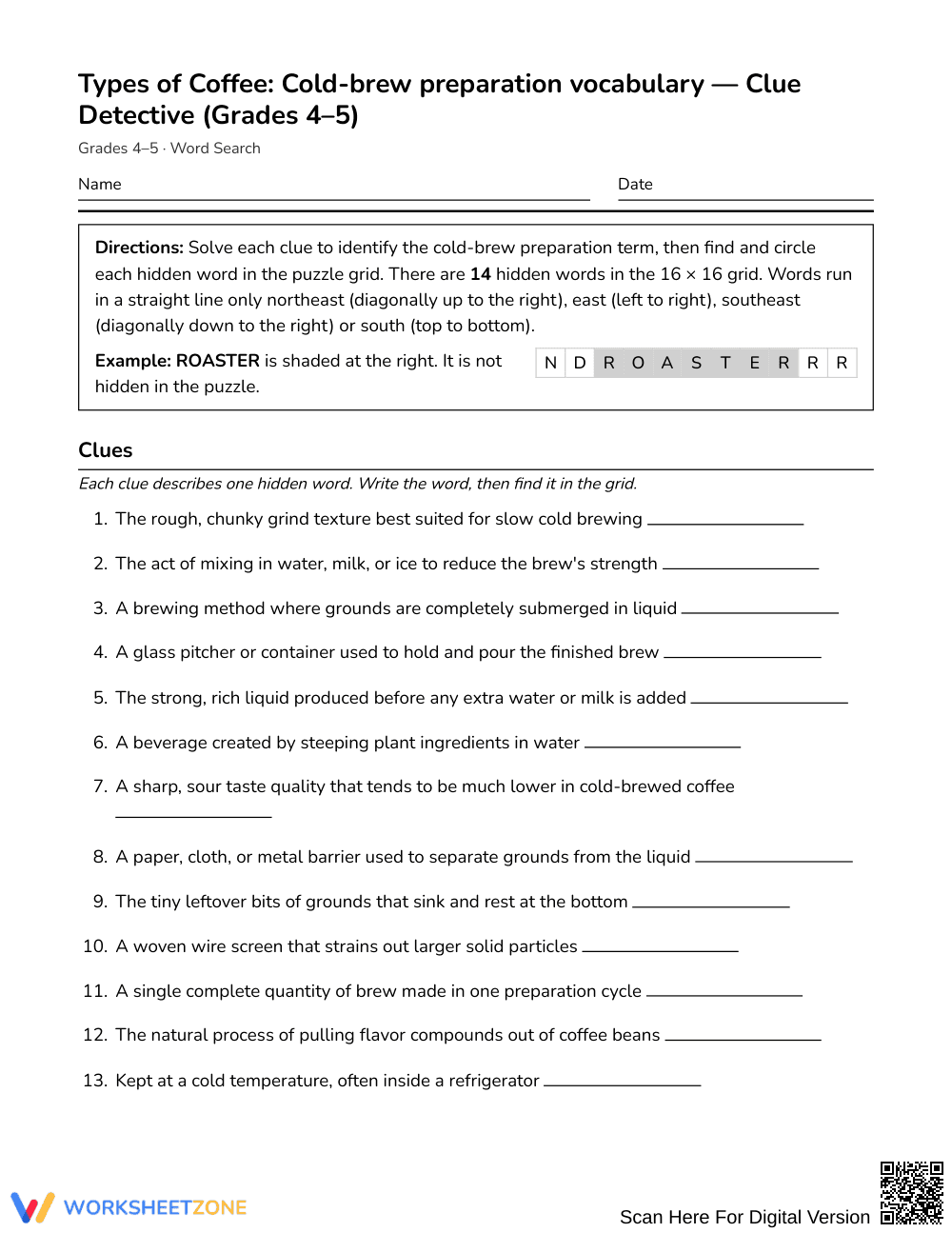
This cold-brew vocabulary word search helps students in Grades 4–5 build technical culinary vocabulary through context-rich clue solving. Learners read descriptive definitions to identify 14 key coffee preparation terms before searching for them in the puzzle grid, strengthening word recognition, orthographic memory, and reading comprehension simultaneously.
At a Glance
- Grade: Grades 4–5 · Subject: English Language Arts (ELA)
- Standard: Not standards-assessed — vocabulary enrichment
- Skill Focus: Cold-brew preparation vocabulary
- Format: 2 pages · 14 words · Answer key included · PDF
- Best For: Vocabulary enrichment and early finishers
- Time: 15–25 minutes
The 2-page student printable features a comprehensive clue detective layout paired with a 16x16 letter matrix. Students review 14 unique vocabulary clues defining culinary terms such as extraction, dilution, carafe, and immersion. After deciphering each meaning, students cross-reference their answers with a shuffled word bank and locate each target term inside the letter puzzle. A comprehensive 3-page answer key provides both solved clue definitions and letter coordinates for quick checking.
The word search challenges students using a 16x16 grid where target terms run along four distinct pathways: northeast, east, southeast, and south. Rather than simply scanning for letter shapes, students engage in two-step processing by first matching definitions to vocabulary targets and then tracking letter sequences across horizontal, vertical, and diagonal vectors. The shuffled word bank provides spelling verification while preserving cognitive engagement during clue resolution.
This activity provides targeted vocabulary enrichment and is not aligned to a specific Common Core standard. Instead, it offers cross-curricular exposure to domain-specific science and culinary vocabulary, reinforcing morphological awareness and context-clue application in an engaging puzzle format.
This activity functions effectively as an independent station after direct instruction on context clues or informational text features. Introduce the sheet after a lesson on procedural food science texts, directing students to read each definition carefully before hunting for terms. For formative assessment, observe whether students identify terms directly from clue meanings or rely heavily on scanning the letter grid first. Most learners complete the activity in 15 to 25 minutes.
Designed specifically for upper elementary students in Grades 4–5, this printable suits general education classrooms, gifted enrichment groups, and speech-language vocabulary clusters. For students requiring visual support, teachers can highlight the initial letter of each word in the clue bank. This resource pairs naturally with an informational reading passage on food preparation science or practical kitchen procedures.
Vocabulary enrichment activities that integrate semantic definition matching with orthographic search patterns support robust lexical acquisition in elementary grades. According to Fisher & Frey (2014), intentional word study that prompts students to retrieve definitions before locating word forms solidifies domain-specific terminology in long-term memory. This Grades 4–5 cold-brew preparation vocabulary word search embeds 14 domain-specific terms within a 16x16 grid, challenging learners to evaluate definitions for concepts like extraction, immersion, and dilution before identifying them along four directional axes. Because this activity is unaligned to formal state testing frameworks, it serves as low-stakes supplementary practice that builds background knowledge for informational reading and culinary science. By requiring students to interpret procedural clues rather than simply copying word lists, the puzzle bridges contextual comprehension and visual word recognition, fostering independent word consciousness across diverse upper elementary learning environments.


