


























Views
Downloads

Essential Classroom Responsibilities Worksheet | Grades 2-5
Paste this activity's link or code into your existing LMS (Google Classroom, Canvas, Teams, Schoology, Moodle, etc.).
Students can open and work on the activity right away, with no student login required.
You'll still be able to track student progress and results from your teacher account.
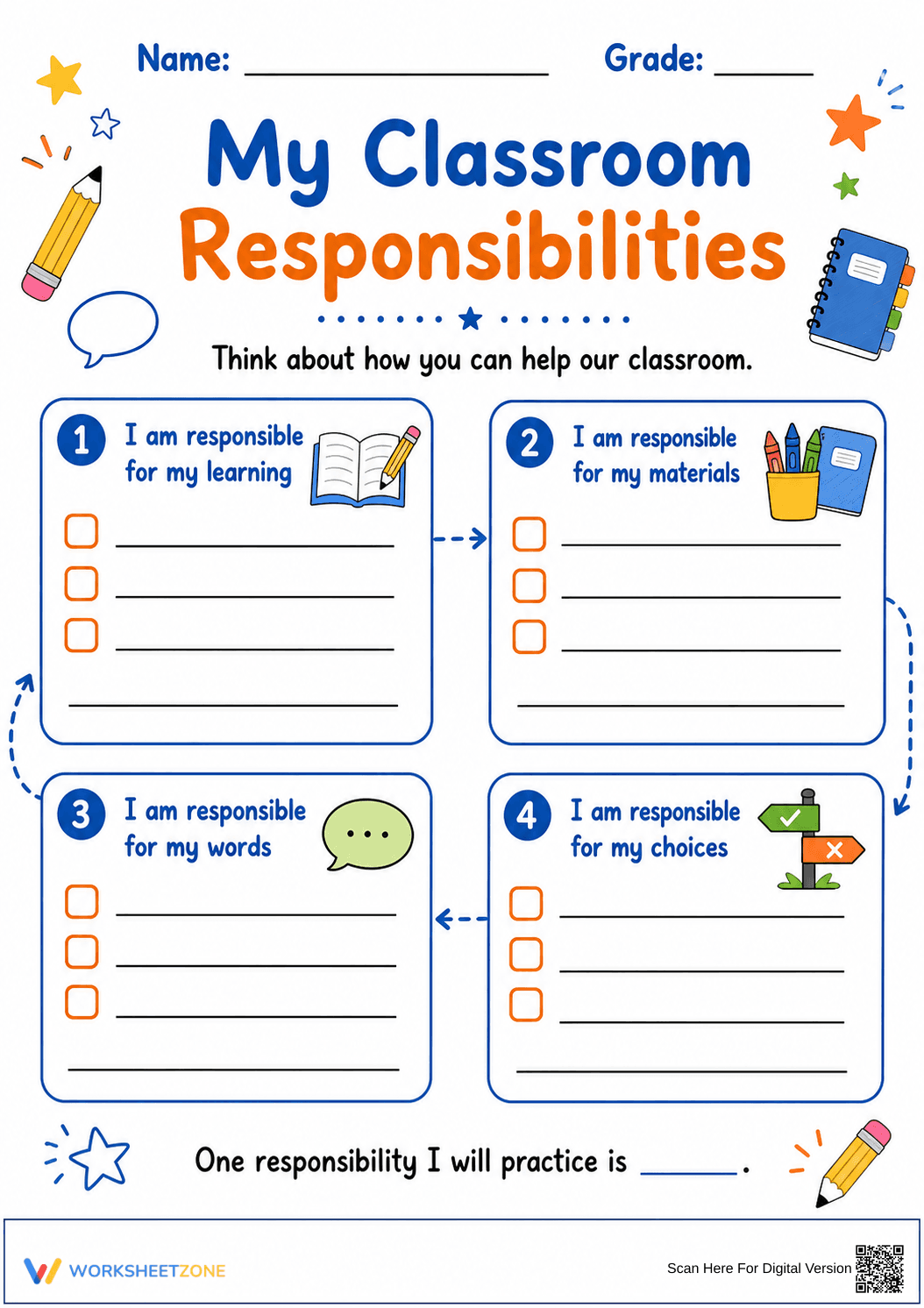
This Grade 3 classroom responsibilities worksheet helps students identify and commit to positive behaviors in the learning environment. By reflecting on learning, materials, words, and choices, students develop a sense of ownership over their daily actions. This resource provides a structured framework for establishing a respectful and productive classroom culture from day one.
At a Glance
- Grade: 3 · Subject: Social Emotional Learning
- Standard:
CCSS.ELA-LITERACY.SL.3.1— Engage in discussions about classroom rules and personal responsibilities- Skill Focus: Personal Accountability
- Format: 1 page · 13 tasks · No answer key needed · PDF
- Best For: Back-to-school routines and behavior management
- Time: 15–20 minutes
This single-page PDF features a visually engaging responsibility map with four distinct quadrants. Each section—Learning, Materials, Words, and Choices—includes three blank checklist lines and a dedicated writing space for personalized student goals. The clean layout uses blue and orange accents with friendly icons to guide students through the reflection process without overwhelming them.
Zero-Prep Workflow
- Print: Select the "Fit to Page" setting and print enough copies for your roster in under 30 seconds.
- Distribute: Hand out the worksheets during your morning meeting or social-emotional learning block.
- Review: Spend 5 minutes discussing the four categories as a group before students complete their individual maps.
Total teacher preparation time is less than 2 minutes, making this an ideal resource for the first week of school or as a mid-year reset for classroom management.
Standards Alignment
The primary standard addressed is `CCSS.ELA-LITERACY.SL.3.1`, which requires students to engage effectively in a range of collaborative discussions, building on others' ideas and expressing their own clearly. This worksheet facilitates that expression by providing a written scaffold for personal accountability. Both standard codes can be copied directly into lesson plans, IEP goals, or district curriculum mapping tools.
How to Use It
Use this worksheet during the first week of school as a foundational activity for co-creating classroom norms. After a direct instruction lesson on what responsibility looks like in action, have students fill out their maps independently. As a formative assessment, circulate the room to observe which students struggle to identify specific behaviors for their words or choices quadrants, indicating a need for further social-emotional coaching. Completion usually takes 15 to 20 minutes.
Who It's For
This resource is designed for general education students in grades 2 through 5, but it is particularly effective for students requiring visual scaffolds for behavioral expectations. It pairs naturally with a Classroom Rules anchor chart or a read-aloud book focused on community and respect.
According to Fisher & Frey (2014), establishing clear expectations and personal accountability is a cornerstone of effective classroom management and student engagement. This worksheet aligns with CCSS.ELA-LITERACY.SL.3.1 by prompting students to internalize and articulate their roles within the learning community. By moving from general concepts to 13 specific, student-generated actions, the resource supports the development of self-regulation skills essential for academic success. Research from the RAND AIRS 2024 report suggests that structured reflection tools significantly improve student adherence to classroom norms compared to verbal instructions alone. This 1-page printable provides the necessary visual cues and writing prompts to help students bridge the gap between understanding a rule and practicing a responsibility. It serves as a durable reference for both teachers and students throughout the school year, fostering a sense of agency and mutual respect in the classroom environment.


