




























Essential Claims vs. Inferences Worksheet | Grade 8 ELA
Paste this activity's link or code into your existing LMS (Google Classroom, Canvas, Teams, Schoology, Moodle, etc.).
Students can open and work on the activity right away, with no student login required.
You'll still be able to track student progress and results from your teacher account.
This worksheet teaches eighth graders to separate what a text states directly from what it only supports. Students read a six-paragraph news account about a town council vote, then sort explicit claims, supported inferences, and unsupported claims, citing paragraph evidence for each decision.
At a Glance
- Grade: 8 · Subject: ELA
- Standard:
RI.8.1— Cite the strongest evidence for what a text says and implies.- Skill Focus: Explicit Claims Versus Supported Inferences
- Format: 5 pages · 10 problems · Answer key included · PDF
- Best For: Evidence-based inference practice after instruction
- Time: 35–45 minutes
What's Inside
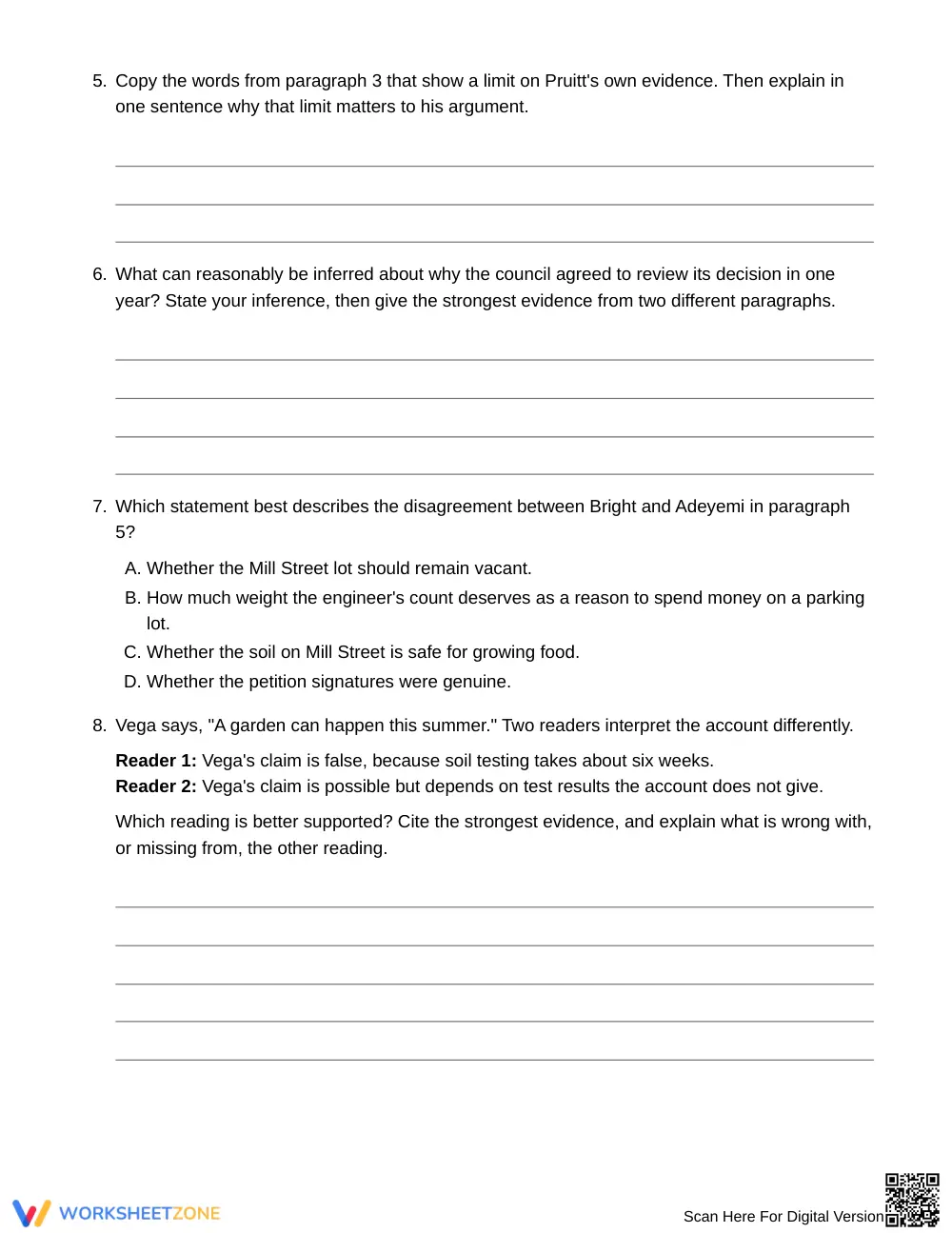
The packet opens with a concept box defining explicit claims, supported inferences, unsupported claims, and strongest evidence. Students then read “The Mill Street Decision” and complete multiple-choice items, a labeling table, short written responses, and two interpretation-comparison tasks. The packet has five student pages and a three-page answer key.
Skill Progression
- Guided practice (Part A, 3 items): Two multiple-choice questions and a labeling table with the concept box as a reference.
- Supported practice (Part B, 5 items): Choosing strongest evidence, quoting limits, and weighing two readings of the same claim.
- Independent practice (Part C, 2 items): Extended written justifications citing multiple paragraphs.
The sequence follows a gradual-release model: I Do, We Do, You Do.
Standards Alignment
RI.8.1 — Cite the textual evidence that most strongly supports an analysis of what the text says explicitly as well as inferences drawn from the text. The standard code can be copied directly into lesson plans, IEP goals, or district curriculum mapping tools.
How to Use It
- After direct instruction: Assign Part A and B as independent classwork, then discuss the labeling table as a class.
- As a formative check: Assign Part C and watch whether students name what the account leaves undetermined, not only what it supports.
Expect 35–45 minutes for the full packet, or split it across two short sessions.
Who It's For
Designed for Grade 8 ELA students learning to justify inferences with text evidence. Students who need more support can work Part A with the concept box open. Pair it with an anchor chart on claim, evidence, and inference.
Standard RI.8.1 asks eighth graders to cite the textual evidence that most strongly supports both what a text says explicitly and the inferences drawn from it. This worksheet, “The Mill Street Decision,” builds that skill through ten tasks on a six-paragraph news account of a town council vote. Students label statements as explicit, supported, or unsupported, choose the strongest evidence, and judge competing interpretations while naming what the text leaves undetermined. The sequence follows the gradual-release model described by Fisher & Frey (2014), moving from guided distinctions to supported application to independent written justification. Because students cite paragraph numbers for their evidence, teachers can see whether a student is reading the text or guessing. The packet has five student pages and a three-page answer key, making it suitable for classwork, homework, or formative checks of evidence-based reasoning in Grade 8 ELA.


