































Essential Circus Vocabulary Word Search | Grades 7–8 ELA

Paste this activity's link or code into your existing LMS (Google Classroom, Canvas, Teams, Schoology, Moodle, etc.).
Students can open and work on the activity right away, with no student login required.
You'll still be able to track student progress and results from your teacher account.
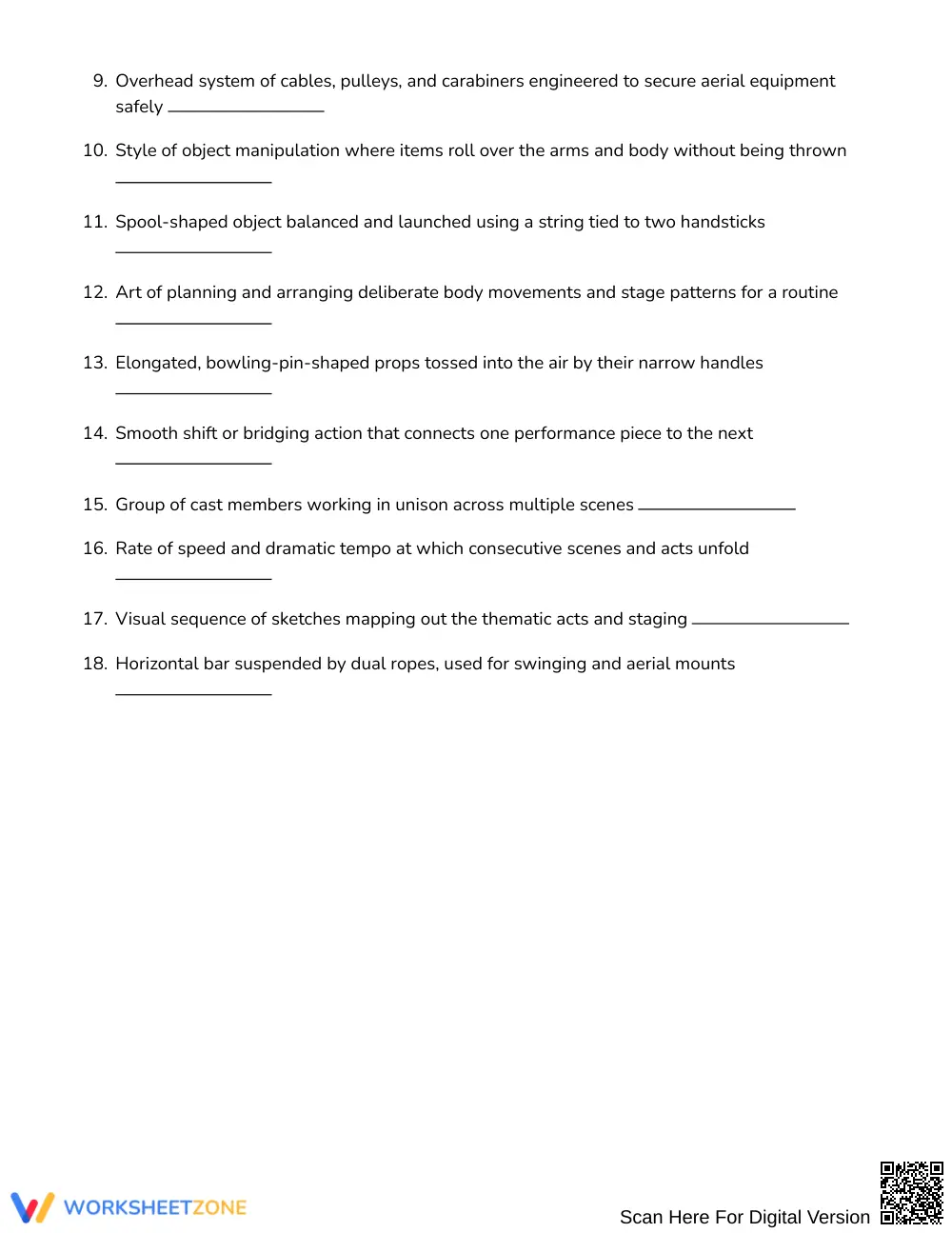
This Grades 7–8 circus arts word search reinforces specialized vocabulary connected to live performance design, aerial apparatus, and juggling routines. Learners read descriptive definitions to identify 18 domain-specific terms before locating them within the letter grid. The activity strengthens technical reading comprehension and contextual retention through focused lexical engagement.
At a Glance
- Grade: Grades 7–8 · Subject: English Language Arts (ELA)
- Standard: Not standards-assessed — vocabulary enrichment
- Skill Focus: Circus production, juggling, and aerial apparatus vocabulary
- Format: 3 pages · 18 words · Answer key included · PDF
- Best For: Thematic vocabulary review and theatrical unit wrap-up
- Time: 25–35 minutes
The 3-page printable activity features a full-page puzzle grid paired with detailed definitional clues and a shuffled word bank. Students encounter 18 target vocabulary terms spanning technical stagecraft, movement disciplines, and performance equipment. The included 4-page answer key provides a complete solution overlay that highlights every hidden term with exact spatial placement, allowing for rapid student self-checking or teacher verification.
This word search uses an expansive 20 x 20 letter grid designed to challenge middle school readers. All 18 vocabulary terms are hidden across eight possible orientations: north, northeast, east, southeast, south, southwest, west, and northwest. Rather than searching for a simple list, students first read comprehensive technical clues to determine each term, consulting the shuffled word bank to verify spelling before tracing words horizontally, vertically, or diagonally.
This activity serves strictly as domain-specific vocabulary enrichment and is not aligned to an individual Common Core state standard. The resource supports general English Language Arts lexical acquisition by prompting middle schoolers to connect precise technical definitions with disciplinary performance vocabulary in an engaging puzzle format.
Introduce this word search after direct instruction on performance planning or physical theater terminology. For an effective mid-unit checkpoint, assign the clues first as an independent matching activity before students begin searching the grid; observe whether learners can define terms like "rigging" and "cue sheet" without prompting. Expect completion in 25 to 35 minutes during independent seatwork, station rotations, or sub plans.
This resource is built for Grades 7–8 English Language Arts or theater arts classes studying performance production, performing arts, or descriptive vocabulary. It offers natural scaffolding through detailed definitions and a word bank, supporting English language learners and developing readers. Pair this puzzle with an informational text on circus history or technical theater staging.
According to research on disciplinary literacy by Fisher & Frey (2014), intentional exposure to specialized vocabulary through active retrieval strengthens reading comprehension across technical domains. When middle school learners analyze context-rich definitions to identify complex terms such as choreography, soundscape, and rigging, they build conceptual schema that extend beyond basic memorization. Orthographic word searches that integrate directional scanning across eight orientations reinforce visual word recognition and morphemic memory, consolidating spelling patterns for multi-syllabic vocabulary. The deliberate pairing of definitional clues with spatial puzzle solving prompts students to process language semantically before engaging in perceptual search routines. This dual-processing mechanism supports long-term lexical retention for adolescent students in Grades 7–8, transforming passive review into active cognitive processing. By embedding 18 domain-specific circus production terms into an interactive puzzle, educators provide purposeful vocabulary enrichment that prepares students for sophisticated technical texts and creative performance arts analysis.


