


























Views
Downloads


Essential Circuit Models Worksheet | Grades 8-12 Science
Paste this activity's link or code into your existing LMS (Google Classroom, Canvas, Teams, Schoology, Moodle, etc.).
Students can open and work on the activity right away, with no student login required.
You'll still be able to track student progress and results from your teacher account.
This physical science worksheet equips students in grades 8–12 to construct, evaluate, and revise scientific models of direct current circuits. Through schematic analysis, graphing exercises, and numerical calculations, learners investigate voltage, current, and resistance relationships to replace intuitive circuit misconceptions with evidence-based reasoning.
At a Glance
- Grade: Grades 8–12 · Subject: Science
- Standard: Physical Science Standards — Construct, evaluate, and revise models of electric charge flow and Ohm's law
- Skill Focus: Voltage, Current, and Resistance Modeling
- Format: 4 pages · 28 problems · Answer key included · PDF
- Best For: High school and middle school physics units
- Time: 45–60 minutes
Across 4 pages and 28 focused problems, students examine meter configurations, build voltage-current data tables, plot linear relationships, and analyze non-ohmic filament heating. The printable packet includes circuit schematics, comparative data sets, and a comprehensive 4-page answer key with step-by-step mathematical calculations and explanatory answers.
Skill Progression
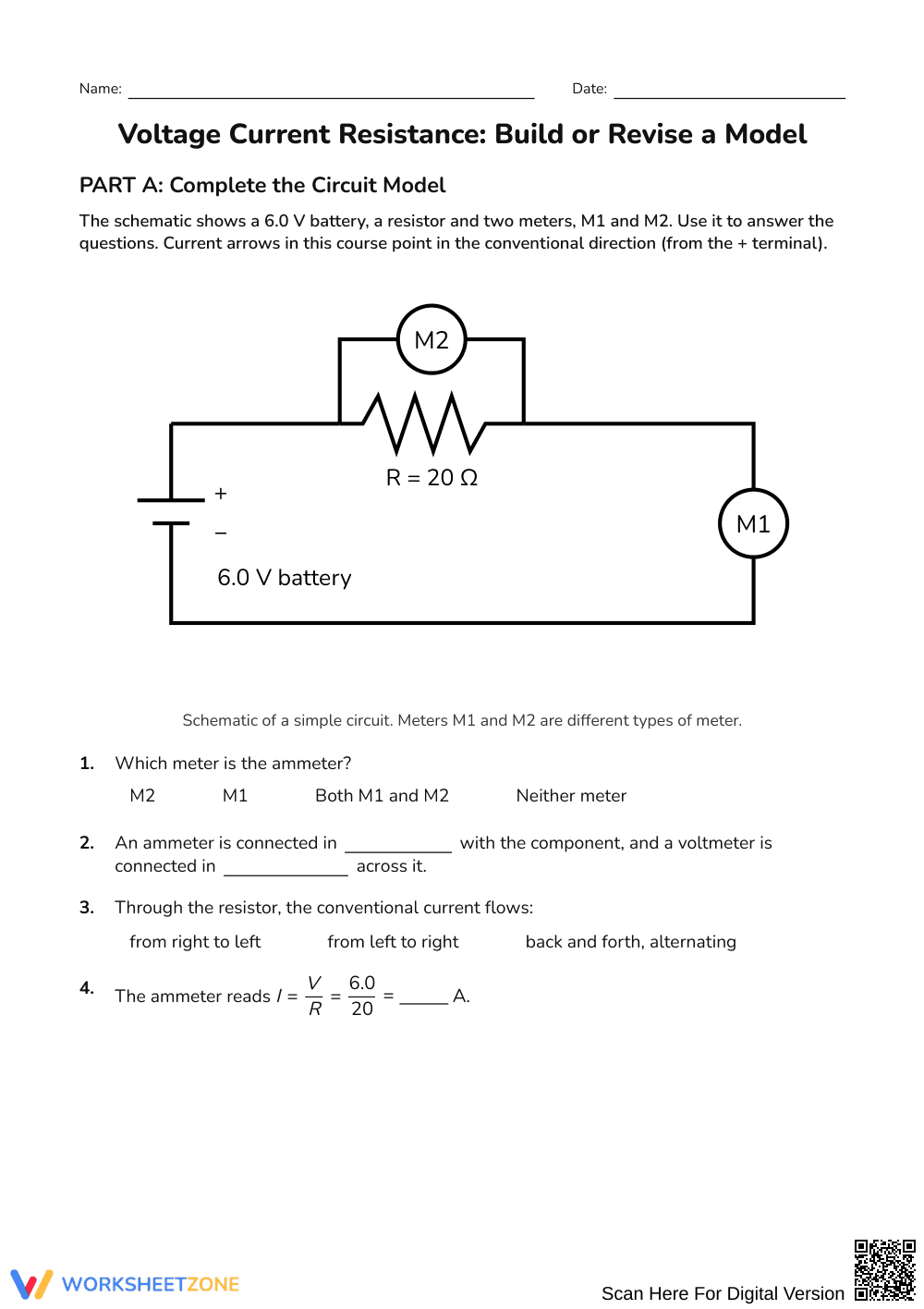
- Guided practice (Tasks 1–7): Students analyze a series circuit schematic, identifying ammeter and voltmeter placement, tracing conventional current direction, and predicting system behavior when meter arrangements change.
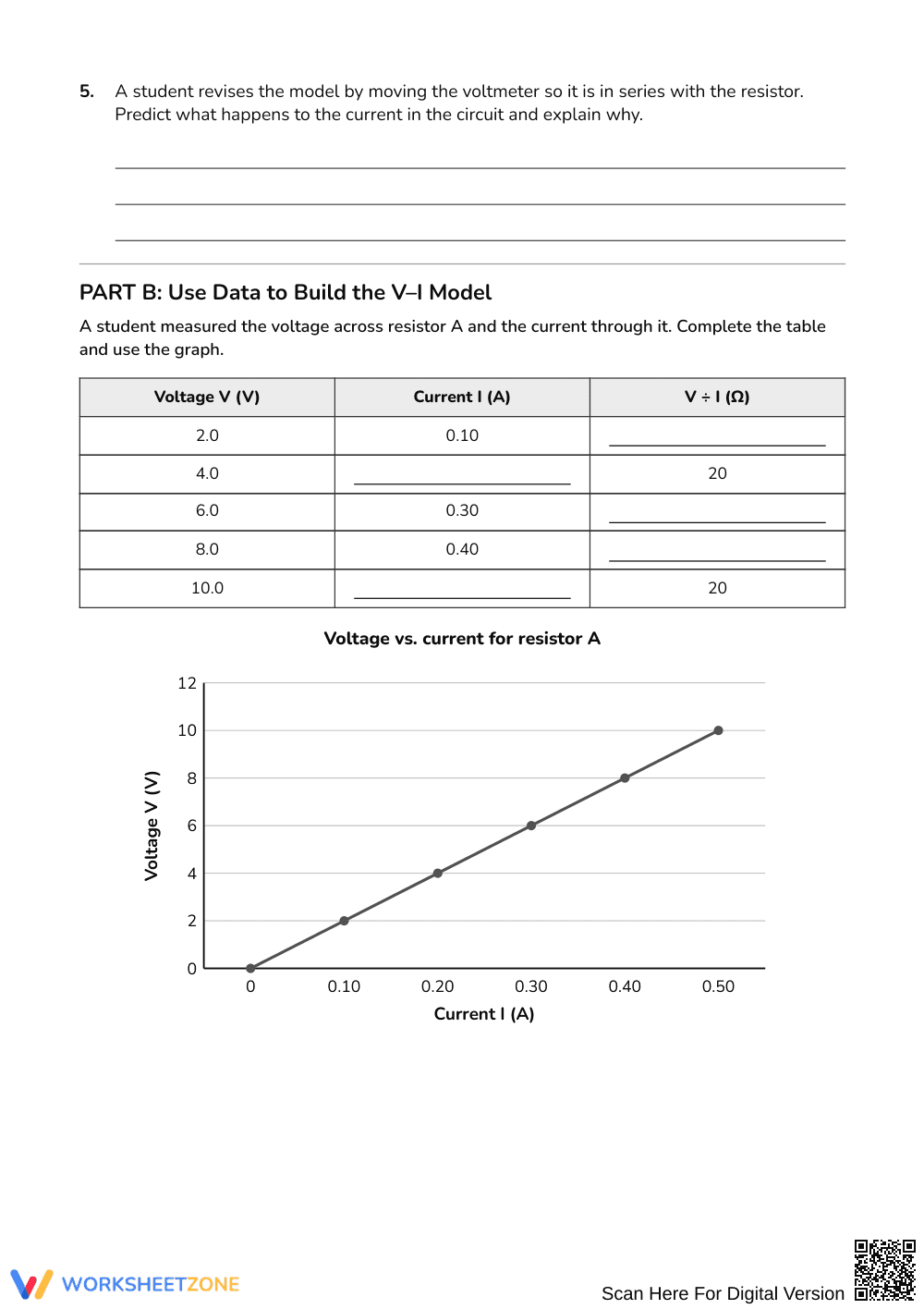
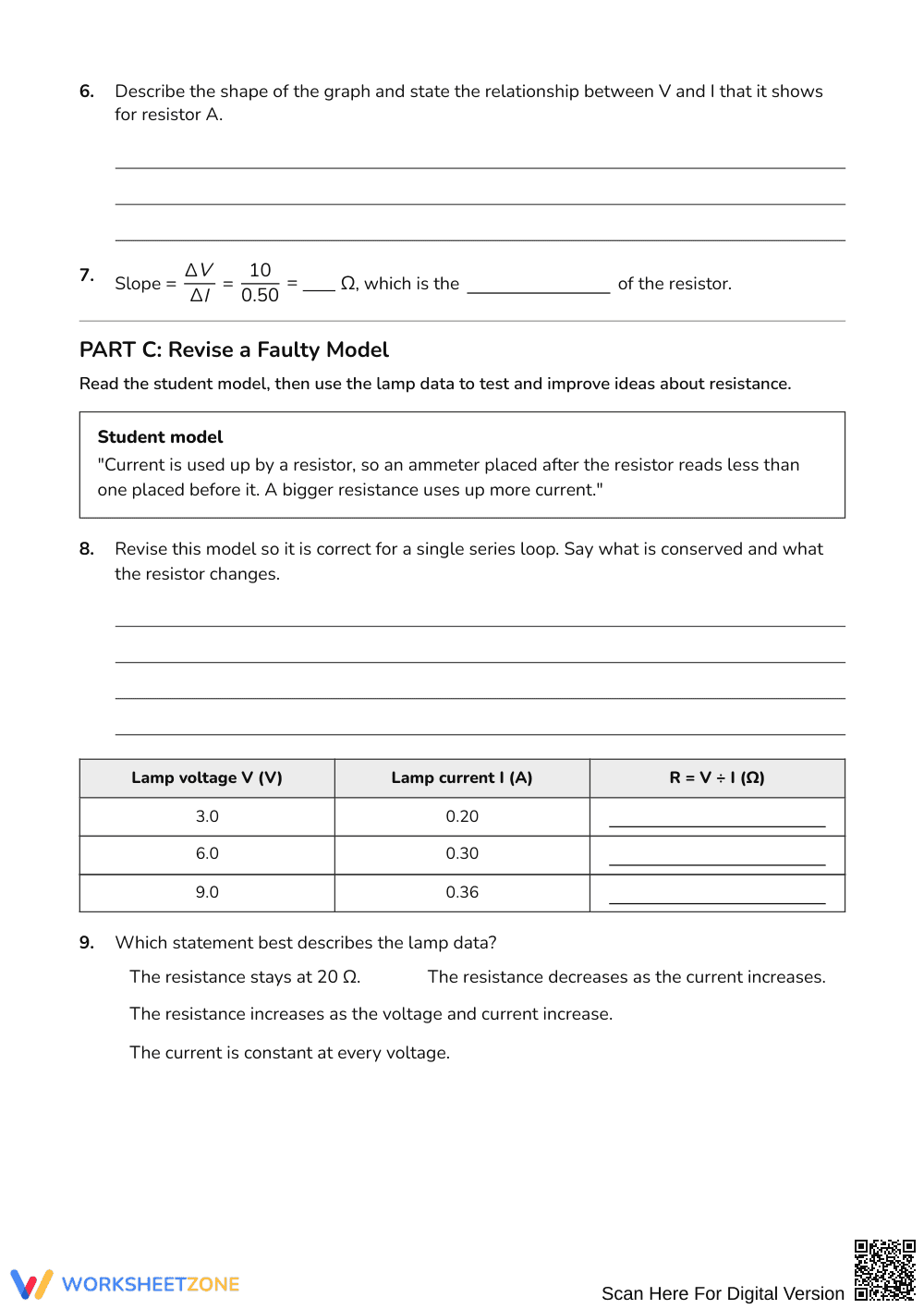
- Supported practice (Tasks 8–20): Learners calculate resistance ratios from empirical voltage-current data, verify ohmic behavior via graph slope, and revise a common misconception claiming current is consumed across loads.
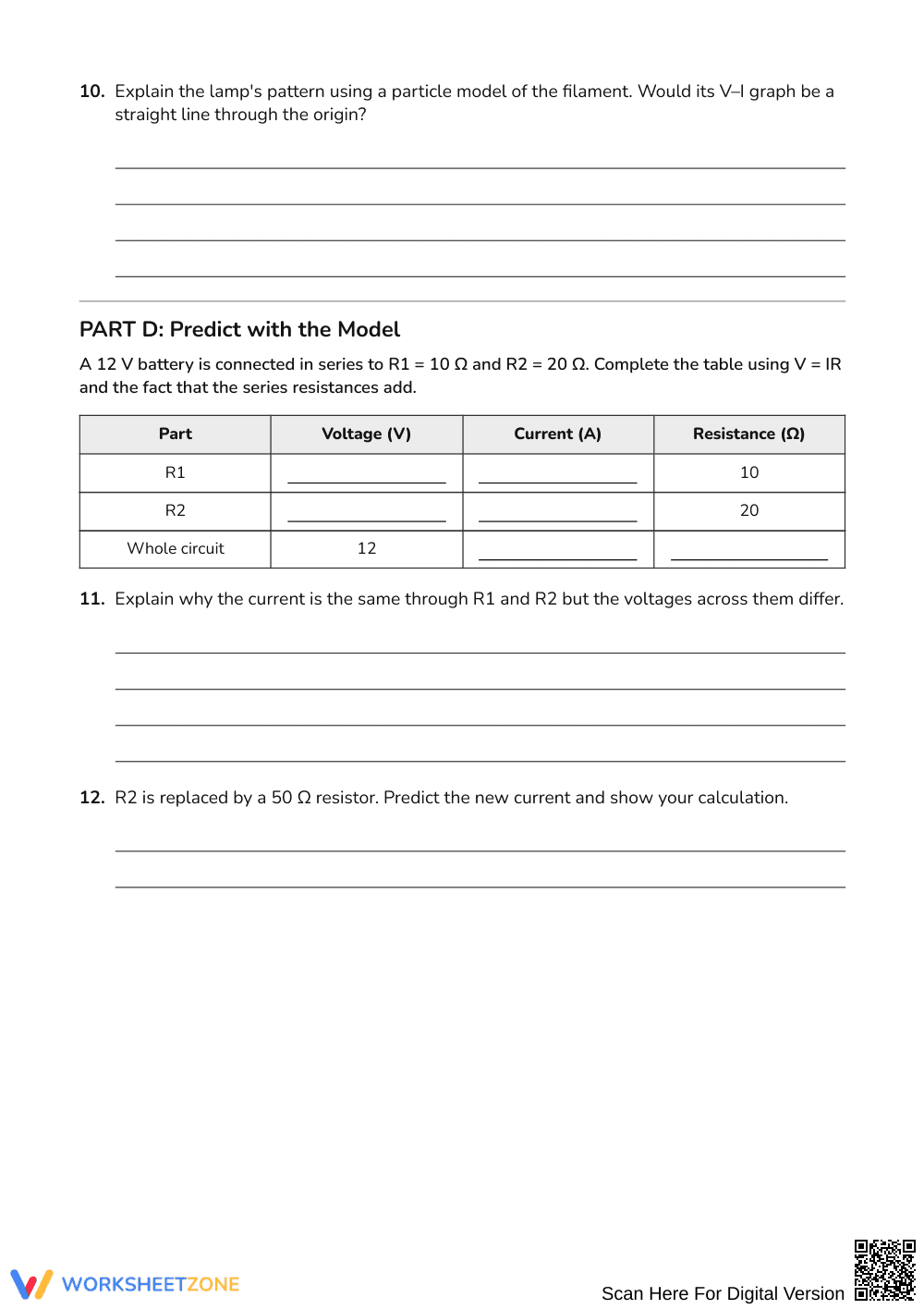
- Independent practice (Tasks 21–28): Students apply Ohm's law to multi-resistor series circuits, calculating distributed voltage drops, identifying constant current along single loops, and predicting system changes when resistance values shift.
This structured progression leverages the gradual release of responsibility model, guiding students from diagrammatic interpretation to independent quantitative prediction.
Standards Alignment
This resource aligns with secondary physical science standards addressing energy transfer and circuit dynamics. Students construct and revise models showing that electric current represents conserved charge flow driven by potential differences. Both standard descriptions can be copied directly into lesson plans, IEP goals, or district curriculum mapping tools.
How to Use It
Assign this worksheet following direct instruction on Ohm's law or as a conceptual bridge after laboratory circuit construction. For formative assessment, inspect student corrections in Part C to verify whether they understand charge conservation rather than current consumption. The 4-page problem set takes 45 to 60 minutes of instructional time.
Who It's For
This practice set serves students in Grades 8–12 enrolled in Physical Science, Conceptual Physics, or introductory Physics courses. Scaffolding supports developing learners through labeled tables, while conceptual revision tasks challenge advanced students. Pair this activity with digital circuit simulations or breadboard lab activities to connect symbolic models with hands-on observations.
Scientific modeling in secondary physics education requires students to systematically coordinate empirical evidence with core theoretical principles. As Fisher & Frey (2014) demonstrate in their research on the gradual release of responsibility, structured scaffolding enables learners to bridge the gap between qualitative conceptual reasoning and quantitative problem-solving. This 4-page, 28-task worksheet targets foundational physical science concepts, specifically how voltage, current, and resistance interact within electrical systems. Rather than relying purely on rote algebraic substitution, the tasks require students to interpret circuit schematics, evaluate non-ohmic filament heating through particle models, and directly confront the widespread misconception that electric current is consumed by circuit components. By engaging in purposeful model construction, testing, and revision across progressive instructional tiers, students achieve durable conceptual understanding and develop transferable analytical skills aligned with rigorous secondary science learning standards.


