


























Views
Downloads


Essential Circuit Comparison Worksheet | Grade 8-12 Science
Paste this activity's link or code into your existing LMS (Google Classroom, Canvas, Teams, Schoology, Moodle, etc.).
Students can open and work on the activity right away, with no student login required.
You'll still be able to track student progress and results from your teacher account.
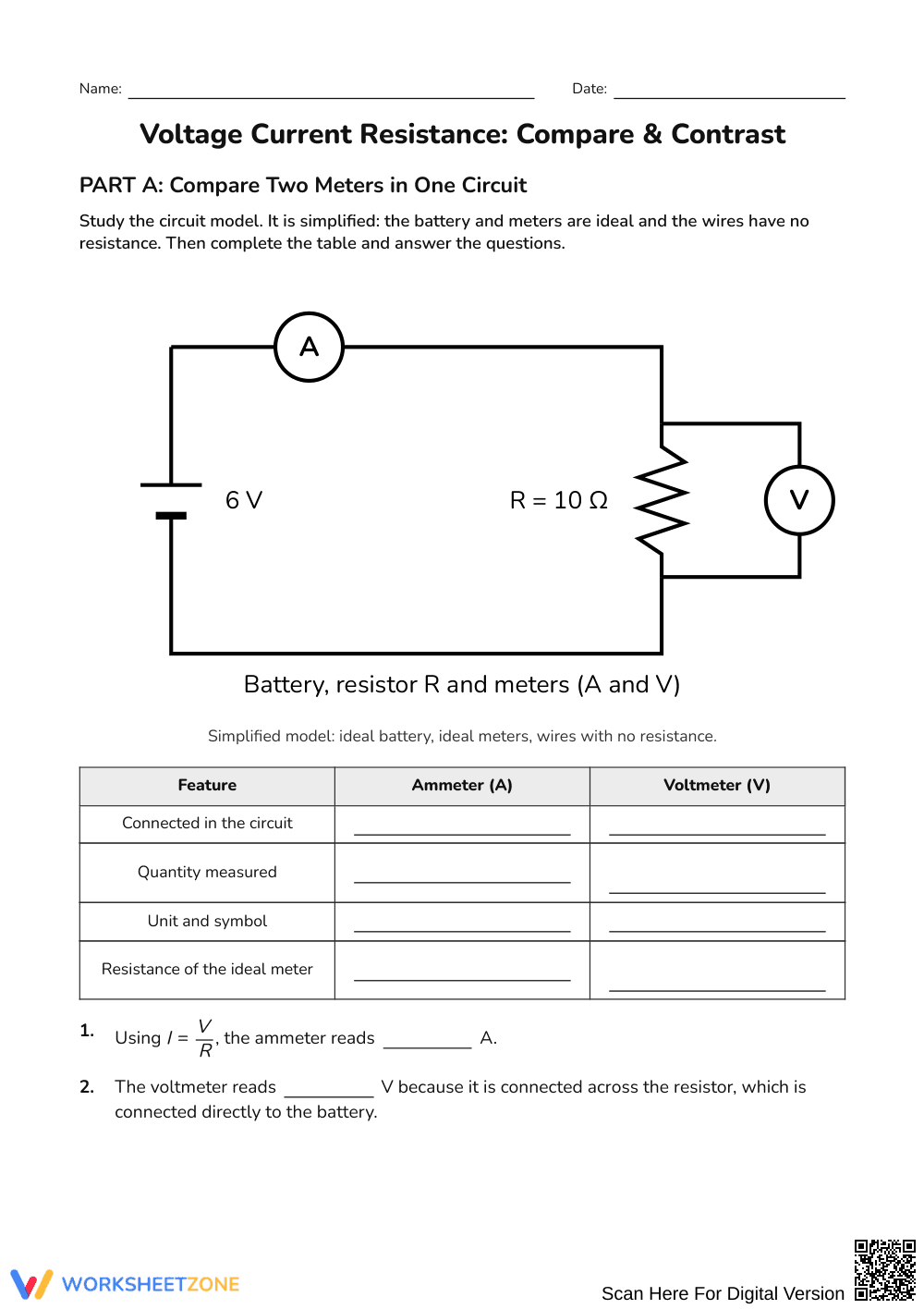
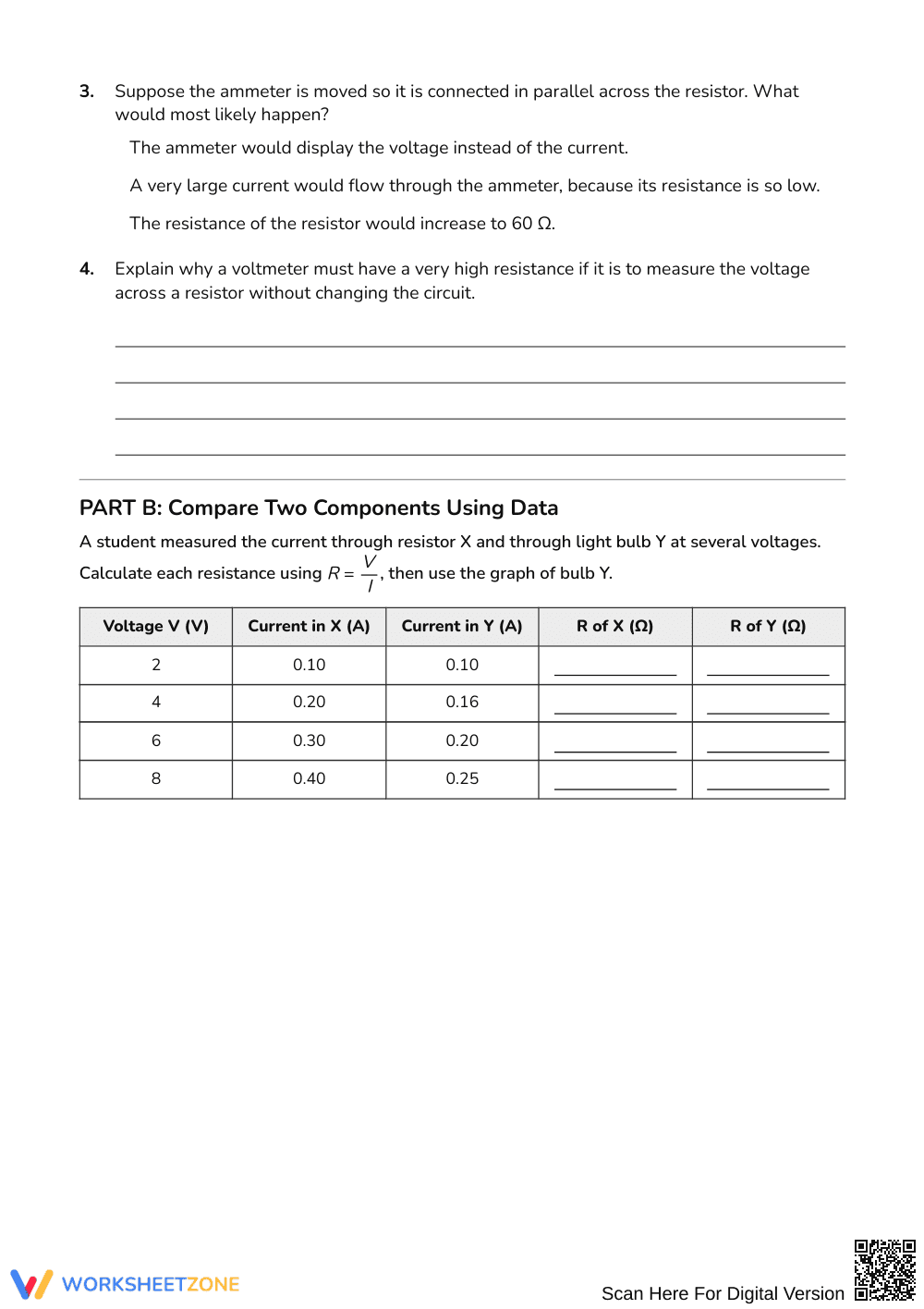
This physical science worksheet guides students through comparing electric meters, ohmic and non-ohmic conductors, and series versus parallel circuits. Across 33 structured tasks, learners analyze circuit schematics, evaluate experimental voltage-current data, and calculate equivalent resistance and power to master core electrical concepts.
At a Glance
- Grade: Grades 8–12 · Subject: Science
- Standard: Compare voltage, current, and resistance across circuit components
- Skill Focus: Circuit comparisons and Ohm's law reasoning
- Format: 4 pages · 33 problems · Answer key included · PDF
- Best For: Physics or physical science practice
- Time: 45–60 minutes
What's Inside
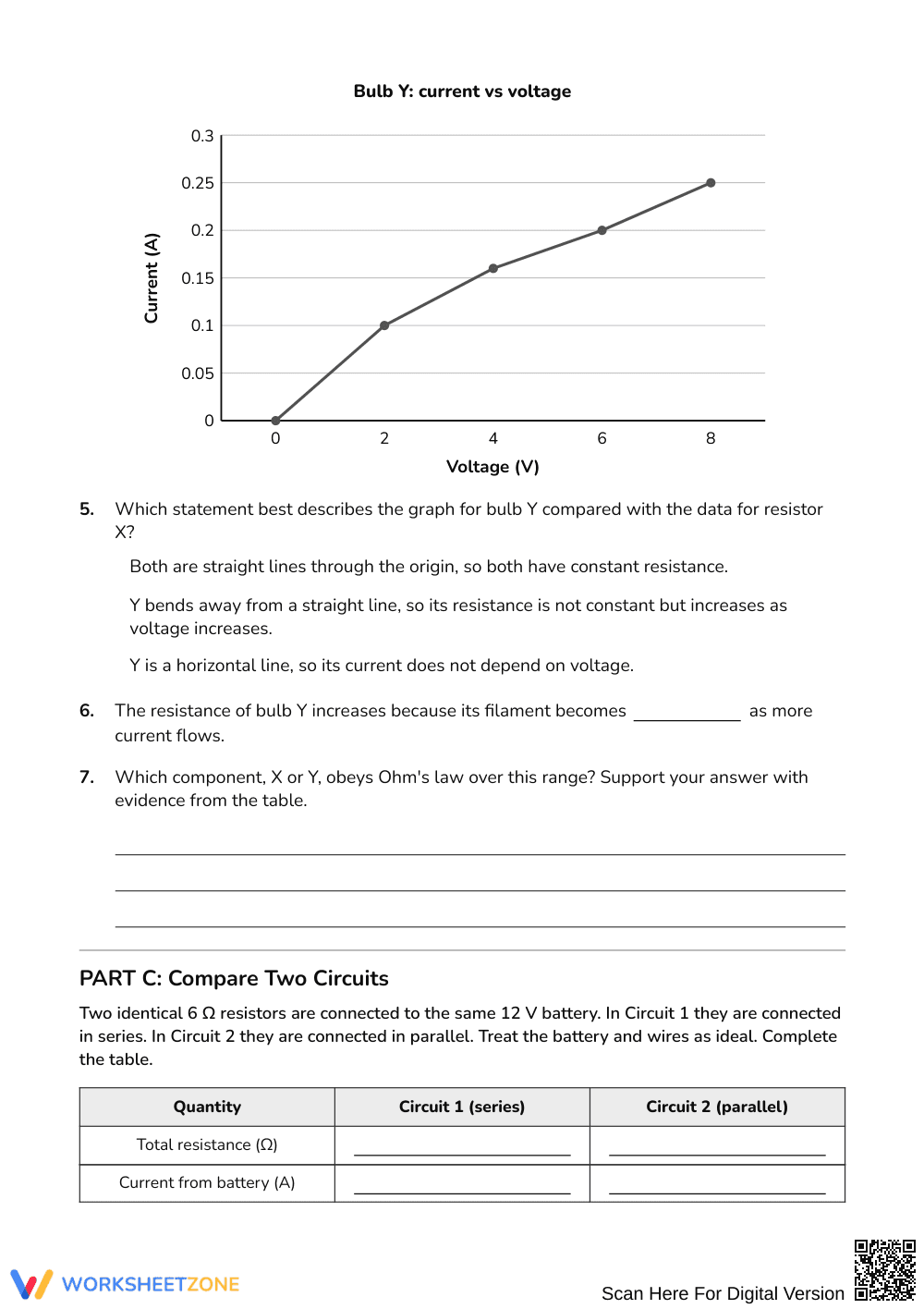
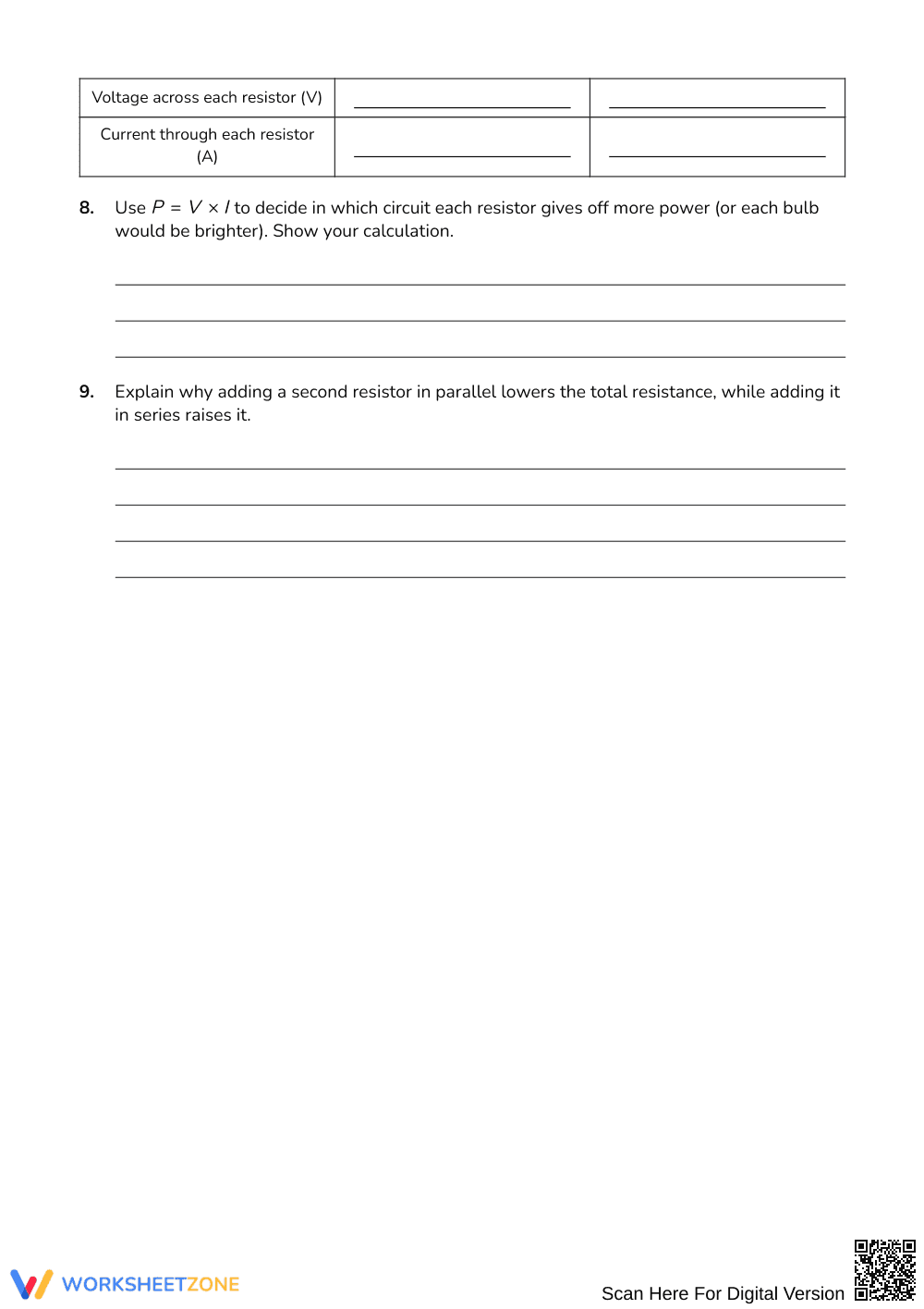
This 4-page activity packet features structured data tables and reasoning prompts across three parts. Students contrast ideal ammeters and voltmeters, evaluate resistance data to identify ohmic versus non-ohmic components, and calculate total resistance, branch current, and power output across series and parallel circuits. A complete 4-page answer key provides worked calculations.
Skill Progression
- Guided practice (Part A, 11 tasks): Students evaluate an idealized circuit model comparing ammeters and voltmeters using a structured matrix and guided prompts on internal meter resistance.
- Supported practice (Part B, 11 tasks): Students calculate resistance from experimental data tables, contrast a linear resistor graph against a curved filament lamp, and identify ohmic behavior.
- Independent practice (Part C, 11 tasks): Students compute equivalent resistance, branch voltage, and power dissipation using P = V × I, explaining why parallel additions lower total circuit resistance.
This progression mirrors the gradual-release model, advancing learners from guided analysis to autonomous calculation.
Standards Alignment
This resource aligns with physical science expectations requiring students to model relationships among electric current, voltage, and resistance. Learners evaluate empirical data to determine mathematical relationships between circuit variables and assess non-linear energy dissipation. Both standard codes can be copied directly into lesson plans, IEP goals, or district curriculum mapping tools.
How to Use It
Deploy this worksheet after direct instruction on Ohm's law and basic circuit arrangements. As a formative check during independent work, observe whether students recognize that a voltmeter's high internal resistance prevents current diversion. For laboratory synthesis, assign Part C following breadboard experiments. Expected completion time spans 45 to 60 minutes.
Who It's For
Designed for physical science and high school physics students, this packet provides comparative tables that support developing learners while challenging advanced students with multi-step power calculations. Pair this resource with a hands-on circuit lab or interactive DC circuit simulation to anchor numerical findings in tactile observations.
Structured comparative organizers and stepped problem sets significantly enhance conceptual retention in secondary science education. According to research documented by Fisher & Frey (2014), the gradual-release framework effectively transitions students from structured conceptual modeling to independent quantitative mastery through guided cognitive handoffs. In this resource, students compare circuit meters, calculate resistance across ohmic and non-ohmic components, and contrast series versus parallel configurations across 33 systematic prompts. By juxtaposing idealized component behaviors against empirical current-voltage measurements, learners directly confront common misconceptions surrounding potential difference and current conservation in circuits. Integrating graphical data interpretation with quantitative problem-solving directly targets secondary physical science performance expectations. The complete four-page sequence and corresponding answer key offer secondary educators an adaptable, research-based instrument for formative evaluation, targeted small-group intervention, and post-laboratory synthesis in general science, physical science, and introductory physics classrooms.


