




























Views
Downloads



Essential Circuit Basics Worksheet | Grades 8-12 Science

Paste this activity's link or code into your existing LMS (Google Classroom, Canvas, Teams, Schoology, Moodle, etc.).
Students can open and work on the activity right away, with no student login required.
You'll still be able to track student progress and results from your teacher account.
This science worksheet guides students in grades 8–12 through electric circuits, focusing on voltage, current, and resistance. By completing structured definitions, circuit diagram analyses, Ohm's law calculations, and misconception repairs, learners build a solid conceptual and quantitative understanding of charge flow.
At a Glance
- Grade: Grades 8–12 · Subject: Science
- Standard: Physical Science — Relate voltage, current, and resistance in circuits
- Skill Focus: Circuit terminology, meter connections, and Ohm's law
- Format: 4 pages · 30 problems · Answer key included · PDF
- Best For: Introductory circuit and physics units
- Time: 45–60 minutes
What's Inside
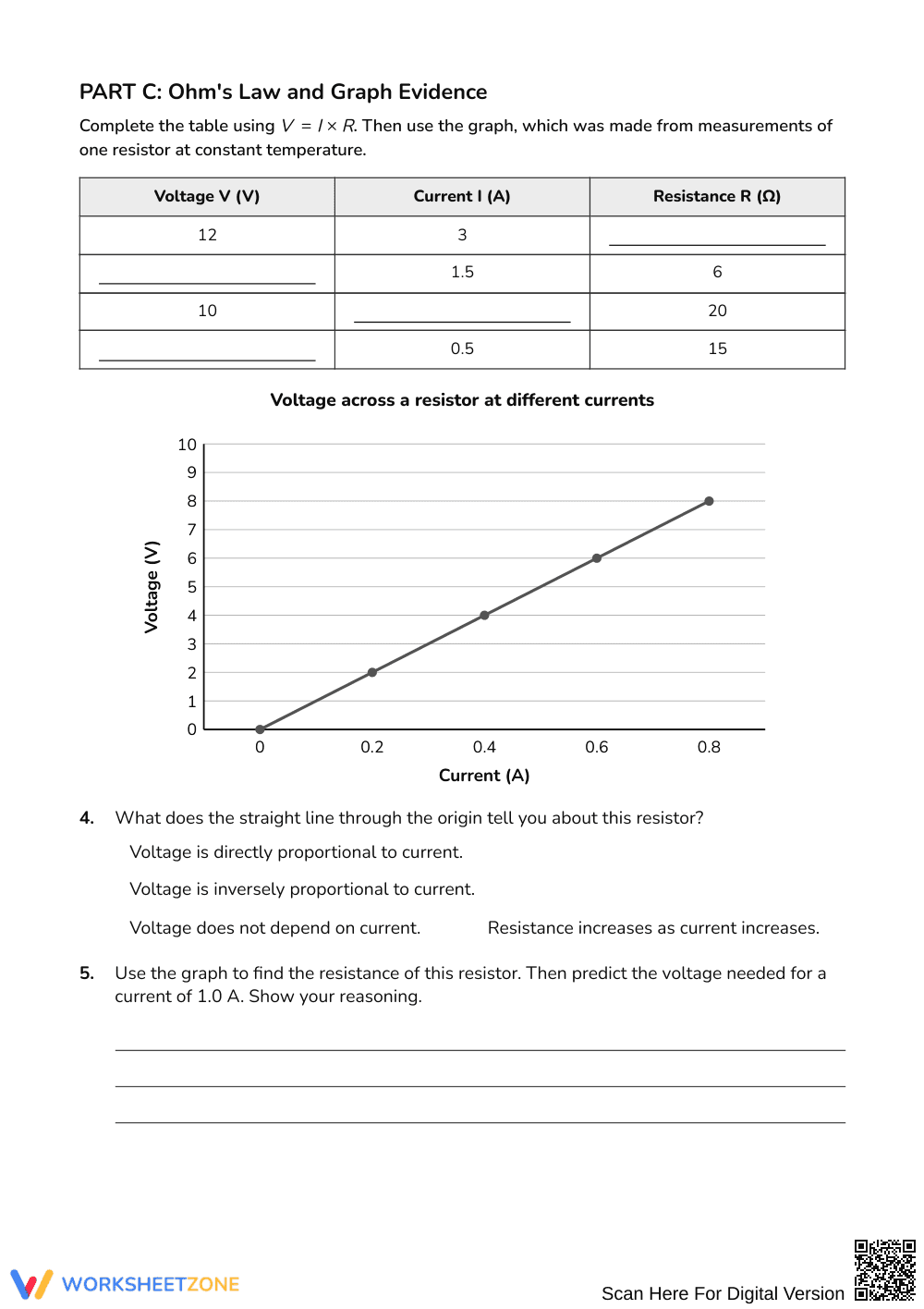
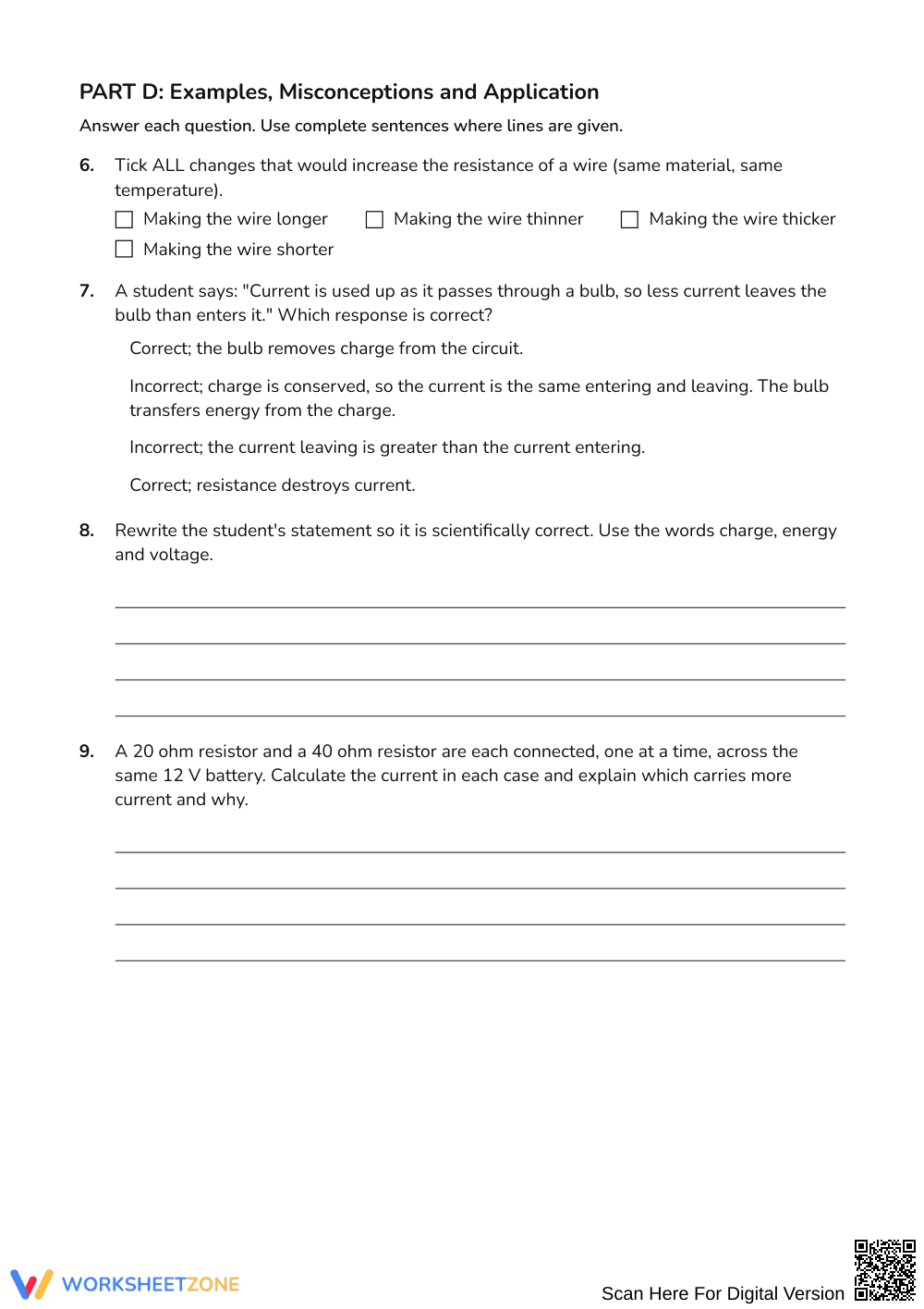
The 4-page resource includes 30 tasks across four sections. Part A features a vocabulary reference box and matching. Part B provides a schematic diagram for meter placement. Part C contains an Ohm's law table and graph. Part D delivers application problems and misconception analysis, supported by a 4-page answer key.
Skill Progression
This worksheet follows a gradual-release instructional model:
- Guided Practice (Part A, 10 tasks): Students use reference definitions to complete quantity tables and match circuit terminology with heavy scaffolding.
- Supported Practice (Parts B & C, 12 tasks): Learners evaluate circuit meters, calculate V = I × R values, and interpret linear voltage-current graphs.
- Independent Practice (Part D, 8 tasks): Students analyze wire resistance variables, resolve a current misconception, and calculate resistor currents.
This sequence supports learners from initial recall to independent quantitative problem-solving following the I Do, We Do, You Do model.
Standards Alignment
This activity aligns with secondary physical science standards for electric circuits and Ohm's law. Students investigate potential difference, current, and resistance while confirming charge conservation in closed systems. Both standard codes can be copied directly into lesson plans, IEP goals, or district curriculum mapping tools.
How to Use It
Deploy this worksheet after direct instruction on Ohm's law for guided partner practice or formative assessment. For assessment observation, check Part D item 2 to confirm students understand charge conservation rather than assuming current is consumed. Completion typically requires 45 to 60 minutes.
Who It's For
This worksheet serves middle and high school students in physical science or introductory physics courses. Clear reference boxes support English learners and students needing accommodations. Pair this print-and-go practice with a virtual circuit simulator lab or breadboard activity.
Mastering fundamental electric circuit concepts requires secondary science students to coordinate specialized vocabulary, circuit diagram conventions, and mathematical problem-solving using Ohm's law. According to empirical research by Fisher & Frey (2014) on effective instructional architectures, guiding learners through structured gradual-release frameworks significantly improves concept retention and procedural fluency in STEM disciplines. This 4-page worksheet reinforces essential physical science competencies by moving students methodically from foundational definitions of voltage, current, and resistance to complex graphical analysis and quantitative circuit calculations. Furthermore, targeted diagnostic items address persistent student misconceptions regarding the conservation of electric charge, helping educators identify and correct erroneous models of current consumption in electrical loads. By integrating guided reference tools, multi-step problem sets, and explicit non-examples, this instructional resource establishes a robust conceptual foundation for advanced study in electromagnetism and applied electrical engineering.


