





























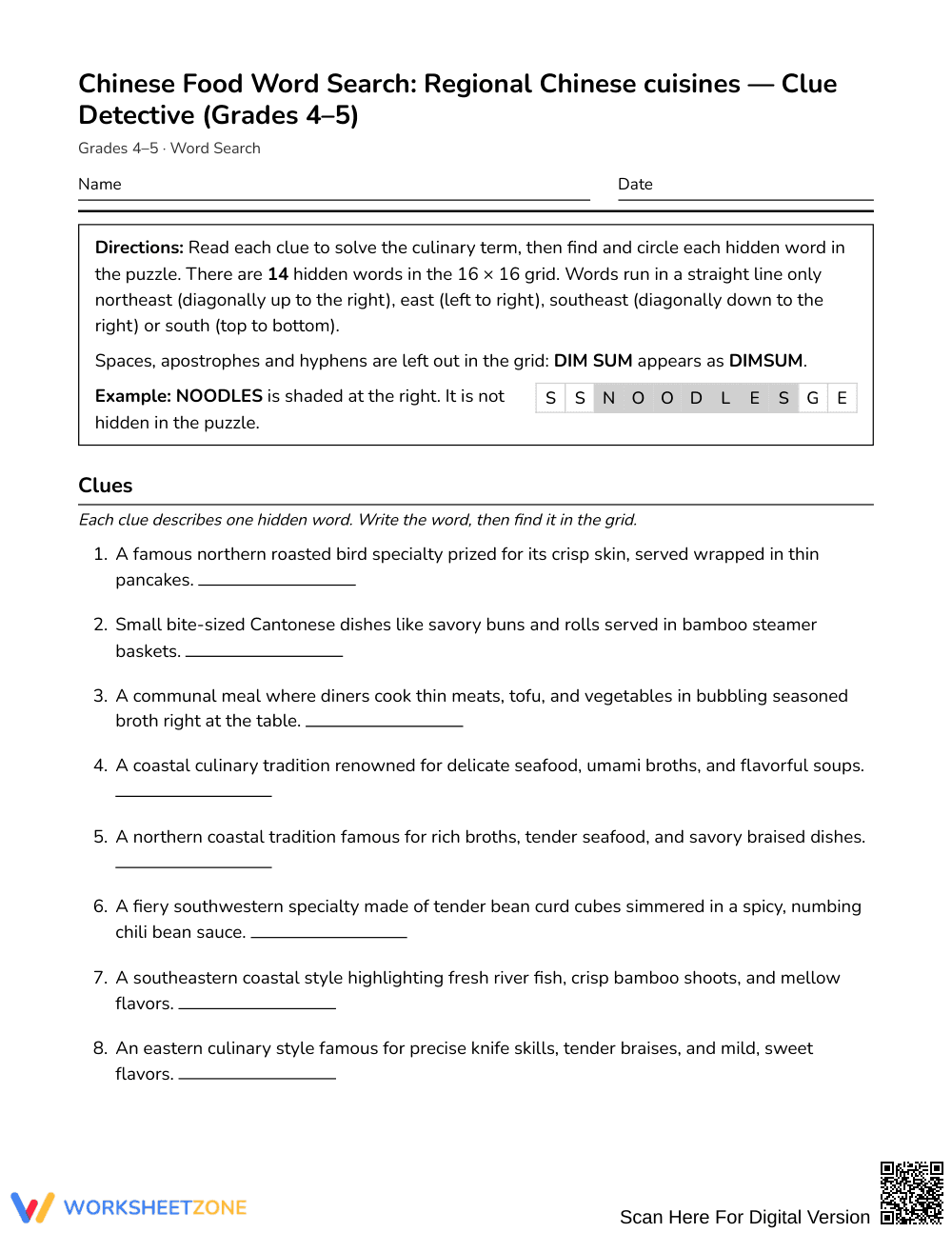


Essential Chinese Cuisines Word Search | Grades 4–5 ELA

Paste this activity's link or code into your existing LMS (Google Classroom, Canvas, Teams, Schoology, Moodle, etc.).
Students can open and work on the activity right away, with no student login required.
You'll still be able to track student progress and results from your teacher account.
This regional Chinese cuisines word search builds cultural vocabulary and reading comprehension for intermediate elementary students. Learners read detailed culinary clues to identify 14 regional cooking styles and dishes before locating them in the puzzle grid. The activity reinforces domain-specific terminology through contextual definition decoding across diverse Chinese culinary traditions.
At a Glance
- Grade: Grades 4–5 · Subject: ELA Vocabulary
- Standard: Not standards-assessed — vocabulary enrichment and cultural exploration
- Skill Focus: Regional Chinese cuisines and culinary terminology
- Format: 3 pages · 14 hidden words · Full answer key · PDF
- Best For: Vocabulary enrichment, cultural literacy, and independent practice
- Time: 20–30 minutes
What's Inside
This 3-page printable resource includes a clue-based word search puzzle and a full solution key. Rather than scanning a simple word bank, students read 14 informative clues describing Chinese regional cooking styles—such as Sichuan, Cantonese, Shandong, and Hunan—alongside dishes like dim sum, mapo tofu, and hot pot. Each clue provides culinary context that students decode to reveal the target term before searching the letter grid.
Puzzle Mechanics
The activity features a 16 x 16 letter grid containing 14 hidden vocabulary terms. Target words run in four directional paths: northeast (NE), east (E), southeast (SE), and south (S). Learners read the descriptive culinary clues to deduce each word, verifying choices against a shuffled word bank before locating letter sequences in the grid. This directional structure offers a focused challenge without reverse or upside-down placements.
Standards Alignment
This word search is designed for vocabulary enrichment and cultural exploration rather than formal standards assessment. While the puzzle reinforces informational reading and domain-specific terminology, it is not aligned to a specific state standard. Educators can integrate the activity during multicultural reading units, social studies geography lessons, or independent language arts stations.
How to Use It
Use this puzzle as a partner activity during a cultural geography unit or as independent practice following direct instruction on global traditions. Have students read each clue aloud and deduce the term before scanning the grid. Formatively assess comprehension by checking whether students connect key regional descriptions to the correct culinary tradition. Most students complete the 14-word search in 20 to 30 minutes.
Who It's For
This resource serves students in Grades 4–5 developing domain-specific vocabulary and reading skills. For students needing support, teachers can highlight starting letters or pair the puzzle with a labeled map of Chinese provinces. The activity pairs effectively with an informational reading passage about East Asian culinary history or a whole-class geography presentation.
Vocabulary enrichment activities that integrate contextual definition decoding promote meaningful semantic connections and long-term word retention in intermediate elementary grades. Research by Fisher & Frey (2014) emphasizes that intentional word-learning experiences—where students encounter domain-specific terminology alongside descriptive context clues—significantly improve reading comprehension compared to isolated rote memorization drills. This Grades 4–5 regional Chinese cuisines word search applies these pedagogical principles by embedding 14 culinary terms within informational clues, guiding students to decode regional definitions prior to visual scanning. By linking geographical regions and cultural culinary traditions directly to target vocabulary, the 16 x 16 grid activity transforms traditional word search mechanics into an active literacy exercise. Teachers utilize this resource to reinforce content-area vocabulary, strengthen morphological awareness, and enhance engagement during global literacy and cultural study units without requiring extensive prep or grading overhead.


