































Essential Chemical Bonding Worksheet | Grades 9-12 Science

Paste this activity's link or code into your existing LMS (Google Classroom, Canvas, Teams, Schoology, Moodle, etc.).
Students can open and work on the activity right away, with no student login required.
You'll still be able to track student progress and results from your teacher account.
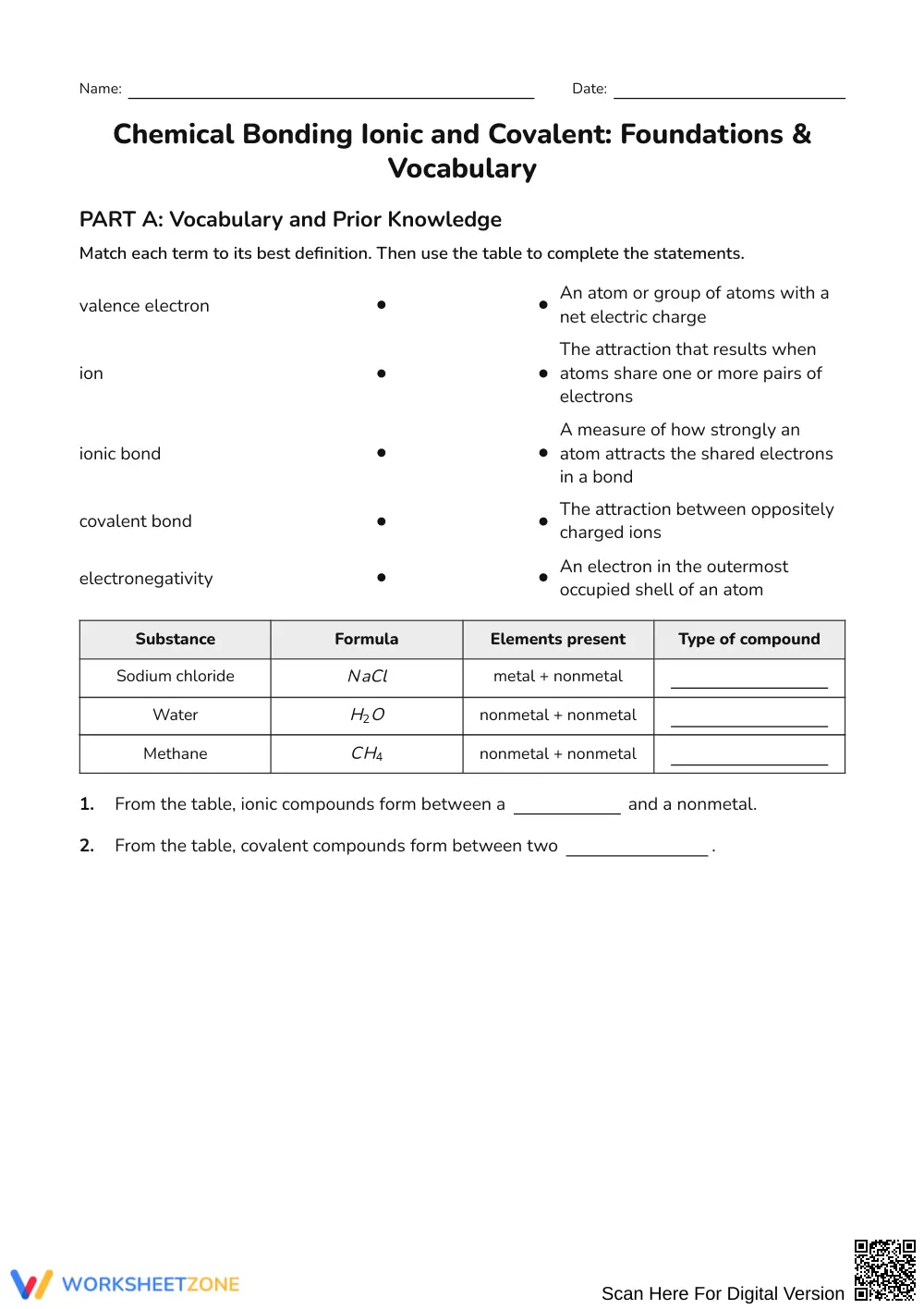
This chemistry worksheet helps high school students build an understanding of ionic and covalent bonding. Through 27 structured questions across 4 pages, learners define key vocabulary, interpret particle models, calculate electronegativity differences, and analyze properties to classify compounds.
At a Glance
- Grade: Grades 9–12 · Subject: Science
- Standard: Physical Science — Differentiate ionic and covalent bonding using atomic models and physical properties
- Skill Focus: Chemical bonding foundations and vocabulary
- Format: 4 pages · 27 problems · Answer key included · PDF
- Best For: Introducing bonding units or concept review
- Time: 45–60 minutes
The 4-page resource includes 27 structured exercises across three parts: vocabulary matching, Bohr and Lewis particle model interpretation, and data-driven bond classification based on electronegativity and conductivity. A complete 4-page answer key provides clear explanations and sample written responses.
Skill Progression
- Guided practice (Part A, Problems 1–7): Matching definitions and identifying compound types establish foundational terms.
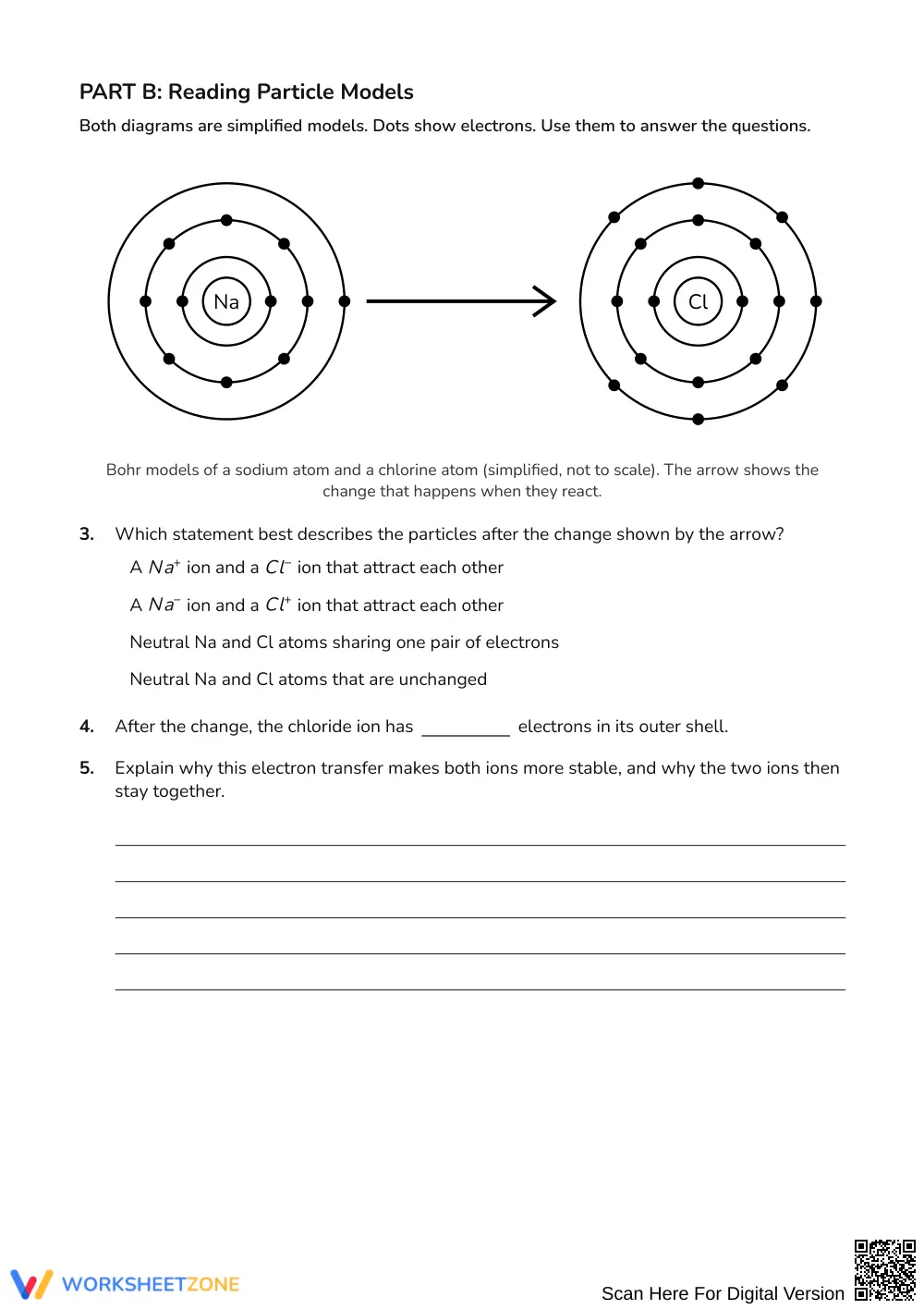
- Supported practice (Part B, Problems 8–15): Interpreting Bohr models and Lewis structures prompts students to explain electron transfer and sharing.
- Independent practice (Part C, Problems 16–27): Analyzing electronegativity values and physical property tables enables learners to classify bonds and address misconceptions.
This sequence implements the gradual release of responsibility model, guiding students toward independent evidence-based analysis.
Standards Alignment
This resource aligns with high school physical science standards for chemical bonding. Students use outer electron configurations and electronegativity to explain electrostatic ionic attractions and covalent sharing. Both standard descriptions can be copied directly into lesson plans, IEP goals, or district curriculum mapping tools.
How to Use It
Use this worksheet after direct instruction on valence electrons. Assign Parts A and B for guided partner practice and Part C for post-lab analysis. Check Part B responses to confirm students distinguish electrostatic attraction from shared pairs. Completion takes 45 to 60 minutes.
Who It's For
This worksheet serves Grades 9–12 chemistry and physical science students. Visual diagrams support learners developing spatial reasoning, while reference tables assist diverse learners. Pair this activity with a lab investigating electrolyte conductivity.
High school chemistry instruction requires explicit bridges between submicroscopic particle behavior and macroscopic substance properties. According to research on schema development by Fisher & Frey (2014), structured instructional progressions that move systematically from definitional vocabulary to visual representations and authentic data analysis prevent fragmented knowledge retention. This 4-page, 27-task worksheet addresses core physical science objectives by requiring students to justify bond classification using electronegativity deltas and observed laboratory properties like electrical conductivity and melting points. Furthermore, the targeted misconception item specifically addresses persistent student confusion between molecular units and continuous ionic crystal lattices. By combining guided definitions, Bohr diagrams, Lewis structures, and quantitative threshold rules within a unified instructional tool, educators provide the deliberate cognitive scaffolding necessary to transition novice science learners into proficient analytical thinkers capable of explaining electrostatic forces and molecular stability.


