




























Views
Downloads



Essential Causal Reasoning Repair Worksheet | Grade 8 ELA

Paste this activity's link or code into your existing LMS (Google Classroom, Canvas, Teams, Schoology, Moodle, etc.).
Students can open and work on the activity right away, with no student login required.
You'll still be able to track student progress and results from your teacher account.
Help eighth-grade readers evaluate argumentative logic with this targeted causal reasoning worksheet. Students analyze two competing school resource proposals, diagnose five logical fallacies in flawed claims, and rewrite assertions into qualified, text-supported arguments. This activity builds analytical stamina while reinforcing standards-based reading and evidence evaluation skills.
At a Glance
- Grade: 8 · Subject: ELA
- Standard:
RI.8.8— Delineate and evaluate arguments, assessing whether reasoning is sound and evidence is sufficient.- Skill Focus: Identifying and Repairing Unsupported Causal Reasoning
- Format: 5 pages · 10 problems · Answer key included · PDF
- Best For: Fallacy identification and argumentative text repair
- Time: 40–50 minutes total
What's Inside
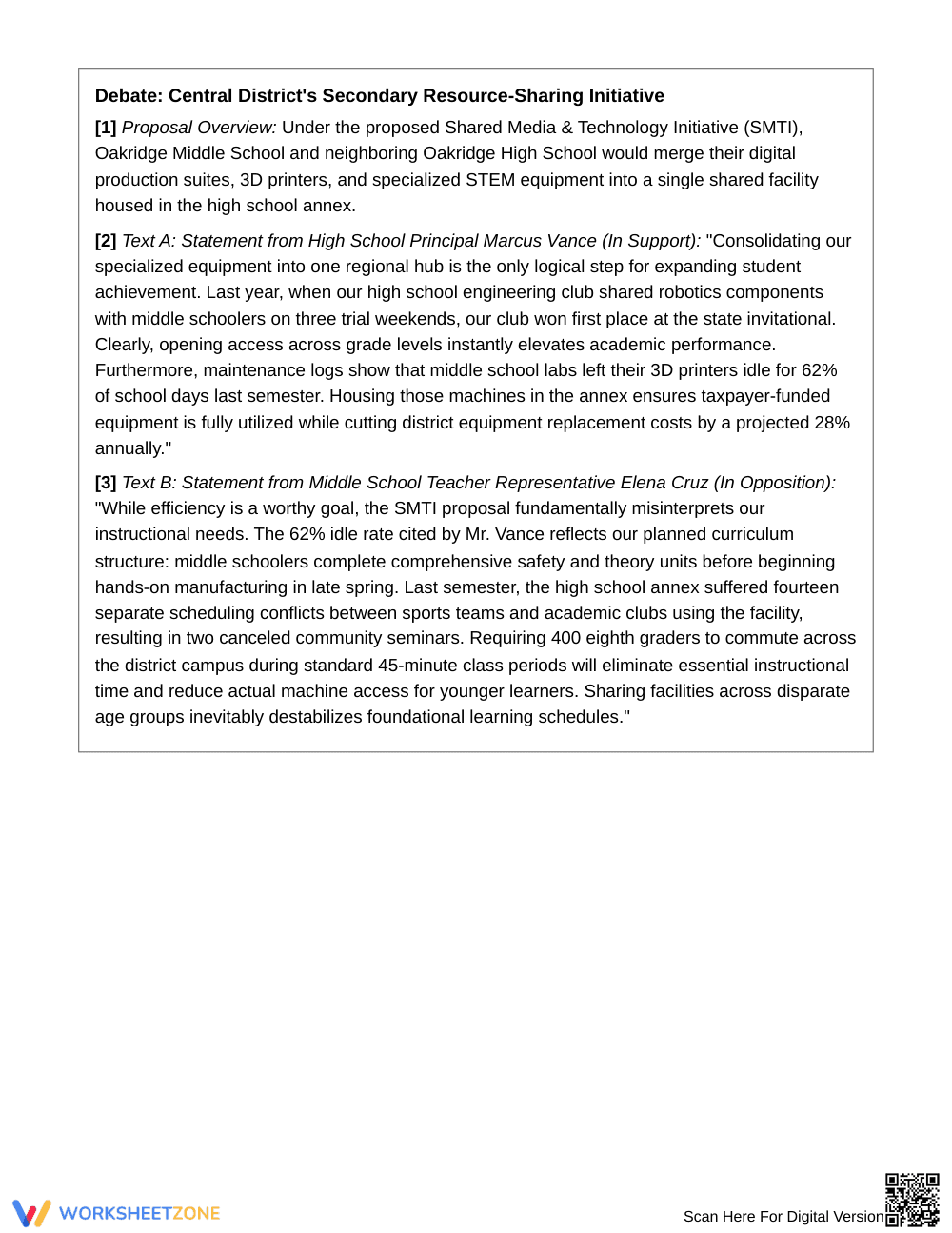
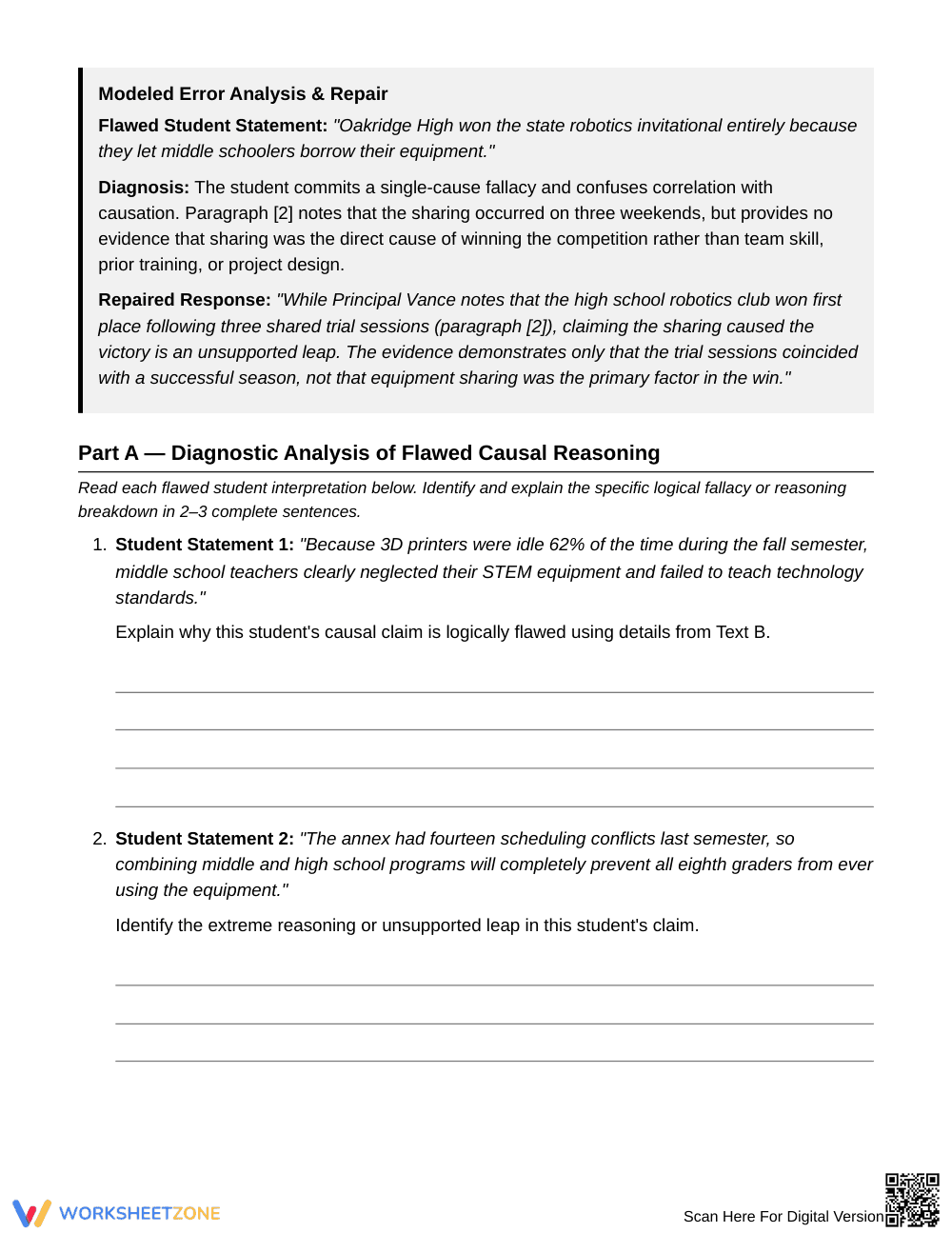
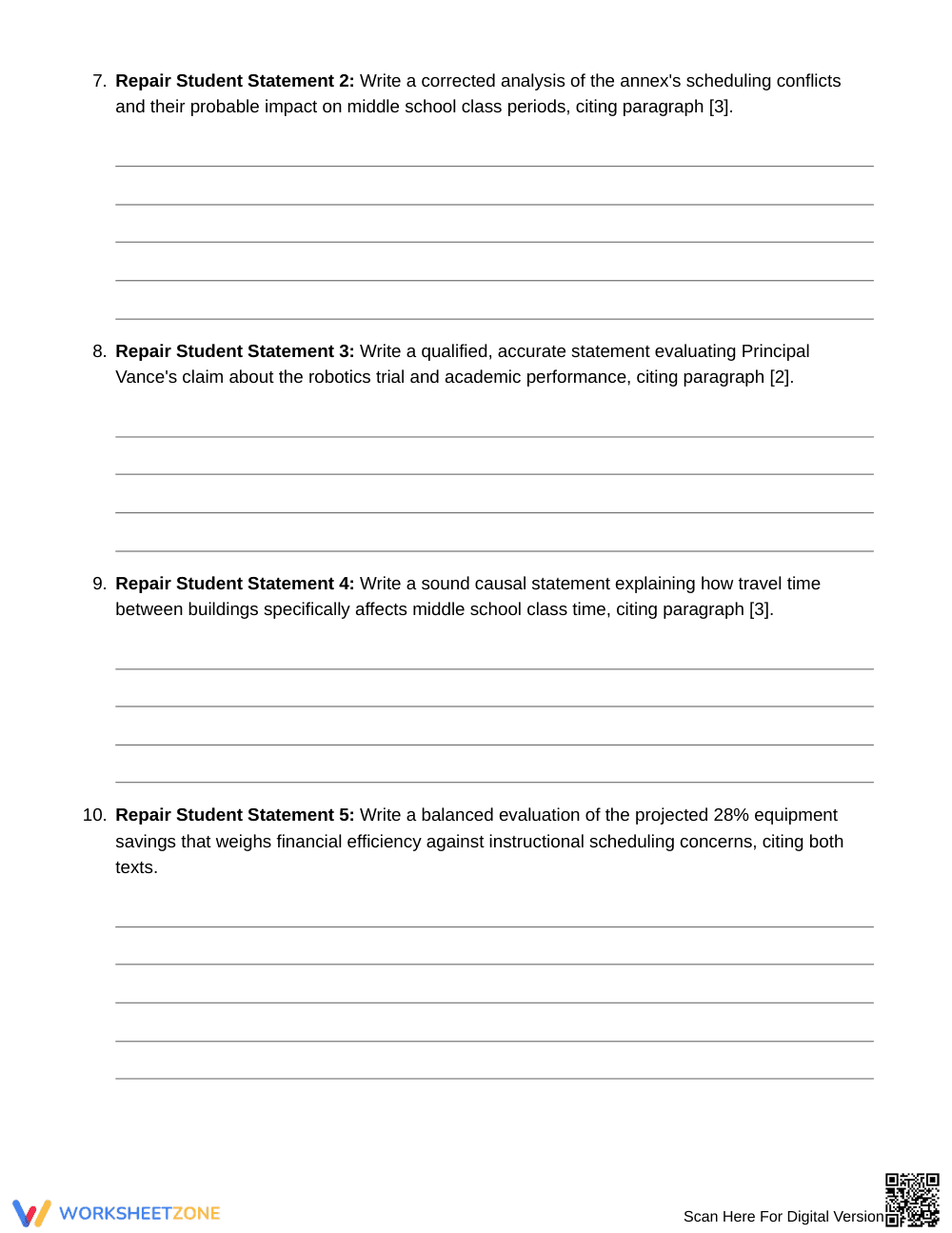
This 5-page packet presents a paired debate on a shared school technology initiative featuring statements from an administrator and a teacher. Students review core definitions and a modeled error repair before completing 10 analytical tasks across two sections, accompanied by a 2-page answer key with exemplar responses.
Skill Progression
- Guided practice (Anchor & Model): Students examine core fallacy definitions alongside a fully annotated error repair demonstrating how to diagnose and correct unsupported causal claims.
- Supported practice (Tasks 1–5): In Part A, learners evaluate five diagnostic claims, explaining logical breakdowns and extreme leaps across both texts in short-answer format.
- Independent practice (Tasks 6–10): In Part B, students independently rewrite each flawed claim into a qualified, evidence-supported statement citing specific paragraph evidence.
This sequence follows a gradual-release framework, moving learners from guided diagnostic critique to independent evidence-based revision.
Standards Alignment
This worksheet aligns to RI.8.8: Delineate and evaluate the argument and specific claims in a text, assessing whether reasoning is sound and evidence is relevant and sufficient. It also supports RI.8.1 through direct textual citation. Both standard codes can be copied directly into lesson plans, IEP goals, or district curriculum mapping tools.
How to Use It
Use this resource during the guided practice stage of an argument unit or as a post-instruction formative assessment. During Part A, observe whether students identify false causation or simply disagree with the author's opinion. Plan for 40 to 50 minutes of instructional time.
Who It's For
Designed for eighth-grade ELA classrooms, this practice also benefits high school intervention tiers and advanced seventh graders. The modeled repair provides necessary scaffolding for developing writers, while the paired texts offer authentic debate complexity. Pair this worksheet with an anchor chart on common logical fallacies.
Mastering standard RI.8.8 requires eighth-grade students to evaluate whether an author's reasoning is logically sound and supported by sufficient evidence, moving beyond simple factual recall to rigorous critical analysis. According to Fisher & Frey (2014), explicit instruction in error analysis and guided argumentative repair enables middle school students to deconstruct complex informational texts and identify logical fallacies such as faulty causation. By isolating student misconceptions in diagnostic exercises before requiring text-grounded revisions, educators create meaningful opportunities for metacognitive reflection and evidence synthesis. Research confirms that when learners actively dissect why a claim fails logically, their ability to produce sound, qualified claims in independent analytical writing increases significantly. This ten-task worksheet provides deliberate, structured practice in detecting unverified assumptions, evaluating competing perspectives, and constructing evidence-based claims, ensuring students achieve measurable mastery in critical reading and argumentative discourse.


