































Essential Butterfly Tools Word Search | Grades 6–7 ELA

Paste this activity's link or code into your existing LMS (Google Classroom, Canvas, Teams, Schoology, Moodle, etc.).
Students can open and work on the activity right away, with no student login required.
You'll still be able to track student progress and results from your teacher account.
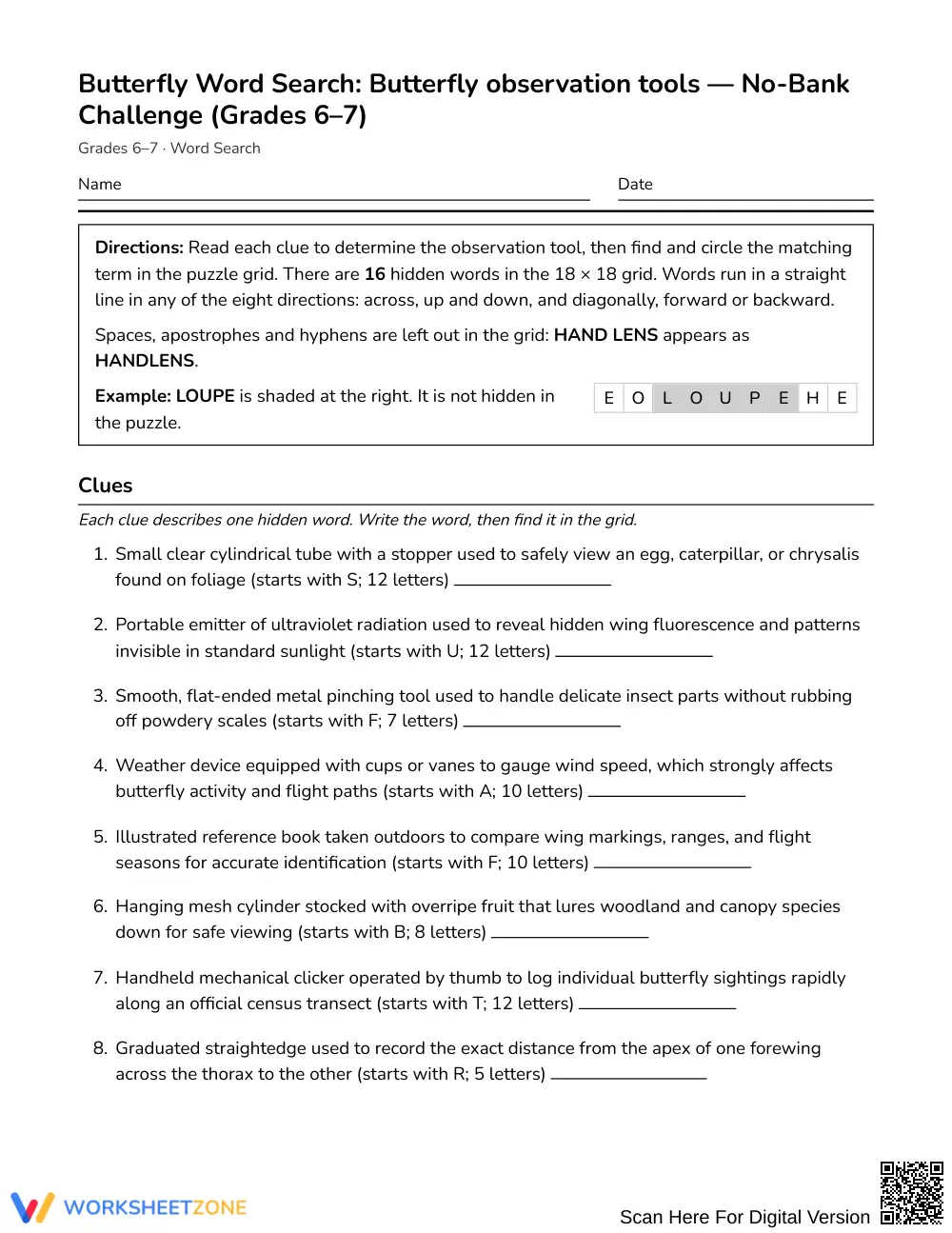
This butterfly observation tools word search expands middle school vocabulary by challenging students to identify specialized field instruments through descriptive context clues. Designed for Grades 6–7 English Language Arts, this activity requires learners to deduce terminology from scientific definitions before locating 16 terms in a dense puzzle grid.
At a Glance
- Grade: Grades 6–7 · Subject: English Language Arts (ELA)
- Standard: Not standards-assessed — vocabulary enrichment and domain-specific terminology
- Skill Focus: Identifying and spelling butterfly observation tools
- Format: 3 student pages · 16 hidden words · Full answer key included · Printable PDF
- Best For: Independent vocabulary enrichment, fast finishers, and cross-curricular science units
- Time: 25–35 minutes of focused puzzle work
What's Inside
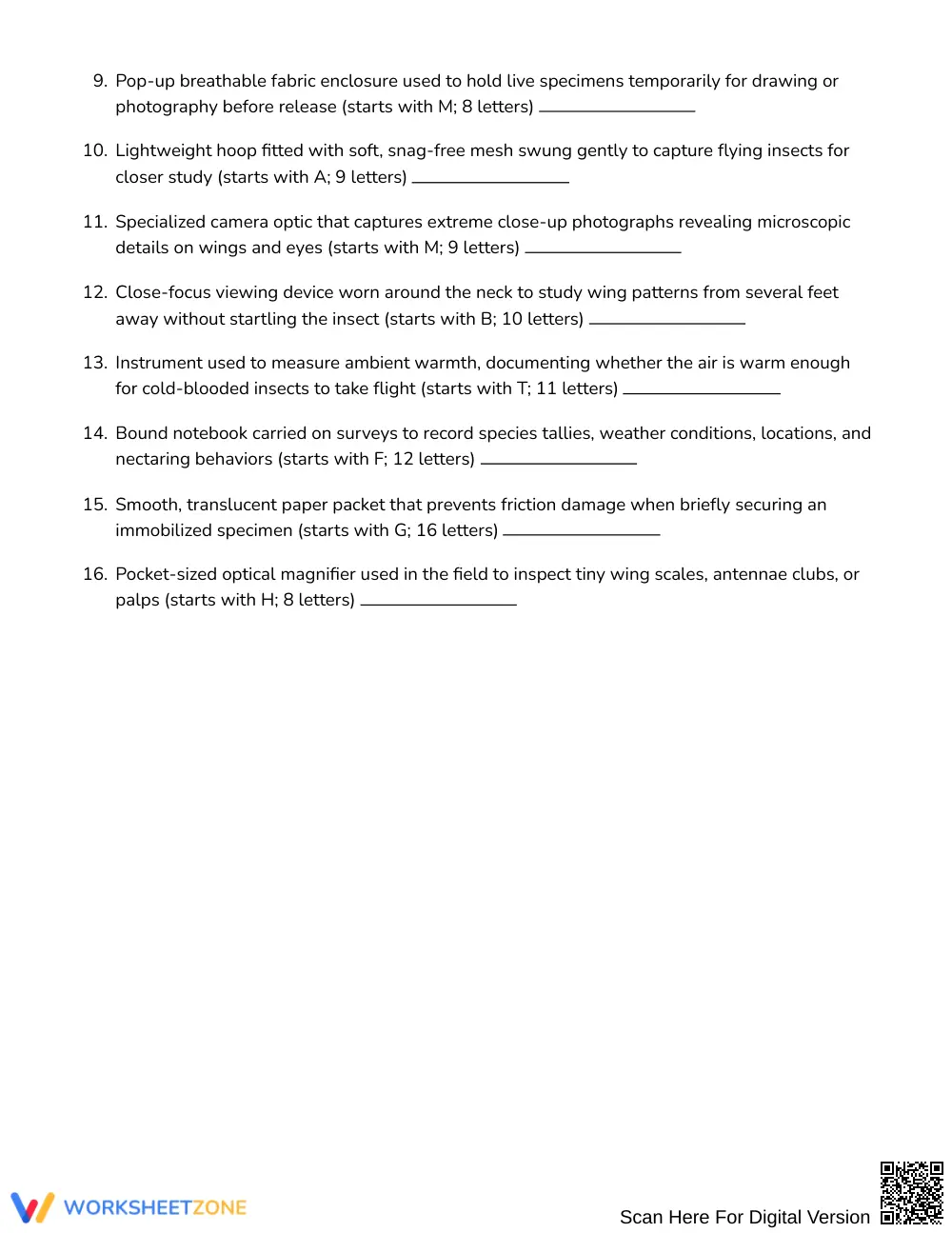
The 3-page printable set features an advanced word search built around 16 specialized terms related to lepidopterology and field research. Rather than providing an overt word bank, the activity supplies 16 detailed, clue-based definitions that require reading comprehension. A comprehensive 4-page answer key provides full letter coordinates and complete solutions for swift checking.
Puzzle Structure and Mechanics
This puzzle presents a challenging 18 x 18 letter grid containing 16 hidden terms. Words are placed in all eight possible compass directions: north, northeast, east, southeast, south, southwest, west, and northwest, including backward and diagonal configurations. Because no pre-listed word bank is supplied, students must actively interpret each scientific clue to identify the target term before scanning the grid.
Standards Alignment
This activity serves strictly as domain-specific vocabulary enrichment and is not aligned to a formal state standard. It enhances general academic and scientific literacy across middle school curricula by requiring students to connect rigorous descriptive definitions with authentic terminology used in biological fieldwork and entomological surveys.
How to Use It
Deploy this puzzle as an engaging introductory exercise prior to an informational reading unit on ecosystems, or assign it as an independent extension during stations. During work time, circulate to observe whether learners successfully infer instruments like anemometers or glassine envelopes from the clue descriptions before searching. Most students will finish the complete puzzle and clue matching within 25 to 35 minutes.
Who It's For
This resource is crafted for students in Grades 6–7 seeking engaging vocabulary practice and critical thinking challenges. It offers targeted enrichment for advanced readers and science enthusiasts who benefit from puzzle-based learning. Pair this word search naturally with an informational passage on pollinator conservation or a field guide reading lesson.
Domain-specific vocabulary acquisition functions as a primary driver of reading comprehension and cross-disciplinary literacy in middle school English Language Arts. According to Fisher & Frey (2014), intentional exposure to technical terminology within meaningful contexts directly strengthens students' ability to access complex informational texts and retain academic language across content areas. This 16-word butterfly observation tools word search targets vocabulary enrichment without reliance on isolated rote memorization. By eliminating the standard word bank and requiring learners to deduce terms from descriptive functional clues, the resource promotes active retrieval practice and morphological analysis. Students systematically connect authentic field research tools—such as aerial nets, glassine envelopes, and anemometers—to their precise scientific applications before engaging in visual search patterns across the grid. Consequently, the puzzle reinforces orthographic awareness, context-clue interpretation, and biological literacy, serving as an effective, low-stakes enrichment mechanism for intermediate learners developing comprehensive subject-area vocabularies.


