





























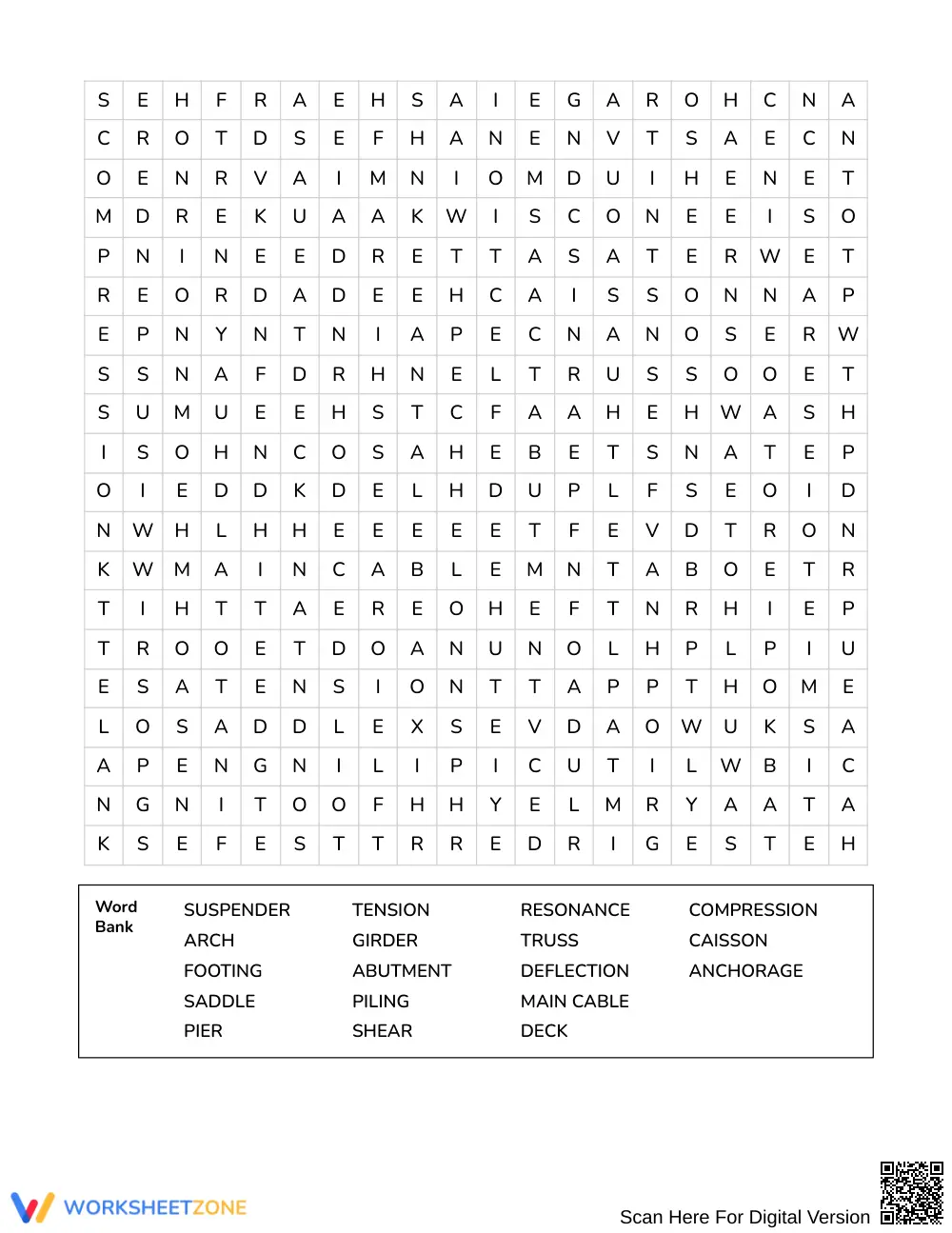


Essential Bridge Structure Word Search | Grades 7–8 ELA

Paste this activity's link or code into your existing LMS (Google Classroom, Canvas, Teams, Schoology, Moodle, etc.).
Students can open and work on the activity right away, with no student login required.
You'll still be able to track student progress and results from your teacher account.
Build domain-specific technical vocabulary with this engineering review word search designed for middle school classrooms. Students investigate core structural engineering principles by reading definitions and locating 18 essential bridge vocabulary words hidden in an engaging letter matrix. This activity reinforces content-area reading comprehension, technical literacy, and structural concepts across cross-curricular STEM and language arts units.
At a Glance
- Grade: Grades 7–8 · Subject: ELA
- Standard: Not standards-assessed — vocabulary enrichment
- Skill Focus: Bridge structure and engineering review
- Format: 3 pages · 18 words · Answer key included · PDF
- Best For: Cross-curricular STEM vocabulary review and fast-finisher enrichment
- Time: 25–35 minutes
What's Inside
This 3-page printable activity features a full-page word search puzzle paired with structured clues and a comprehensive answer key. Students reference 18 complete technical definitions covering bridge types, structural forces, and support elements—such as compression, tension, abutment, and truss—before locating each term within the letter grid. The included answer key highlights word placements for rapid grading.
Puzzle Structure
The puzzle features a dense 20 x 20 letter grid designed to challenge middle school students. Words run in all 8 possible directions: north, northeast, east, southeast, south, southwest, west, and northwest, including forward, backward, and diagonal orientations. Students read technical clues for all 18 words and reference a shuffled word bank to track their progress as they circle each term.
Standards Alignment
This activity serves as supplemental vocabulary enrichment and is not aligned to a specific state or national academic standard. It supports cross-disciplinary technical literacy by bridging physical science concepts with language arts vocabulary acquisition, helping students internalize complex informational text terminology.
How to Use It
Incorporate this activity after direct instruction on informational text structures or during an engineering unit review. For an interactive warm-up, have students identify the definition clue first before hunting for the matching vocabulary term. During independent seatwork, monitor whether students connect the physical definitions to structural bridge components. Expected completion time is 25 to 35 minutes.
Who It's For
This resource is crafted for Grades 7–8 students studying technical vocabulary, informational reading, or STEM topics. It accommodates diverse learners by providing explicit definitional clues alongside the letter grid, offering accessible support for striving readers. Pair this word search with an informational article on civil engineering or bridge construction blueprints.
Acquiring domain-specific vocabulary is essential for middle school reading comprehension across technical and informational texts. This Grades 7–8 bridge engineering review word search targets 18 core structural vocabulary terms through definitional clues and spatial puzzle solving. As highlighted by Fisher & Frey (2014), intentional exposure to technical terminology across content areas strengthens conceptual schema and reinforces long-term vocabulary retention. By reading functional engineering definitions before locating terms such as tension, resonance, and abutment in an eight-directional 20 x 20 grid, students deepen their contextual grasp of civil engineering concepts without relying on rote memorization. Designed as an unaligned supplemental vocabulary enrichment activity, this resource supports differentiated literacy blocks, sub plans, and cross-curricular STEM units. Teachers can evaluate foundational comprehension through student ability to match real-world bridge components with correct architectural terminology efficiently across standard middle school instructional timeframes.


