































Essential Blue Minerals Word Search | Grades 4–5 ELA

Paste this activity's link or code into your existing LMS (Google Classroom, Canvas, Teams, Schoology, Moodle, etc.).
Students can open and work on the activity right away, with no student login required.
You'll still be able to track student progress and results from your teacher account.
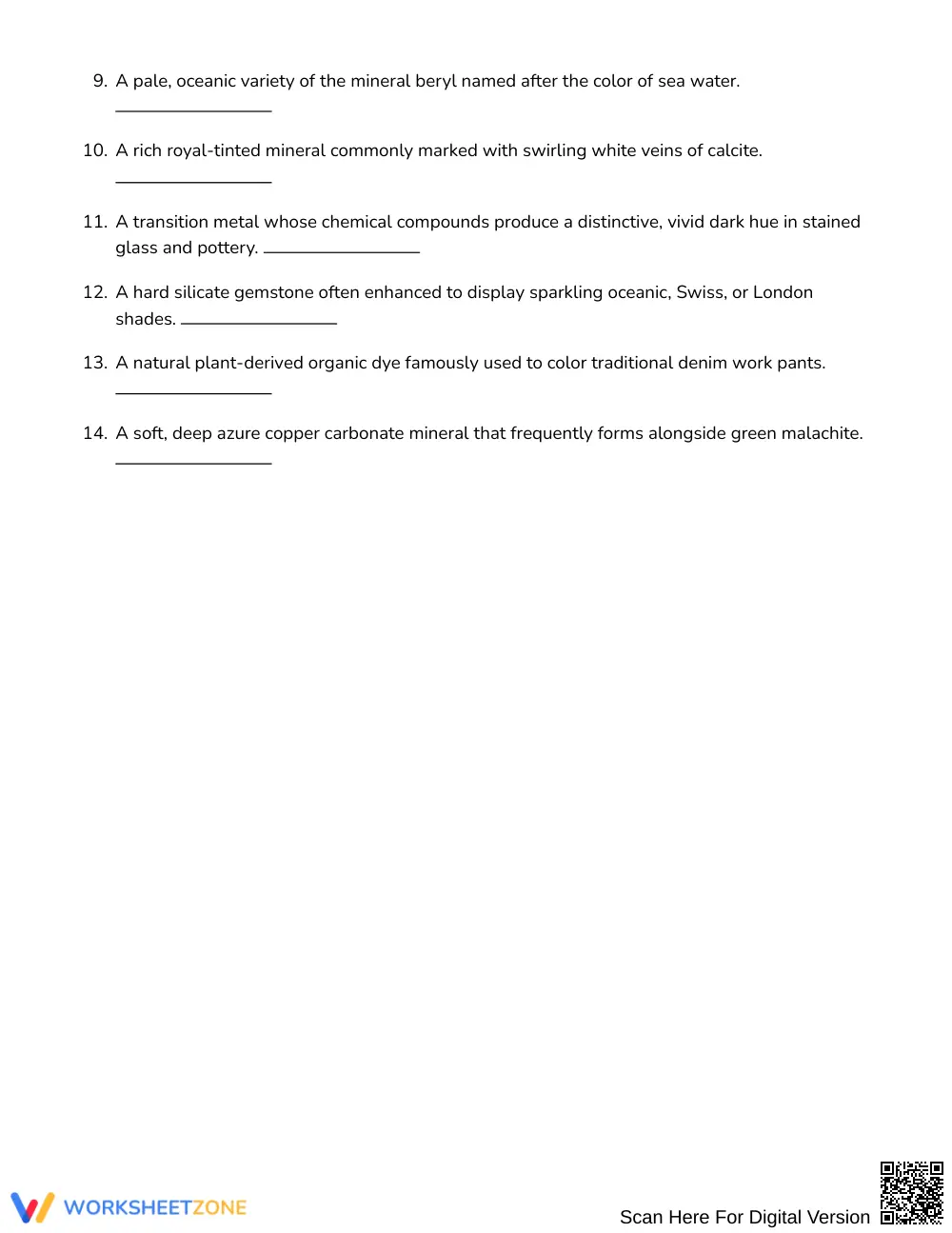
This vocabulary word search builds science and language arts terminology by engaging students with blue minerals and materials. Learners read 14 informative clues describing distinctive substances, such as lapis lazuli, azurite, and cobalt, and locate each target term within the grid to reinforce spelling, word recognition, and factual retention.
At a Glance
- Grade: Grades 4–5 upper elementary · Subject: English Language Arts (ELA)
- Standard: Not standards-assessed — vocabulary enrichment
- Skill Focus: Blue minerals, gemstones, pigments, and materials vocabulary
- Format: 3 pages · 14 words · Comprehensive answer key included · Printable PDF
- Best For: Independent vocabulary enrichment, cross-curricular science pairing, and early finishers
- Time: 20–30 minutes of focused word search practice
What's Inside
This 3-page printable activity features a Clue Detective word search containing 14 words hidden in the puzzle. Rather than relying on a basic word bank, the sheet challenges students to read descriptive science clues to deduce mystery terms before finding them. The resource includes a full 3-page answer key showing exact letter coordinates for rapid checking.
How the Puzzle Works
Students navigate a 16 x 16 letter grid designed to reinforce spatial awareness. Words are placed in four distinct directions: northeast (NE), east (E), southeast (SE), and south (S). To solve the puzzle, learners examine scientific clues to deduce each mineral, check their answers against a shuffled word bank, and trace the matching letter sequences.
Standards Alignment
This activity is designed specifically for vocabulary enrichment and is not aligned to a standard. It supports cross-disciplinary literacy by introducing upper elementary learners to domain-specific earth science and physical science terminology without standardized testing constraints.
How to Use It
Use this word search during an earth science unit after direct instruction on rocks and minerals to solidify terminology. Alternatively, assign it as a morning warm-up before introducing a cross-curricular reading lesson on ancient trade and pigments. For formative assessment, observe whether students identify minerals directly from clues or need the shuffled word bank. Most students finish within 20 to 30 minutes.
Who It's For
This resource is tailored for Grades 4–5 students who benefit from engaging vocabulary practice in language arts or science. For differentiated support, pair struggling readers with a partner to decode mineral names together, or provide highlighters to mark key clues. This activity pairs naturally with an informational geology reading passage or an anchor chart of mineral structures.
Word puzzle tasks reinforce domain-specific vocabulary acquisition by connecting contextual definitions to orthographic patterns. According to Fisher & Frey (2014), intentional word exposure embedded within engaging, structured literacy routines supports long-term vocabulary retention and conceptual understanding across content areas. This 3-page word search emphasizes blue minerals and materials vocabulary for Grades 4–5 learners without formal standards assessment constraints. By prompting students to deduce 14 specific geological terms—including azurite, celestine, and lapis lazuli—from informational clue descriptions before searching a 16 x 16 letter grid, the activity strengthens reading comprehension, orthographic mapping, and scientific terminology recognition. As highlighted by Fisher & Frey (2014), combining definition analysis with visual word identification facilitates deeper cognitive processing than passive rote memorization. Consequently, educators can utilize this targeted vocabulary puzzle to build student confidence and reinforce complex academic language during independent practice, small-group literacy centers, or cross-curricular science blocks.


