
































Essential Bathroom Objects Word Search | Grades 7–8 ELA

Paste this activity's link or code into your existing LMS (Google Classroom, Canvas, Teams, Schoology, Moodle, etc.).
Students can open and work on the activity right away, with no student login required.
You'll still be able to track student progress and results from your teacher account.
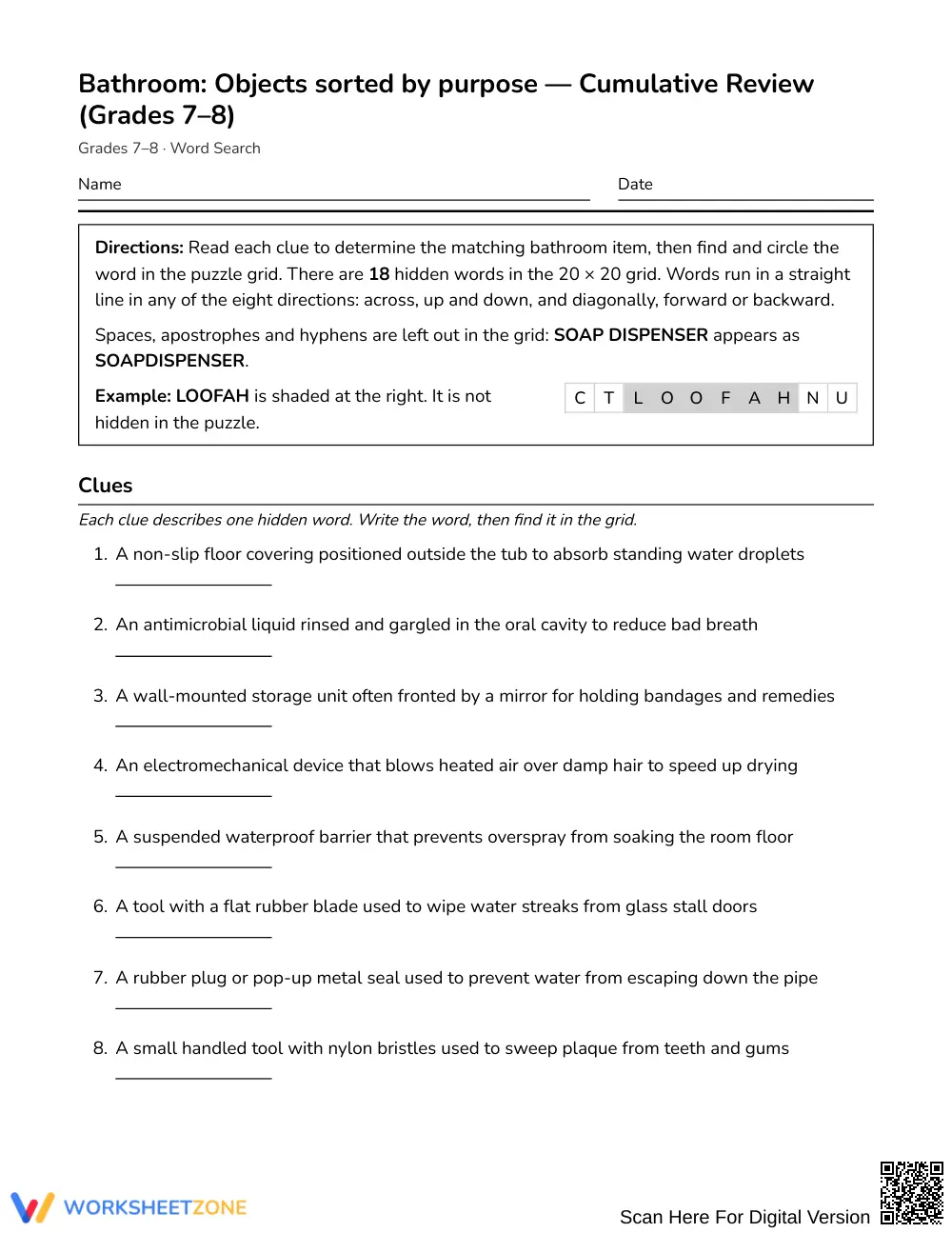
This Grades 7–8 vocabulary word search builds practical semantic knowledge by challenging students to identify 18 functional bathroom objects based on descriptive purpose clues. Learners analyze everyday tools and hygiene items, match each definition to precise terminology, and locate target vocabulary within an engaging, print-ready activity designed for immediate classroom application.
At a Glance
- Grade: Grades 7–8 · Subject: ELA
- Standard: Not standards-assessed — vocabulary enrichment
- Skill Focus: Objects sorted by purpose
- Format: 3 pages · 18 words · Answer key included · PDF
- Best For: Vocabulary review and fast-finisher practice
- Time: 20–30 minutes
What's Inside
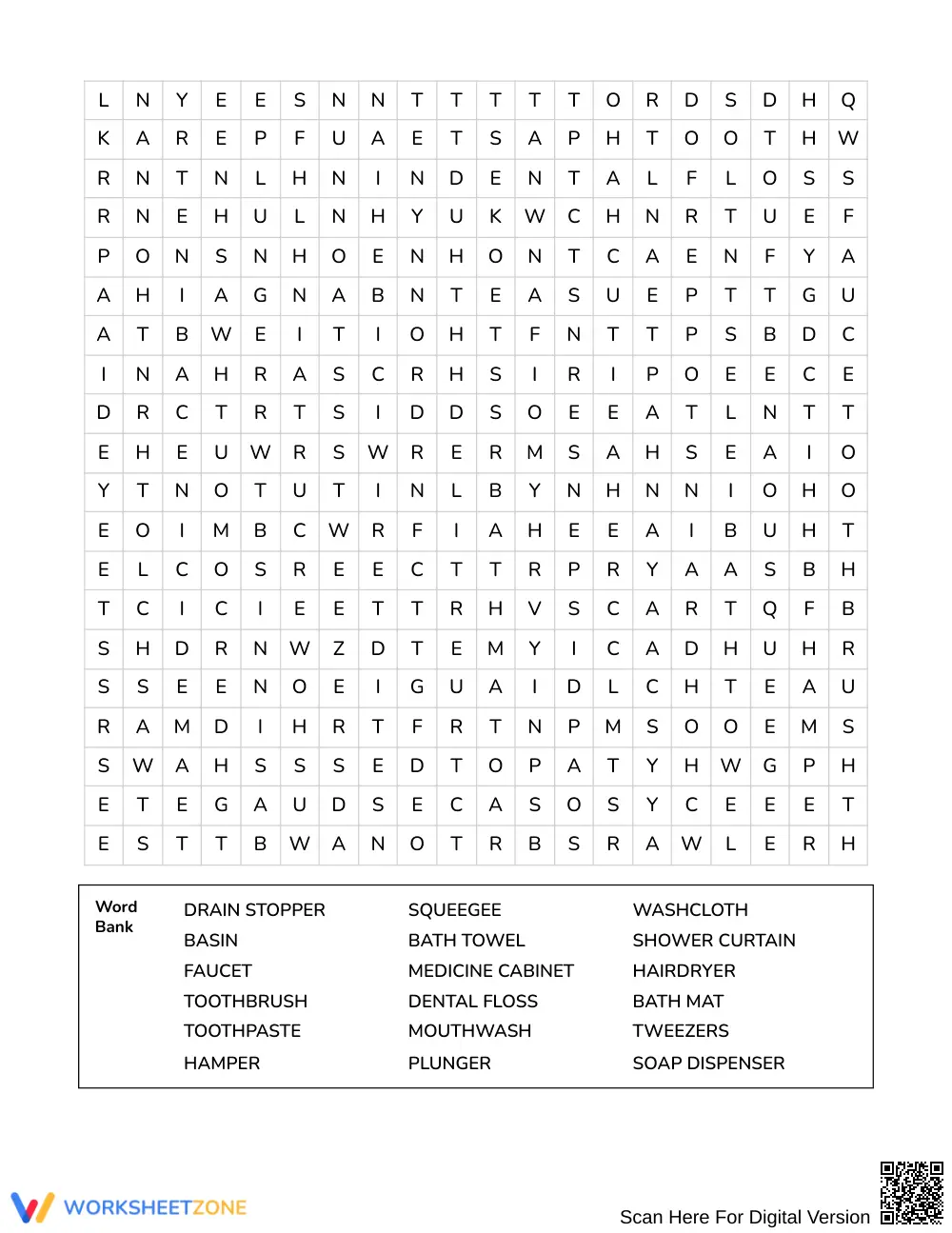
This 3-page printable activity delivers a comprehensive vocabulary challenge centered on household utility. Students read 18 functional definitions that describe objects by their operational purpose rather than simple physical traits. A comprehensive 4-page answer key provides clear visual solutions highlighting exact coordinates and orientations within the grid, enabling effortless grading and independent student self-checking.
Puzzle Mechanics and Structure
The activity centers on an expansive 20 by 20 letter grid designed to reinforce orthographic recall. Words run in all 8 compass directions: north, northeast, east, southeast, south, southwest, west, and northwest. Students work from a shuffled list of clues that define appliances, textiles, and hygiene fixtures, requiring learners to solve each clue before scanning the letter field.
Standards Alignment
This learning resource serves as general vocabulary enrichment and is not aligned to an assessed educational standard. It supports cross-curricular literacy by expanding functional domain knowledge, strengthening contextual decoding, and prompting students to connect concrete household nouns with their mechanical and hygienic functions across middle school language arts instruction.
How to Use It
Deploy this word search during independent seatwork following direct instruction on functional definitions, or assign it as an engaging warm-up activity. During completion, circulate to observe whether students solve definitions before searching or rely solely on letter scanning. Most learners complete the full 18-word puzzle within 20 to 30 minutes.
Who It's For
This activity is designed for Grades 7–8 English Language Arts students mastering precise functional terminology, including English learners building practical domestic vocabulary. Pair this printable puzzle directly with an informational passage on sanitation history or an anchor chart highlighting root words in plumbing and hygiene technology to reinforce conceptual retention.
Contextual vocabulary enrichment strengthens reading comprehension by connecting functional descriptions to precise terminology. According to Fisher & Frey (2014), intentional exposure to domain-specific words through structured contextual clues accelerates language acquisition and cognitive retention in adolescent learners. By requiring students to analyze descriptive definitions rather than simple word lists, this activity transforms traditional word searches into active semantic processing tasks. Learners must evaluate functional phrases—such as mechanical flow regulation or antimicrobial rinses—and link those operations to target nouns like faucet and mouthwash. This dual-step process of clue interpretation and orthographic retrieval bolsters morphological awareness and semantic mapping across middle school grade bands. Integrating purpose-driven sorting tasks into recurring classroom routines provides low-stakes, high-utility reinforcement that supports independent literacy development, academic discourse, and general contextual understanding across diverse secondary English language arts learning environments.


