




























Views
Downloads


Essential Basic Integration Worksheet | Grade 12 Calculus

Paste this activity's link or code into your existing LMS (Google Classroom, Canvas, Teams, Schoology, Moodle, etc.).
Students can open and work on the activity right away, with no student login required.
You'll still be able to track student progress and results from your teacher account.
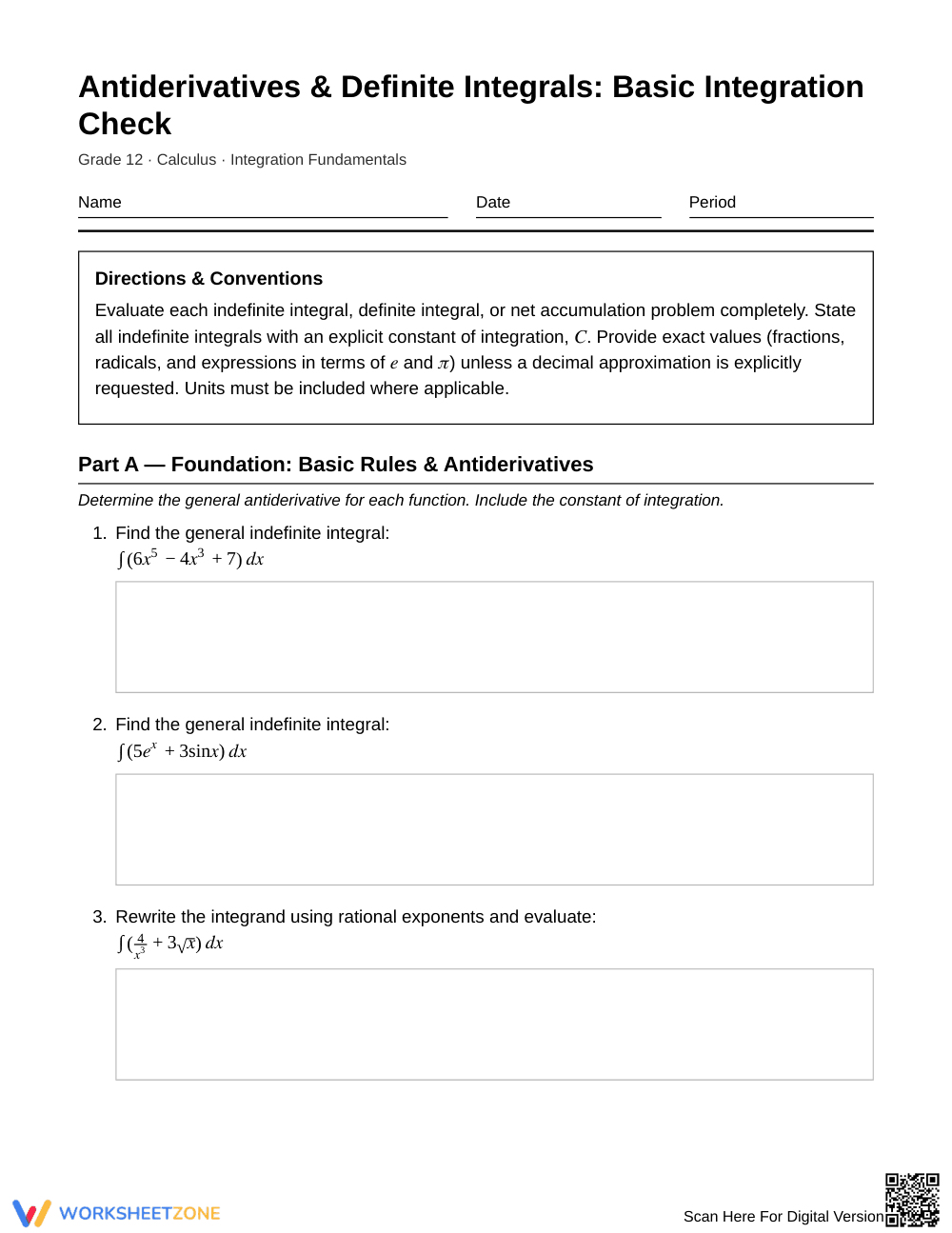
This Grade 12 calculus worksheet equips students to master fundamental antiderivatives and definite integral evaluations across 16 rigorous problems. Students progress from basic algebraic and trigonometric antiderivative rules to multi-step accumulation applications, solidifying computational fluency and conceptual understanding of net change under the Fundamental Theorem of Calculus.
At a Glance
- Grade: 12 · Subject: High School Calculus
- Standard: Calculus Integration Core — Apply indefinite antiderivative rules and evaluate definite integrals to determine accumulation
- Skill Focus: Basic Integration Check and Accumulation
- Format: 5 pages · 16 problems · Complete step-by-step answer key included · Printable PDF
- Best For: Post-instruction skill mastery and cumulative unit review
- Time: 45–60 minutes
What's Inside
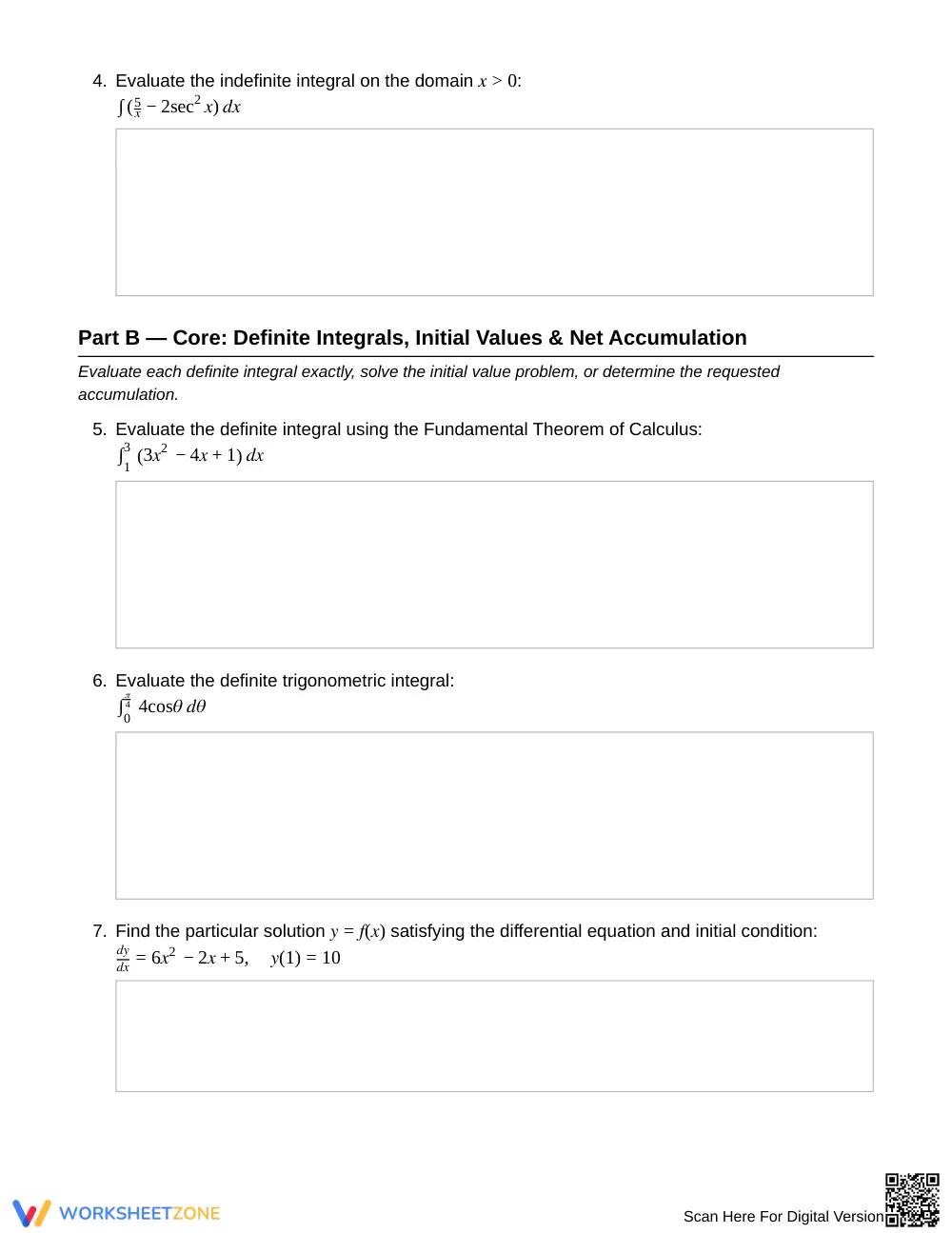
This 5-page resource presents 16 problems structured into three parts. Part A reviews indefinite integrals with power, exponential, and trigonometric terms. Part B features definite integrals, initial value problems, and real-world net change. Part C challenges students with absolute value integrals, piecewise functions, and kinematic accumulation. A complete 5-page answer key provides step-by-step solutions.
Skill Progression
- Guided practice: Part A offers 4 foundational problems reinforcing basic polynomial, trigonometric, and exponential antiderivative rules with constant of integration reminders.
- Supported practice: Part B presents 8 core problems applying the Fundamental Theorem of Calculus to definite integrals, initial values, and rate accumulation contexts.
- Independent practice: Part C delivers 4 complex problems requiring piecewise splitting, absolute value integration, and double-integration rectilinear kinematics.
This structure implements a gradual-release instructional model that moves students from foundational computation to independent contextual analysis.
Standards Alignment
This worksheet aligns with high school calculus curriculum standards for Antiderivatives and Definite Integrals. Students determine general antiderivatives, solve differential equations using initial conditions, and evaluate definite integrals to calculate net change. Supporting standards include algebraic integrand manipulation and piecewise integration. Both standard codes can be copied directly into lesson plans, IEP goals, or district curriculum mapping tools.
How to Use It
Deploy this worksheet after direct instruction on the Fundamental Theorem of Calculus as an in-class summative checkpoint or targeted homework review. During seatwork, observe whether students remember to evaluate boundary split points on piecewise and absolute value problems. Expected completion time is 45 to 60 minutes.
Who It's For
This practice set is built for Grade 12 calculus students mastering integration techniques. For differentiation, assign Parts A and B for foundational support before tackling Part C. Pair this document with an antiderivative rules anchor chart during initial review.
Grounded in calculus integration standards, this comprehensive Grade 12 worksheet provides structured practice evaluating indefinite and definite integrals, solving initial value differential equations, and calculating net physical accumulation. As established by Fisher & Frey (2014) in their foundational framework for guided learning, structured scaffolding that transitions intentionally from direct rule execution to complex, unassisted multi-step problem solving significantly bolsters long-term conceptual retention and mathematical fluency. Across 16 carefully sequenced tasks, students practice applying polynomial, exponential, trigonometric, and rational power integration rules, implementing the Fundamental Theorem of Calculus, and resolving continuous piecewise boundary conditions. By connecting analytical antidifferentiation techniques directly to concrete particle kinematics and fluid rate models, the resource reinforces net change interpretation while equipping high school learners with essential tools for advanced STEM coursework. The complete 5-page instructional set includes a detailed answer key that supports independent study, peer collaboration, and targeted formative assessment.


