




























Essential Baseball Drills Word Search | Grades 6–7 ELA
Paste this activity's link or code into your existing LMS (Google Classroom, Canvas, Teams, Schoology, Moodle, etc.).
Students can open and work on the activity right away, with no student login required.
You'll still be able to track student progress and results from your teacher account.
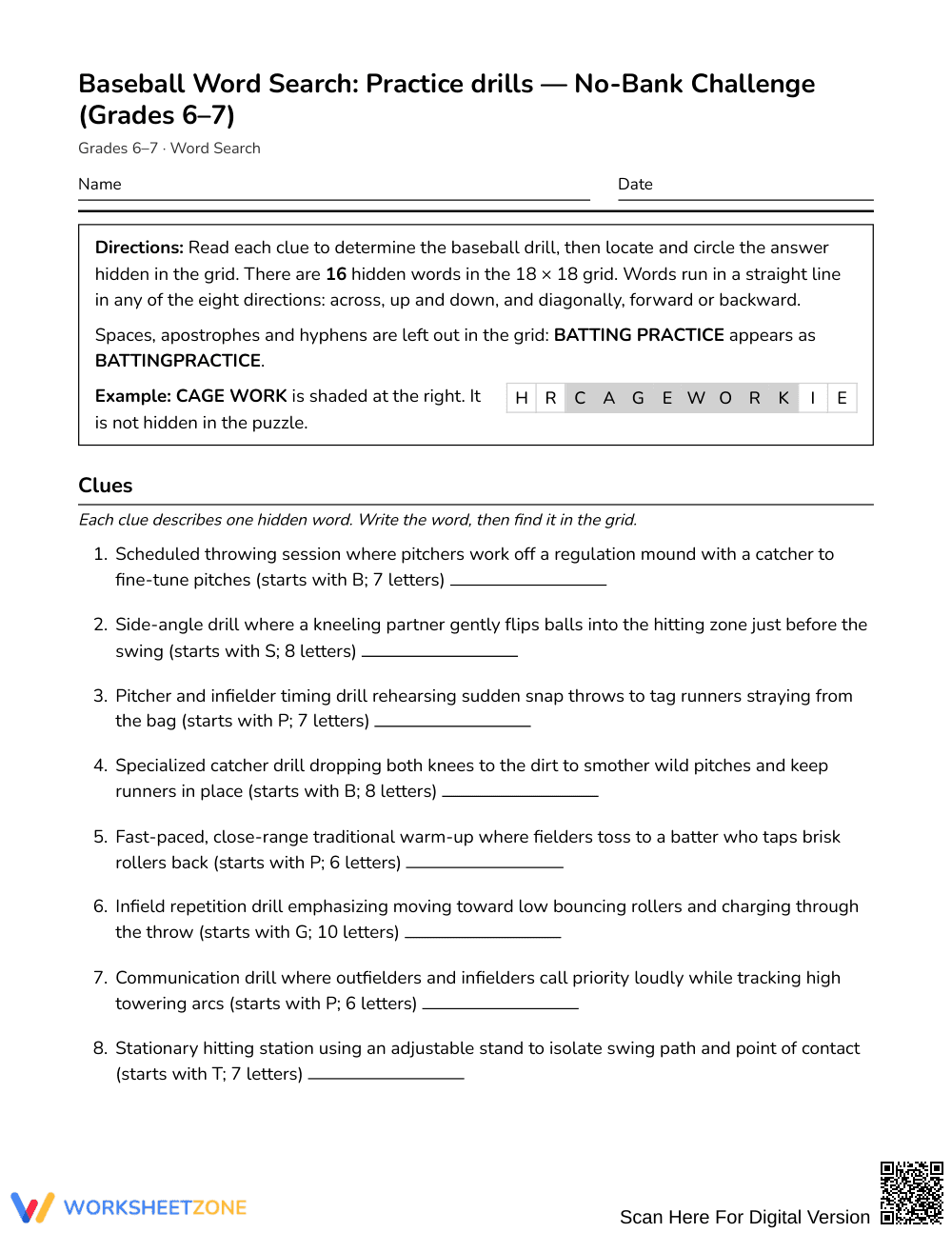
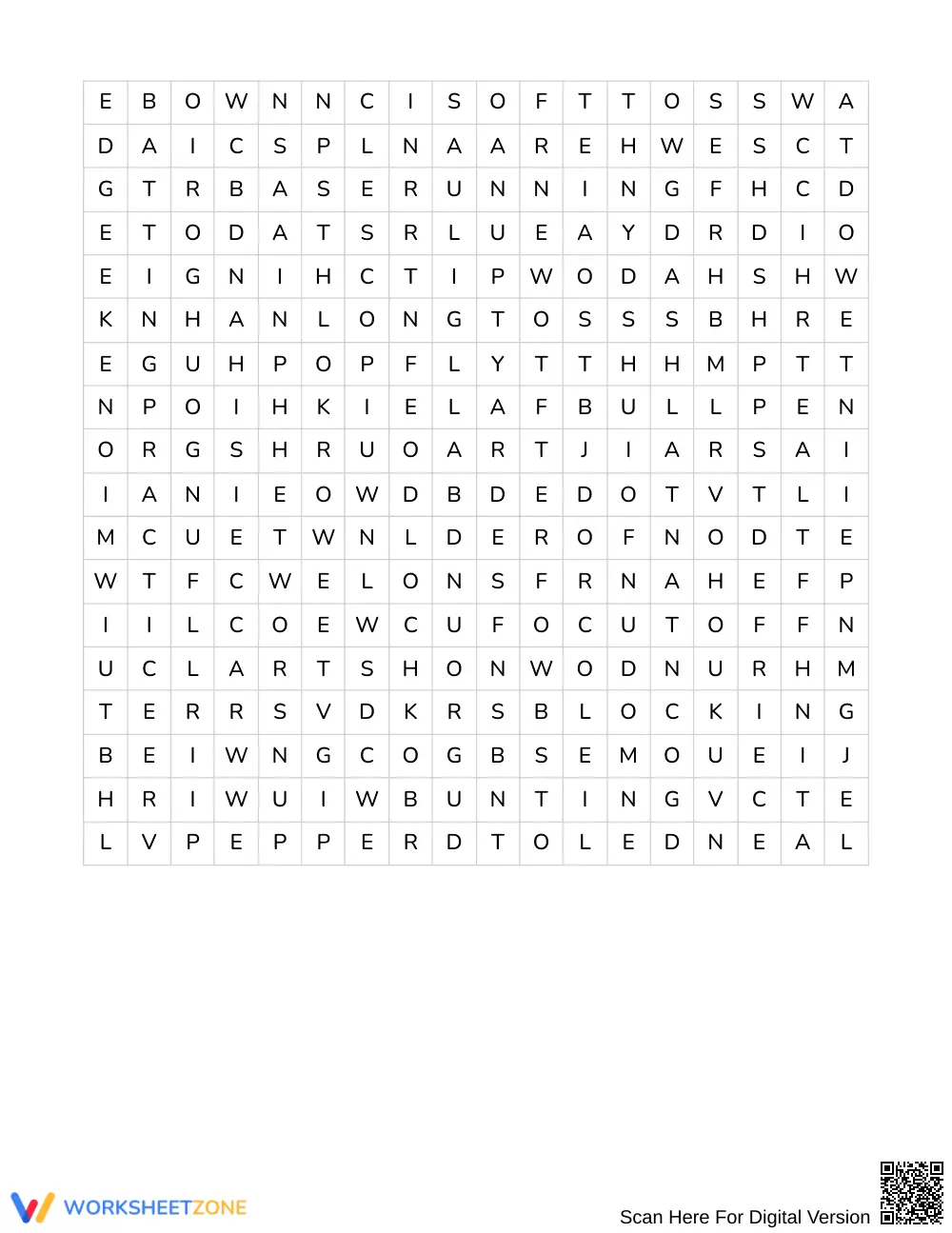
This baseball practice drills word search reinforces sports vocabulary for students in Grades 6–7. Learners define 16 sport-specific concepts using clues before finding the hidden terms within an 18 x 18 grid. The activity strengthens domain-specific terminology, active recall, and pattern recognition during ELA vocabulary units.
At a Glance
- Grade: Grades 6–7 · Subject: English Language Arts (ELA)
- Standard: Not standards-assessed — vocabulary enrichment
- Skill Focus: Baseball practice drills and athletic terminology
- Format: 3 pages · 16 words · 4-page answer key included · PDF
- Best For: Vocabulary enrichment, independent stations, and early finishers
- Time: 25–35 minutes of focused student work
This 3-page printable resource includes an 18 x 18 letter grid alongside 16 clue-based terminology prompts without a word bank. Students analyze descriptive athletic clues—covering drills such as batting practice, soft toss, and rundowns—to identify each target term. A complete 4-page answer key provides coordinate-level solutions for efficient grading or student self-checking.
Puzzle Structure and Mechanics
This vocabulary search uses specific puzzle parameters to support orthographic scanning and recall:
- Grid Dimensions: An 18 x 18 letter matrix provides 324 positions for hidden terms.
- Directional Complexity: Words run in all 8 directions: N, NE, E, SE, S, SW, W, and NW, including forward, backward, and diagonal lines.
- Clue-Driven Format: The puzzle omits a word bank; learners read 16 definitional clues to deduce drill names before searching.
Standards Alignment
This resource serves as vocabulary enrichment and is not aligned to a specific academic standard. It reinforces domain-specific terminology by requiring students to match athletic concepts to functional definitions. Teachers can integrate these materials into sports literature units, cross-curricular physical education studies, or informational reading exercises without tracking formal benchmark codes.
How to Use It
Assign this activity after direct instruction on context clues or informational sports texts. In an independent learning station, students spend 25 to 35 minutes reading drill descriptions and circling identified terms. Alternatively, use it as a collaborative partner warm-up during non-fiction reading units. For formative assessment, check whether students solve the clues before searching, identifying any misunderstandings of technical terms like fungo or pepper.
Who It's For
This word search is designed for Grades 6–7 students who benefit from engaging vocabulary practice. For struggling readers requiring differentiation, offer a personal terminology glossary or allow peer discussion. The activity pairs effectively with informational articles on athletic training, baseball memoirs, or lessons addressing tier-three vocabulary in informational texts.
Domain-specific vocabulary acquisition relies on multiple encounters with technical terms in diverse contexts. According to Fisher & Frey (2014), intentional word study that connects conceptual definitions with active orthographic processing deepens semantic comprehension and enhances long-term retention. This printable baseball practice drills word search prompts middle school learners to retrieve 16 specialized athletic terms—including technical drill procedures like fungo, bullpen, and rundown—directly from descriptive functional clues rather than passive word lists. Eliminating the conventional word bank transforms a standard leisure puzzle into an active retrieval task that exercises morphological awareness and contextual deduction. By scanning an 18 x 18 grid across eight directional paths, students sustain cognitive focus while establishing stable mental representations of athletic jargon. This focused vocabulary enrichment activity offers an evidence-aligned mechanism for reinforcing tier-three sports terminology during middle grade English language arts coursework.


