


























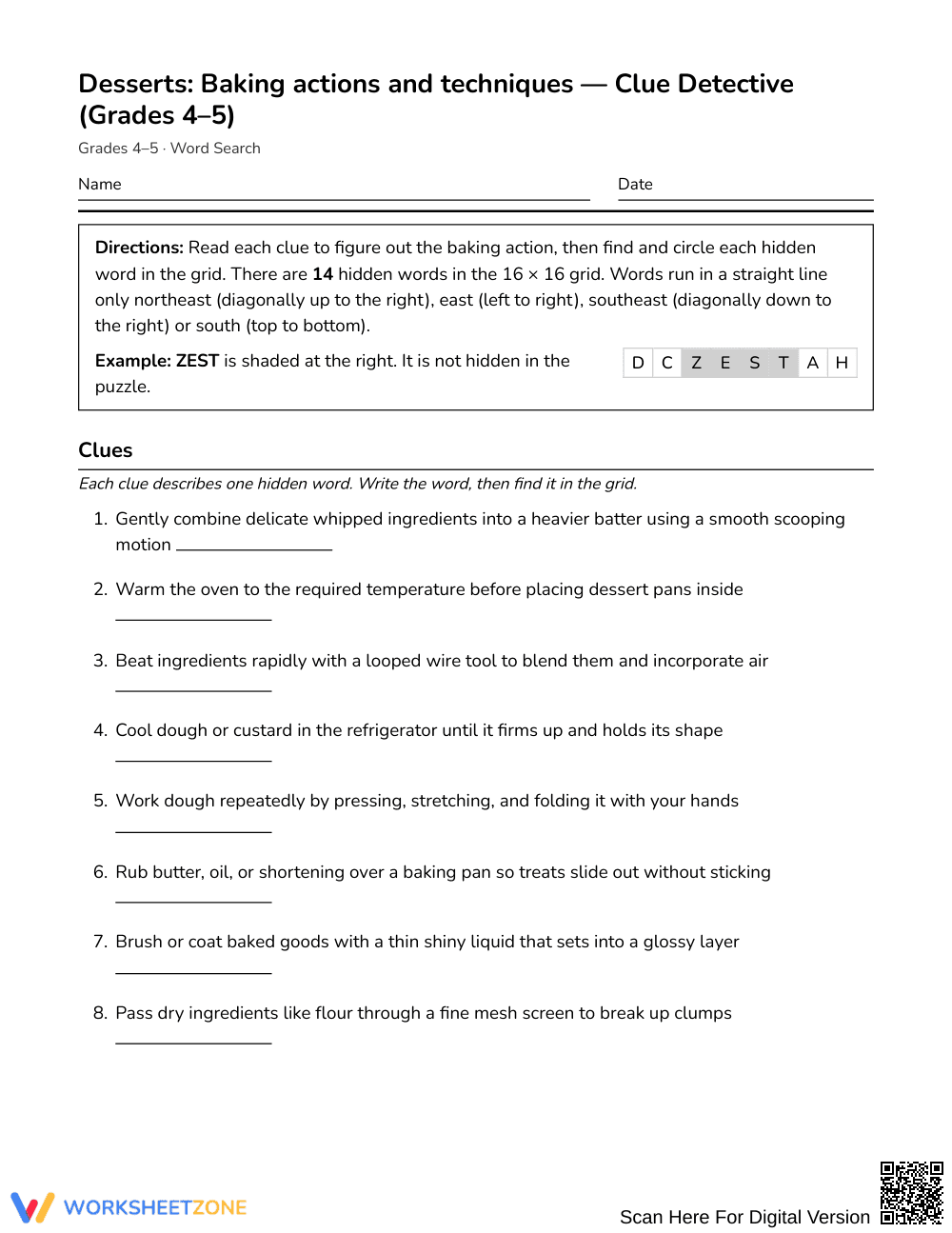


Essential Baking Actions Word Search | Grades 4–5 ELA
Paste this activity's link or code into your existing LMS (Google Classroom, Canvas, Teams, Schoology, Moodle, etc.).
Students can open and work on the activity right away, with no student login required.
You'll still be able to track student progress and results from your teacher account.
This Grades 4–5 vocabulary word search builds culinary knowledge by challenging students to connect baking actions with descriptive definitions. Learners read clues for 14 target verbs—including whisk, knead, fold, and preheat—before locating each term within a letter grid. The activity reinforces precise procedural language, helps pupils retain domain-specific verbs, and sharpens analytical reading habits.
At a Glance
- Grade: Grades 4–5 · Subject: English Language Arts (ELA)
- Standard: Not standards-assessed — vocabulary enrichment and culinary context
- Skill Focus: Culinary baking actions and descriptive culinary techniques
- Format: 3 pages · 14 words · Full answer key included · Printable PDF
- Best For: Independent vocabulary stations, early finishers, and culinary enrichment
- Time: 20–30 minutes
What's Inside
This 3-page printable activity features a Clue Detective word search designed to deepen culinary comprehension. Students work through 14 contextual clues describing authentic culinary methods, such as beating ingredients rapidly, sifting dry flour, and piping frosting. A shuffled word bank appears alongside the clues, prompting learners to identify actions before searching. A 3-page answer key provides clear solution grids, allowing for quick peer verification or rapid teacher grading.
Puzzle Structure and Mechanics
The activity centers on a 16 x 16 letter grid containing 14 hidden dessert preparation terms. Words run in four distinct directions: northeast (NE), east (E), southeast (SE), and south (S). Rather than copying a list, students read clues, deduce the matching action verb from the shuffled word bank, and locate each term. This directional variety trains visual scanning and reinforces orthographic memory without using backward placements.
Standards Alignment
This activity serves as vocabulary enrichment and is not aligned to a specific grade-level standard. It supports cross-curricular literacy by introducing specialized terminology found in culinary arts, technical procedures, and informational recipe texts.
How to Use It
Deploy this puzzle during independent reading rotations or after direct instruction on procedural writing. Before searching, have students read clues with a partner and identify corresponding terms. As a formative assessment observation tip, check whether learners solve the clues first or scan for letters haphazardly; this reveals whether they understand verbs like fold and drizzle. Completion typically takes 20 to 30 minutes.
Who It's For
This resource is crafted for Grades 4–5 learners acquiring tier-two and tier-three vocabulary. For students needing support, have them highlight target verbs in the word bank before inspecting the grid. Pair this activity with an authentic informational recipe or procedural passage to see these action verbs applied in real-world contexts.
Targeted vocabulary enrichment enables upper-elementary students to bridge everyday speaking with domain-specific technical terminology. Research by Fisher & Frey (2014) demonstrates that intentional exposure to specialized action verbs accelerates content comprehension, particularly when definitions are actively paired with contextual problem-solving tasks. Rather than memorizing isolated terms, learners who analyze descriptive clues for cooking actions like kneading, sifting, and creaming internalize how procedural verbs function in informational texts. Incorporating structured word puzzles within intermediate English language arts provides repeated retrieval opportunities, strengthening spelling accuracy and semantic recognition. This clue-based word search supports intentional vocabulary growth across 14 focused terms without requiring complex testing apparatus. By engaging students in meaningful clue deciphering and directional visual scanning, educators foster lexical precision and reading confidence across diverse classroom settings, validating word exploration as a proven component of balanced literacy instruction.


