

































Essential Argument Revision Worksheet | Grade 10 English II

Paste this activity's link or code into your existing LMS (Google Classroom, Canvas, Teams, Schoology, Moodle, etc.).
Students can open and work on the activity right away, with no student login required.
You'll still be able to track student progress and results from your teacher account.
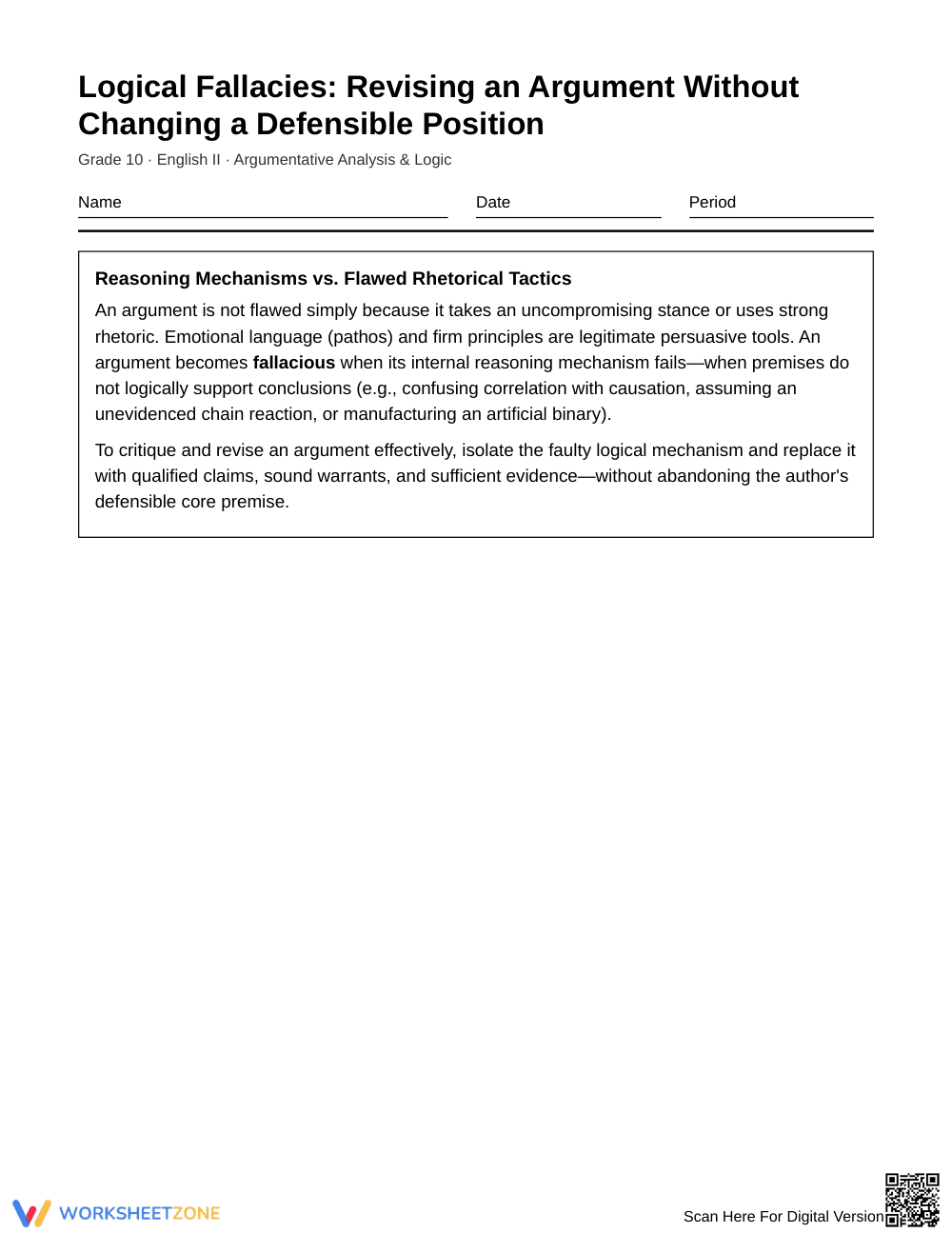
This Grade 10 English II worksheet teaches students how to critique fallacious reasoning and revise flawed arguments while preserving valid core claims. By analyzing paired texts on school eligibility policies, learners isolate faulty mechanisms—including slippery slopes and false dilemmas—and replace them with qualified, evidence-based warrants.
At a Glance
- Grade: 10 · Subject: English II
- Standard:
RI.9-10.8— Delineate and evaluate argument reasoning, claims, and fallacies in text- Skill Focus: Revise an argument without changing a defensible position
- Format: 6 pages · 8 problems · 3-page answer key included · PDF
- Best For: High school rhetoric units and argumentative writing remediation
- Time: 45–60 minutes
What's Inside
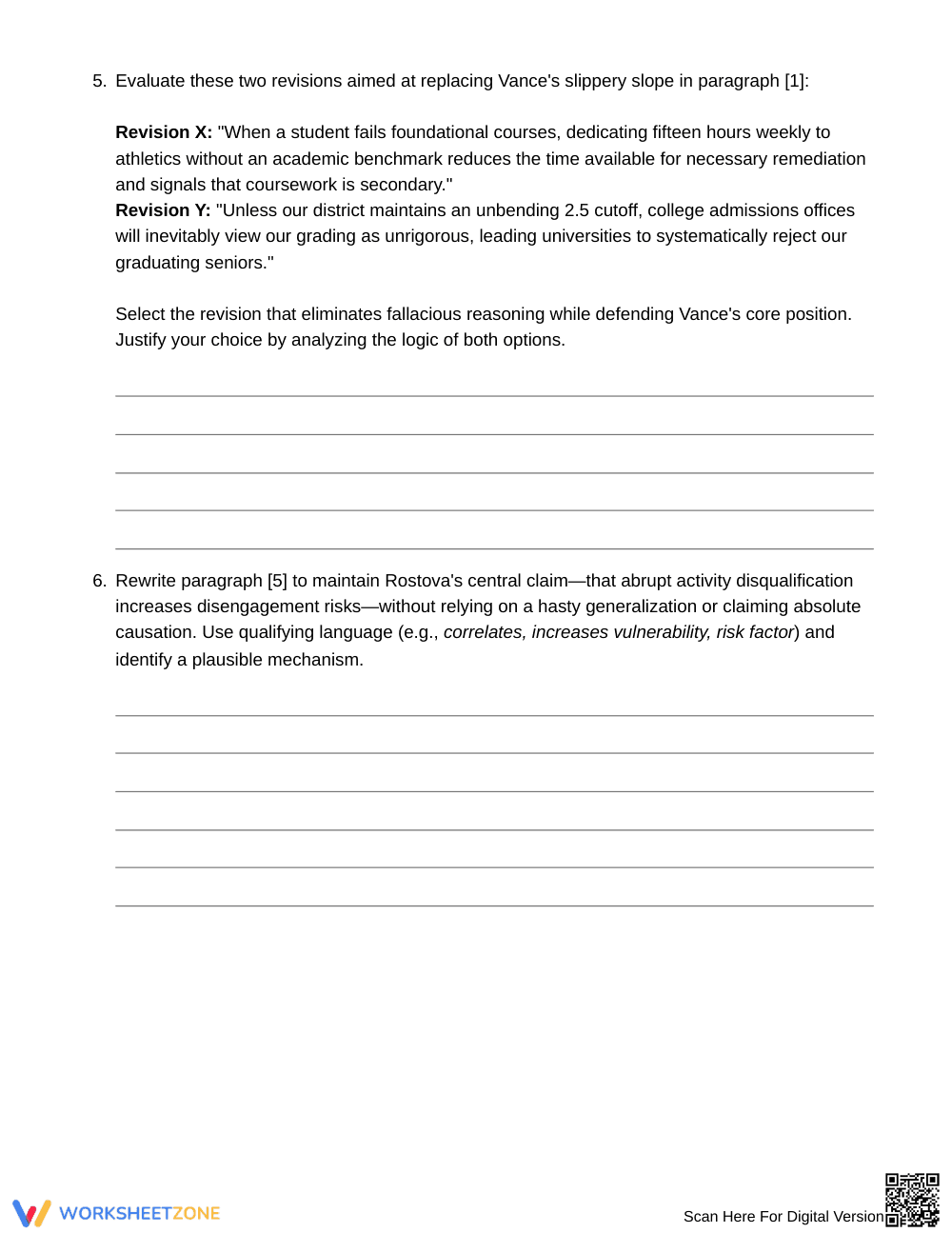
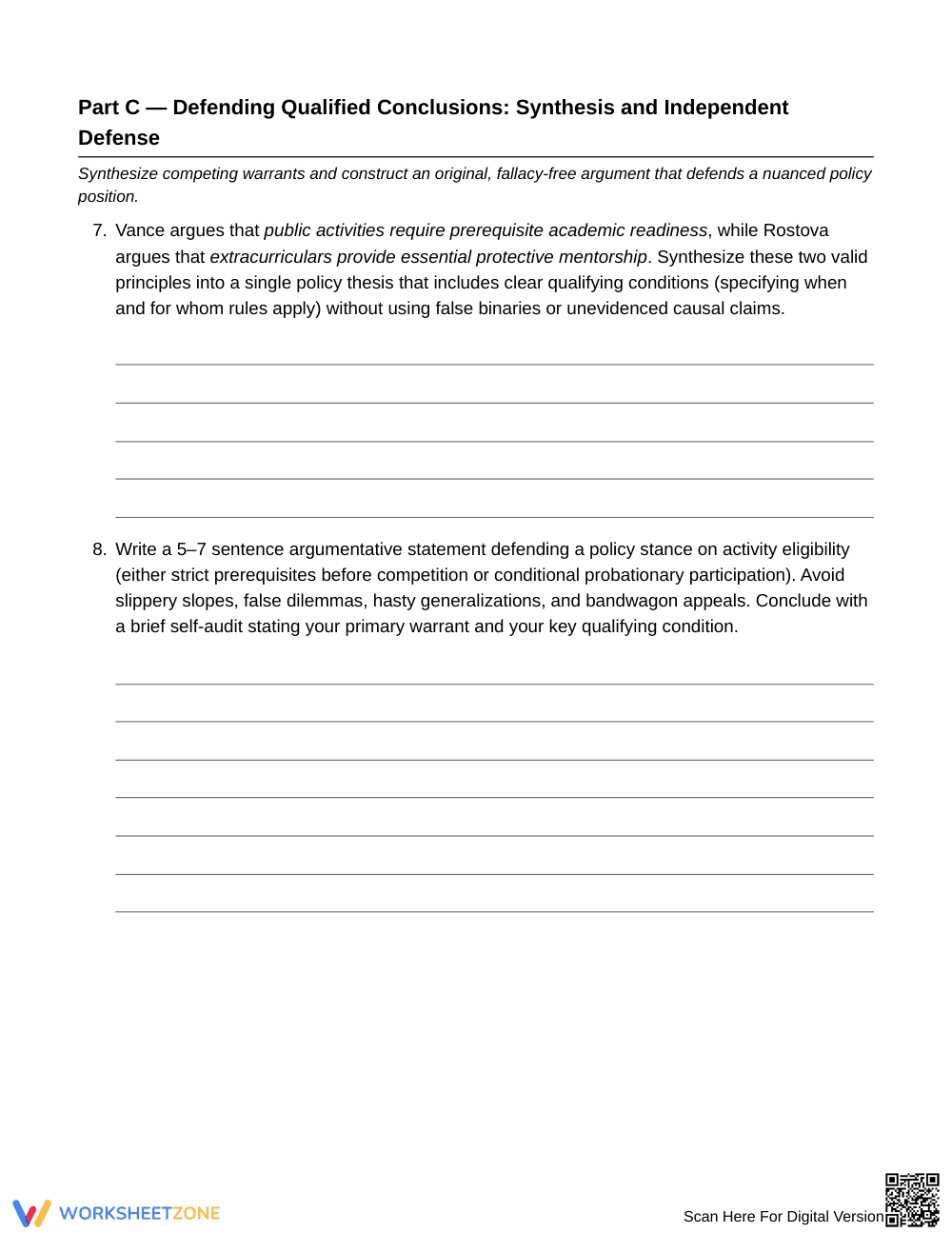
This 6-page printable resource features two point-counterpoint texts, eight scaffolded tasks, and a full 3-page answer key with exemplar responses. Students analyze logical breakdowns, evaluate revision options, and rewrite arguments using qualifying language.
Skill Progression
- Guided Practice (Part A — 2 tasks): Students identify fallacies across texts—including correlation-causation errors, slippery slopes, and hasty generalizations—while extracting defensible underlying claims.
- Supported Practice (Part B — 4 tasks): Learners evaluate alternative policy options, distinguish emotional resonance from appeals to pity, select valid revisions, and rewrite paragraphs with qualifiers.
- Independent Practice (Part C — 2 tasks): Students synthesize opposing warrants into a qualified policy thesis and write an independent defense with a warrant self-audit.
This gradual-release progression moves tenth graders from diagnosing logical flaws to crafting defensible arguments.
Standards Alignment
This worksheet directly aligns to RI.9-10.8: Delineate and evaluate the argument and specific claims in a text, assessing whether the reasoning is valid and evidence is relevant and sufficient. It also supports W.9-10.1 through argument synthesis and precise qualification. Both standard codes can be copied directly into lesson plans, IEP goals, or district curriculum mapping tools.
How to Use It
Administer this worksheet after direct instruction on logical fallacies or as a mid-unit formative check before essay drafting. During practice, check whether students preserve the author's defensible stance in Part B rather than reversing it. Total completion time is 45 to 60 minutes.
Who It's For
This resource is designed for Grade 10 English II students mastering argumentative logic. Differentiate by offering sentence frames for Part C synthesis or having students complete Part B in pairs. It pairs naturally with argumentative mentor texts and rhetorical analysis lessons.
According to research by Fisher & Frey (2014) on the gradual release of responsibility, scaffolded argumentative analysis significantly improves secondary students' ability to transfer logical reasoning into independent expository writing. This Grade 10 English II worksheet provides direct alignment to standard RI.9-10.8 by guiding learners to evaluate faulty reasoning mechanisms—such as hasty generalizations, false dilemmas, and slippery slopes—without abandoning defensible core claims. Through an 8-task progression spanning 6 pages with a 3-page answer key, students dissect two competing texts on student activity eligibility, evaluate model revisions, and synthesize opposing viewpoints into qualified policy theses. By bridging analytical reading with applied sentence-level revision, the resource equips tenth-grade students with the critical-thinking frameworks necessary to distinguish emotional appeals from substantive warrants, satisfy rigorous state literacy benchmarks, and construct defensible, fallacy-free arguments across diverse academic disciplines.


