




























Views
Downloads



Essential Argument-Quality Check Worksheet | Grade 8 ELA

Paste this activity's link or code into your existing LMS (Google Classroom, Canvas, Teams, Schoology, Moodle, etc.).
Students can open and work on the activity right away, with no student login required.
You'll still be able to track student progress and results from your teacher account.
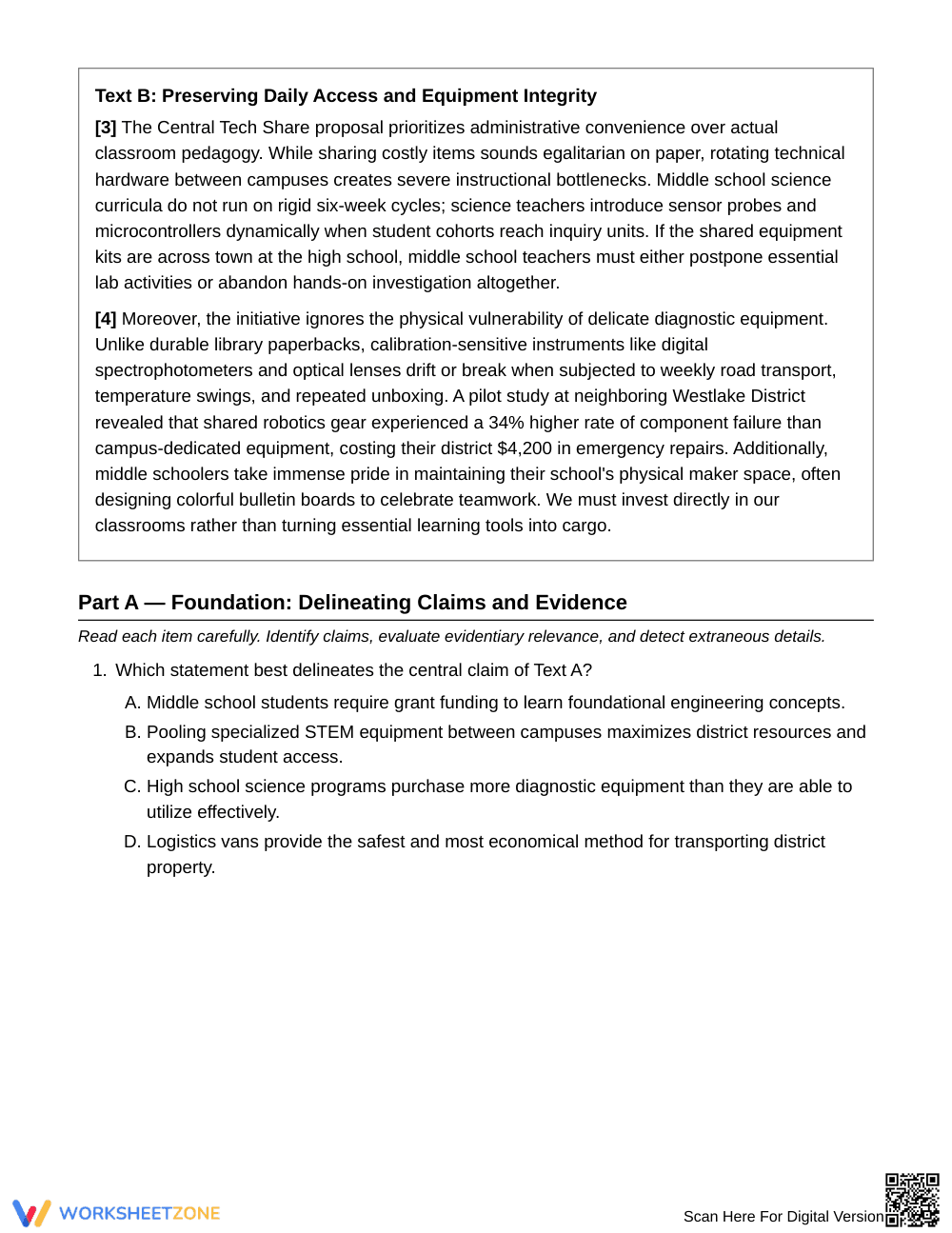
This Grade 8 ELA worksheet equips students to evaluate the strength and validity of opposing informational texts. Through paired passages on school resource sharing, learners analyze claims, detect irrelevant details, and assess reasoning soundness. Students develop critical reading competencies essential for mastering rigorous informational text standards.
At a Glance
- Grade: 8 · Subject: ELA
- Standard:
RI.8.8— Evaluate the argument and specific claims in a text, assessing reasoning and evidence sufficiency- Skill Focus: Argument-Quality Check
- Format: 5 pages · 12 problems · Answer key included · PDF
- Best For: Informational text paired analysis and assessment prep
- Time: 45–60 minutes
What's Inside
The 5-page resource presents a paired-text debate between two school logistics models alongside 12 targeted analytical tasks. Students work with a built-in terminology reference defining sound reasoning, relevant evidence, sufficient evidence, and irrelevant evidence. The worksheet includes multiple-choice claim delineation, structured short-response evidence critiques, a comparative data synthesis table, and a comprehensive 3-page explanatory answer key.
Skill Progression
- Guided Practice (Part A, 3 items): Students identify central claims and flag extraneous details using the foundational vocabulary reference box for initial scaffolding.
- Supported Practice (Part B, 6 items): Learners evaluate logical analogies, pinpoint missing evidence, and analyze unstated assumptions across individual paragraphs.
- Independent Practice (Part C, 3 items): Students complete a financial evidence comparison matrix, analyze unaddressed counterclaims, and construct an extended evaluative synthesis.
This gradual release sequence transitions middle schoolers systematically from identifying argument components to conducting independent evaluative synthesis.
Standards Alignment
This worksheet directly targets RI.8.8: Delineate and evaluate the argument and specific claims in a text, assessing whether the reasoning is sound and the evidence is relevant and sufficient; recognize when irrelevant evidence is introduced. It also supports RI.8.9 by prompting students to analyze two texts with conflicting viewpoints on the same topic. Both standard codes can be copied directly into lesson plans, IEP goals, or district curriculum mapping tools.
How to Use It
Implement this resource during mid-unit guided instruction or as a paired-text summative evaluation following your rhetoric unit. For formative assessment, examine student responses to Part B Item 5 to observe whether students detect underlying assumptions or accept claims at face value. Expect students to complete all 12 tasks within 45 to 60 minutes of focused analytical work.
Who It's For
This activity is designed for general education Grade 8 ELA classrooms, advanced Grade 7 readers, and high school intervention groups needing structured argument delineation. Pair this worksheet with a direct instruction lesson on rhetorical fallacies or an argumentative writing unit where students evaluate evidence before drafting their own essays.
Mastering standard RI.8.8 requires middle school students to distinguish between superficially convincing claims and valid evidence-based arguments. According to Fisher & Frey (2014), structured close reading of paired, competing informational texts accelerates students' ability to evaluate reasoning quality, recognize faulty logic, and detect extraneous details. When learners actively critique opposing arguments rather than merely summarizing content, their analytical reading proficiency improves significantly across all academic disciplines. This 5-page worksheet provides 12 scaffolded tasks that guide Grade 8 students through explicit claim delineation, evidentiary sufficiency checks, and comparative evaluation. By engaging directly with authentic policy debates, students build durable critical thinking habits that support high school reading readiness and standardized assessment success across informational text domains.


