































Essential Area Model Division: Patterns & Missing Values

Paste this activity's link or code into your existing LMS (Google Classroom, Canvas, Teams, Schoology, Moodle, etc.).
Students can open and work on the activity right away, with no student login required.
You'll still be able to track student progress and results from your teacher account.
This Grade 4 division worksheet equips students to master area models through missing dimensions, base-ten multiplication patterns, and error analysis. Learners connect concrete visual rectangles directly to abstract quotients, building conceptual understanding of multidigit division. By evaluating missing factors and explaining calculation mistakes, fourth graders develop deep mathematical reasoning and procedural fluency.
At a Glance
- Grade: 4 · Subject: Mathematics
- Standard:
4.NBT.B.6— Find whole-number quotients and remainders using strategies based on place value and area models- Skill Focus: Area model division, unknown dimensions, and place-value patterns
- Format: 2 pages · 11 problems · Answer key included · PDF
- Best For: Core instruction follow-up and targeted intervention
- Time: 25–35 minutes
What's Inside
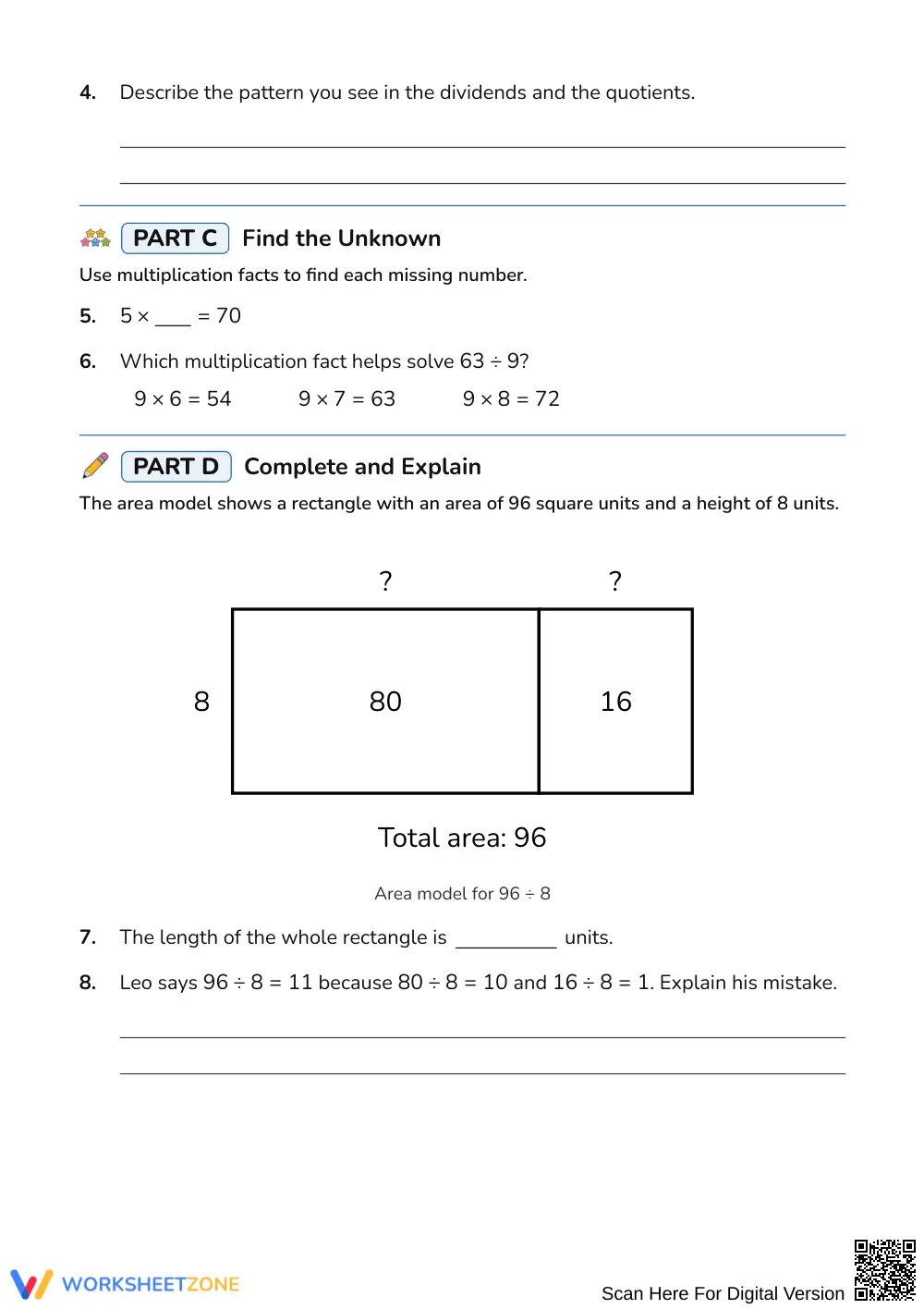
Across two structured student pages, this resource delivers 11 focused tasks organized into four developmental sections. Students engage with visual rectangle diagrams showing partial areas, numeric pattern tables extending across powers of ten, related multiplication facts, and a written error-analysis task. A comprehensive two-page answer key provides complete numerical solutions alongside model explanatory responses.
Skill Progression
- Guided Practice (Part A, 3 problems): Students analyze a visual area model with given partial products to identify missing rectangle dimensions with visual scaffolding.
- Supported Practice (Parts B & C, 5 problems): Learners extend division patterns across powers of ten and apply multiplication facts to solve for unknown values.
- Independent Practice (Part D, 3 problems): Students independently calculate multi-digit dimensions and critique common conceptual errors in division reasoning.
This structured sequence follows the gradual-release model, transitioning students from scaffolded visual models to independent mathematical justification.
Standards Alignment
This resource focuses on primary standard `4.NBT.B.6`: Find whole-number quotients and remainders with up to four-digit dividends and one-digit divisors, using strategies based on place value, the properties of operations, and the relationship between multiplication and division. The activities also reinforce supporting standard `4.OA.A.1` by interpreting multiplication equations as comparative statements. Both standard codes can be copied directly into lesson plans, IEP goals, or district curriculum mapping tools.
How to Use It
Deploy this worksheet immediately after direct instruction on partial quotients to solidify conceptual connections, or use it during small-group remediation for students struggling with multidigit division. During the error-analysis task in Part D, check whether students identify place-value confusion versus basic calculation mistakes to guide immediate corrective feedback. Most fourth-grade learners complete all 11 items within 25 to 35 minutes.
Who It's For
This activity is designed for fourth-grade general education students learning multidigit division, while offering targeted support for tier-two math intervention and English learners using visual area representations. Pair this worksheet directly with a classroom base-ten block demonstration or an interactive anchor chart illustrating partial quotients and rectangular area decomposition.
Mastering multidigit division under standard 4.NBT.B.6 requires students to synthesize place-value understanding with geometric models of multiplication. According to Fisher & Frey (2014), structured instructional progressions that guide learners from visual representations to independent mathematical critique produce significant, measurable gains in conceptual retention and procedural accuracy. When fourth-grade students manipulate area models to identify unknown dimensions, discover base-ten patterns across powers of ten, and articulate error analyses, they bridge the cognitive gap between concrete operations and abstract division algorithms. This 11-problem resource systematically implements purposeful scaffolding, moving learners from guided partial-product identification to rigorous written justification. Educational research confirms that diagnosing and confronting common computational misconceptions through structured visual discourse solidifies foundational number sense, effectively preparing elementary mathematicians for multi-step problem solving, complex fractions, standard long division algorithms, and algebraic relationships in subsequent grade levels.


