































Essential Area Between Curves Worksheet | Grade 12 Calculus

Paste this activity's link or code into your existing LMS (Google Classroom, Canvas, Teams, Schoology, Moodle, etc.).
Students can open and work on the activity right away, with no student login required.
You'll still be able to track student progress and results from your teacher account.
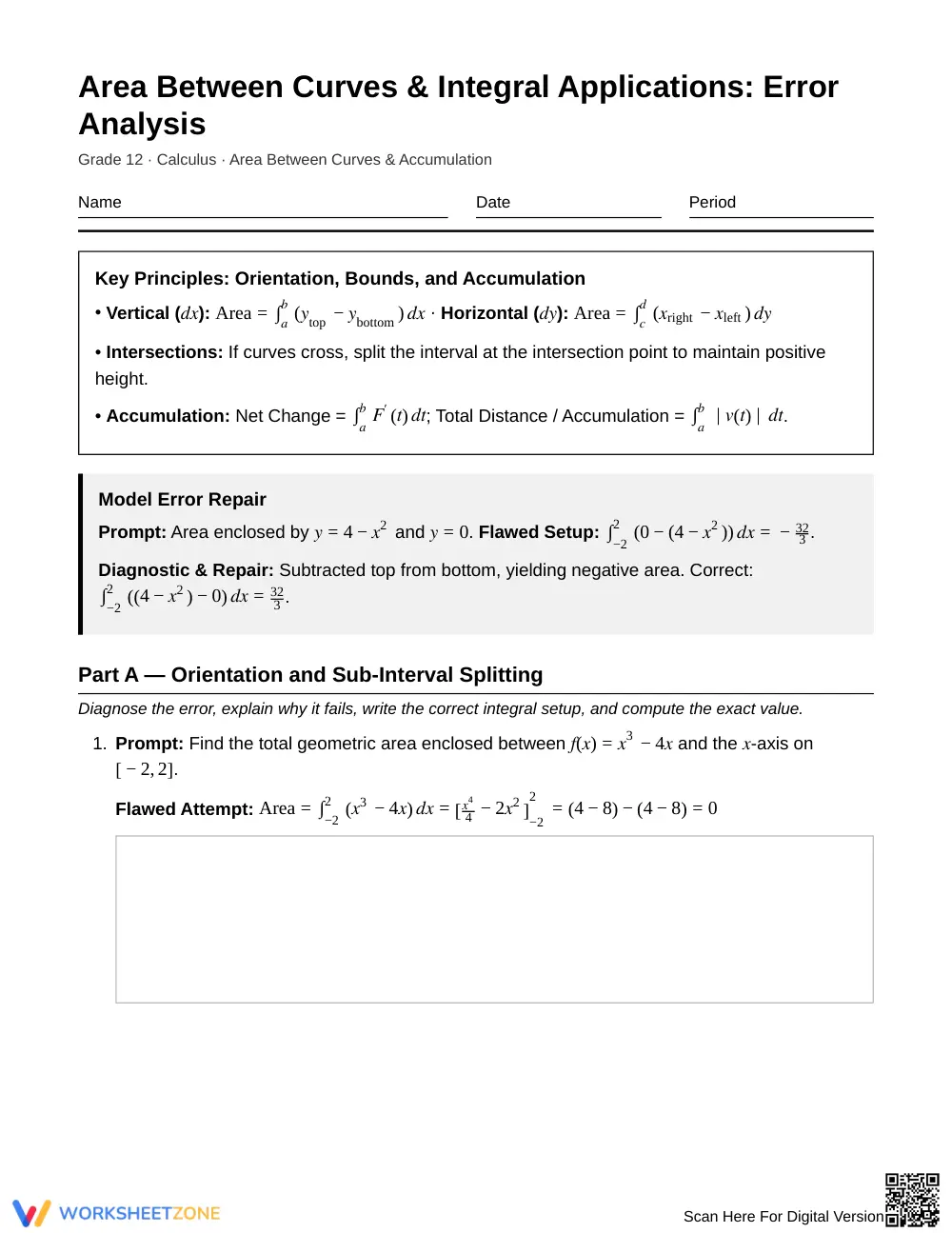
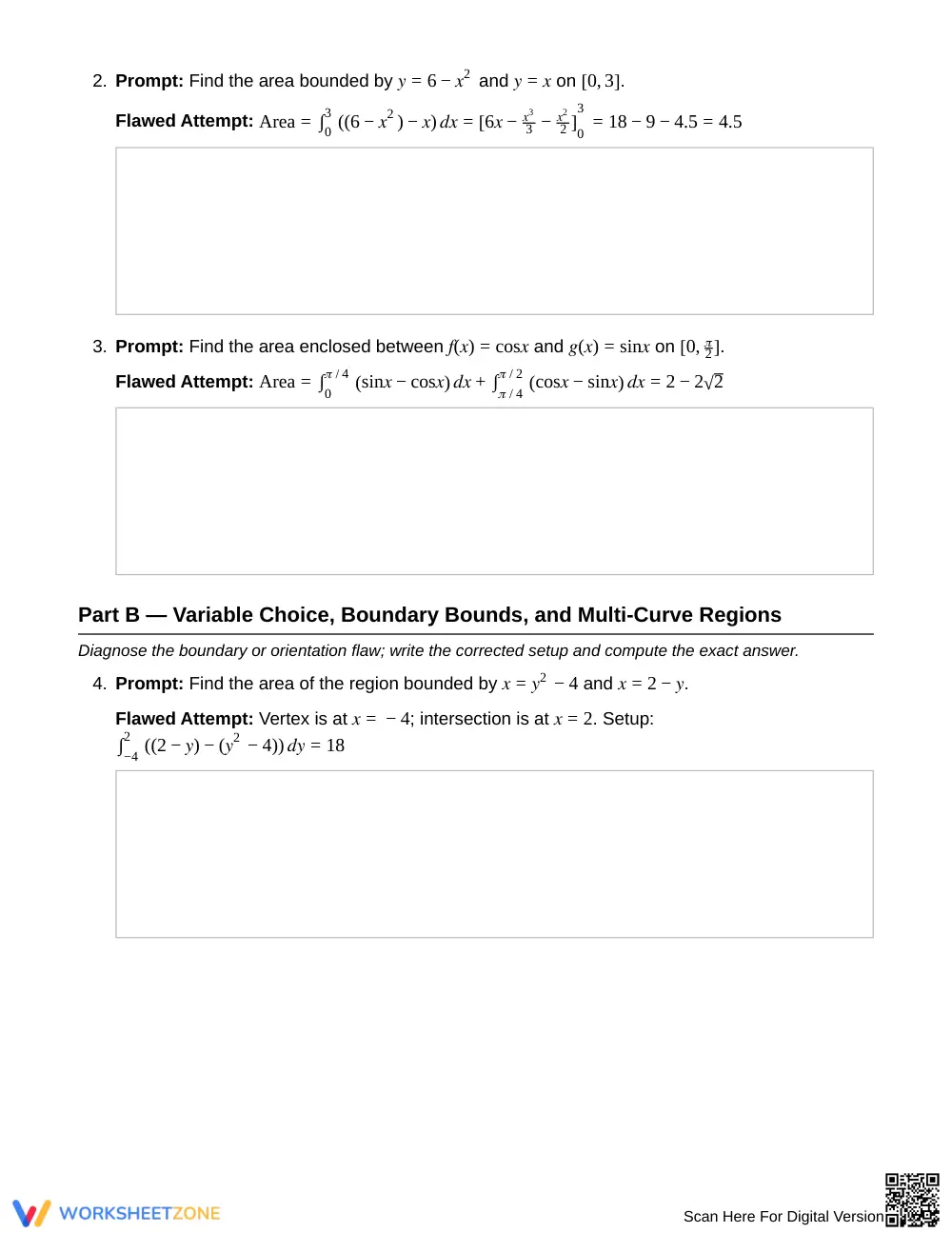
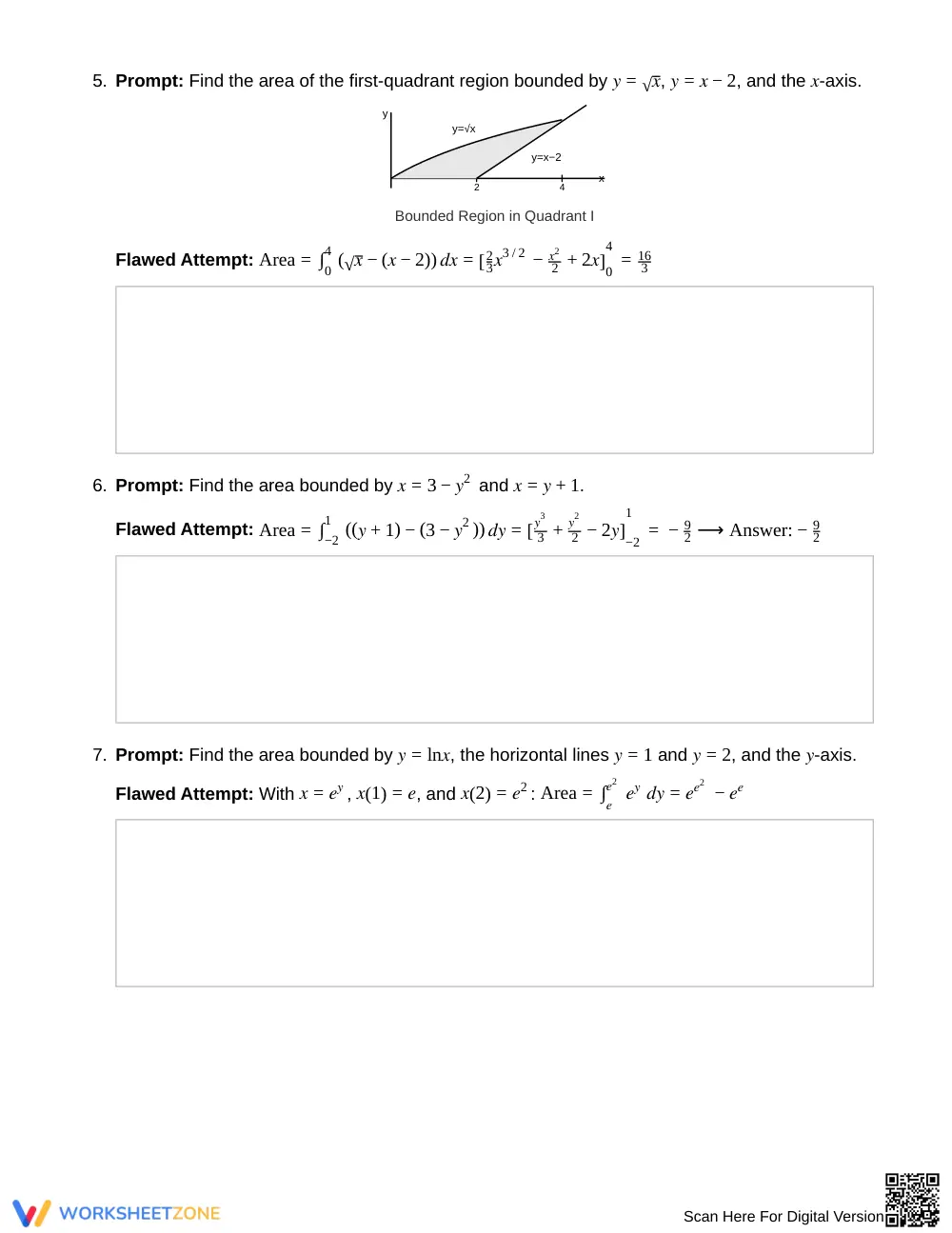
This error analysis worksheet guides Grade 12 calculus students through diagnosing and correcting common setup mistakes in definite integrals. Students evaluate flawed attempts involving curve orientations, multi-region splitting, horizontal slices, and net accumulation to build rigorous analytical precision in integral applications.
At a Glance
- Grade: 12 · Subject: Calculus
- Standard: Analyze and correct definite integral setups for area and accumulation
- Skill Focus: Correct Bounds and Top-Minus-Bottom Errors
- Format: 4 pages · 10 problems · Answer key included · PDF
- Best For: AP Calculus review and formative assessment
- Time: 45–60 minutes
What's Inside
The 4-page worksheet contains 10 in-depth error-repair tasks organized into three distinct parts, preceded by a key principles reference box and a fully worked model problem. It includes a complete 2-page step-by-step answer key showing mathematical justifications and exact algebraic evaluations.
Skill Progression
- Guided practice (Part A, 3 problems): Students examine orientation and sub-interval errors, focusing on vertical slice orientation, root finding, and sign changes when curves cross.
- Supported practice (Part B, 4 problems): Learners tackle variable selection, horizontal slices with respect to y, boundary identification, and multi-curve bounded regions accompanied by visual diagrams.
- Independent practice (Part C, 3 problems): Students resolve advanced kinematic displacement versus distance missteps, net inflow-outflow rate accumulations, and incorrect symmetry assumptions.
This structured progression leverages an intentional gradual-release model, moving students from foundational sign analysis to multi-step non-routine applications.
Standards Alignment
This activity targets core advanced calculus competencies in definite integrals, specifically determining area between intersecting curves, switching integration axes, and modeling accumulation with rate functions. The principles of error identification directly support curriculum goals in analytical reasoning and precision. Both standard alignments can be copied directly into lesson plans, IEP goals, or district curriculum mapping tools.
How to Use It
Use this resource after direct instruction on area between curves and integration techniques. In a cooperative review setting, assign student pairs to identify the conceptual flaw before computing the correct definite integral. Formatively assess student mastery by monitoring whether they split intervals at curve intersections or mistakenly evaluate the absolute value outside the integral. Typical completion time ranges from 45 to 60 minutes.
Who It's For
Designed for Grade 12 AP Calculus AB, BC, or introductory college calculus students. It offers targeted support for students who understand integration rules but struggle with boundary geometry. Pair this activity with visual curve-sketching mini-lessons or dynamic graphing software demos.
Error analysis in advanced mathematics directly improves conceptual fluency and prevents procedural misconceptions. According to Fisher & Frey (2014), engaging students in diagnosing worked examples with deliberate errors deepens metacognitive monitoring and reinforces foundational reasoning more effectively than repetitive calculation alone. This 10-problem worksheet requires Grade 12 calculus learners to evaluate flawed setups across single and multi-curve boundaries, distinguish between net accumulation and total distance, and correctly identify vertical versus horizontal integration variables. By articulating mathematical justifications before writing corrected integral setups, students cultivate the analytical rigor demanded on AP-level examinations and collegiate STEM coursework. The structured layout and full answer key ensure educators can efficiently target individual learning gaps and reinforce essential integral calculus concepts.


