





























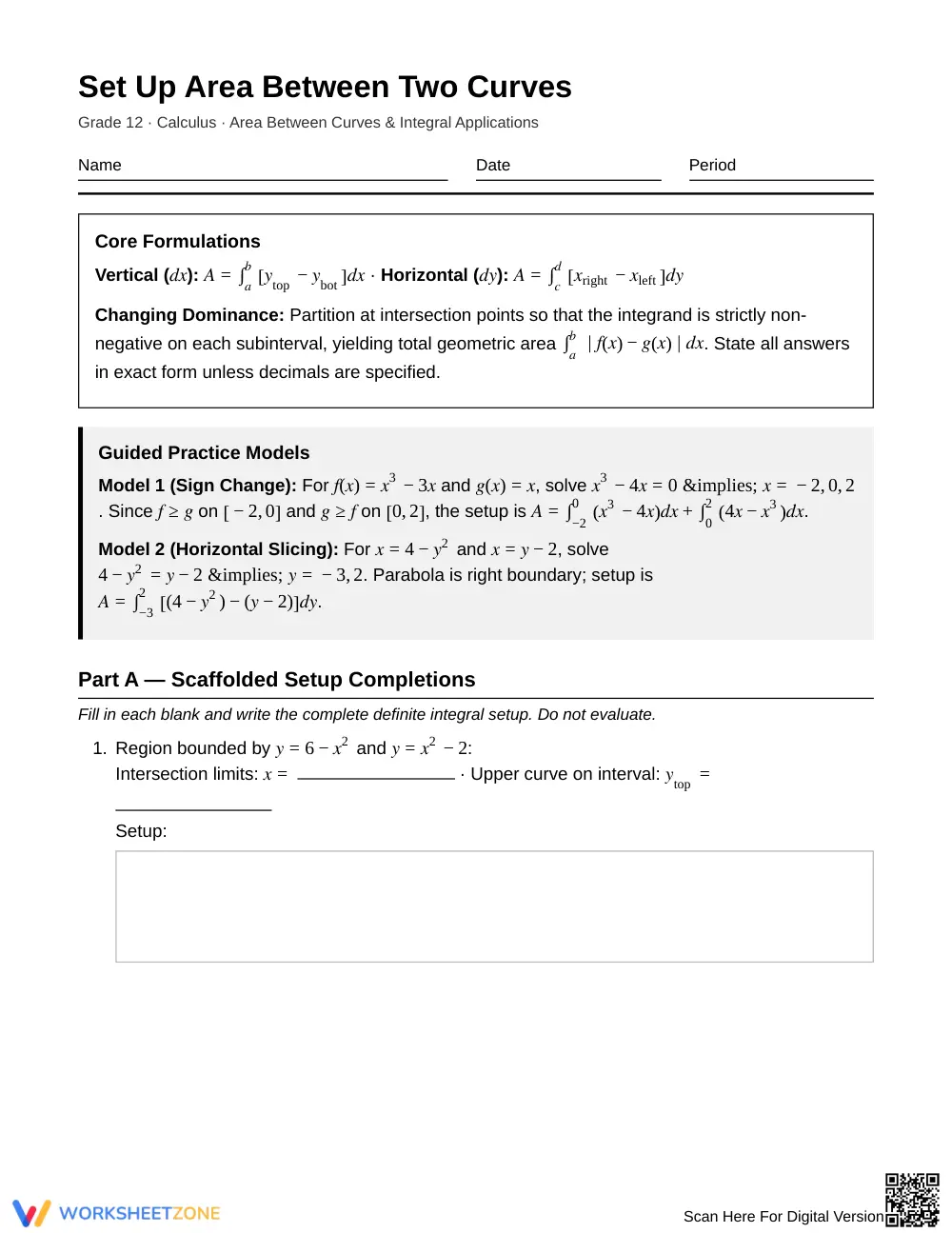

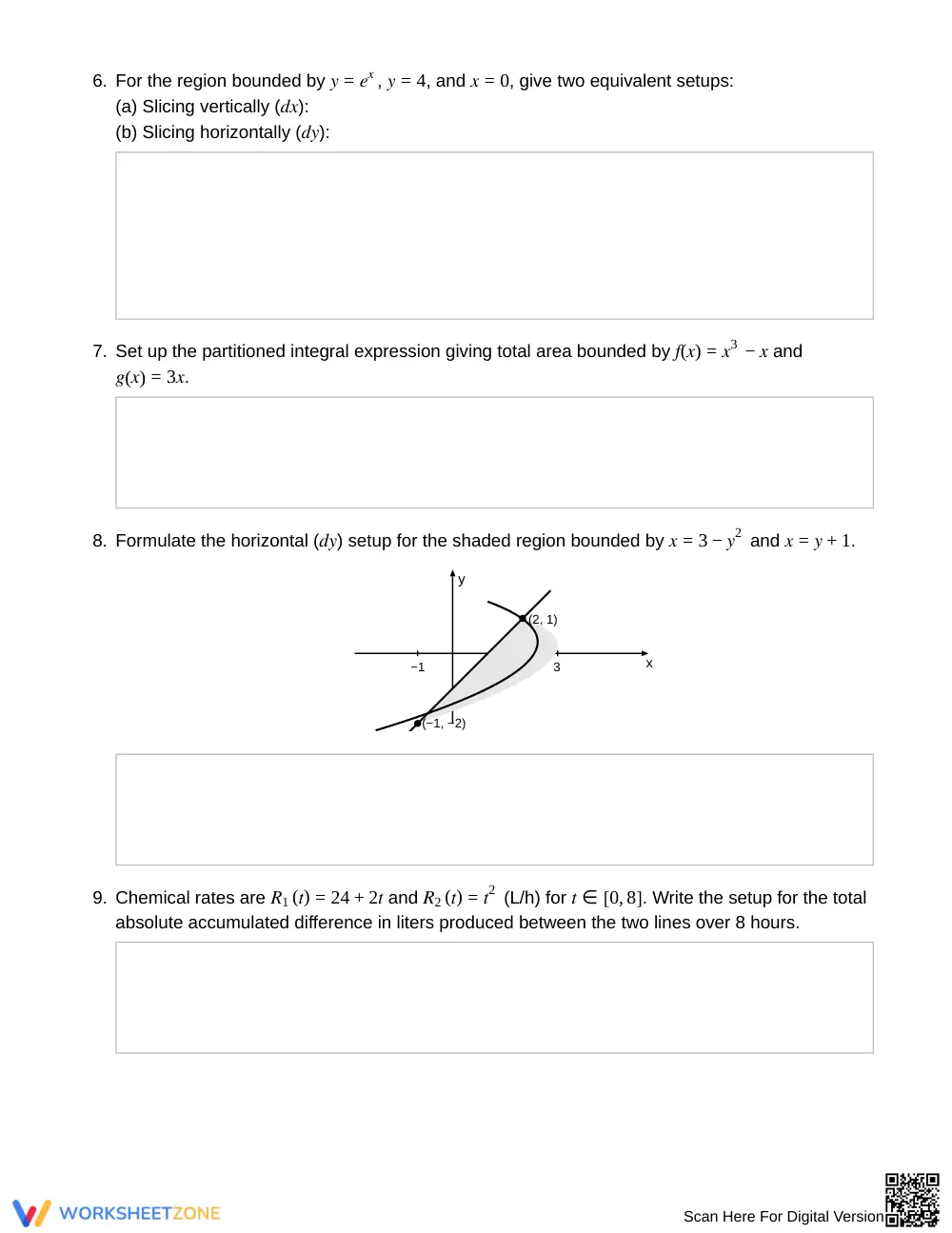


Essential Area Between Curves Worksheet | Grade 12 Calculus

Paste this activity's link or code into your existing LMS (Google Classroom, Canvas, Teams, Schoology, Moodle, etc.).
Students can open and work on the activity right away, with no student login required.
You'll still be able to track student progress and results from your teacher account.
Mastering definite integral setups is vital for advanced calculus students analyzing geometric regions. This 4-page worksheet guides Grade 12 learners through formulating exact integrals for area between two curves along both vertical and horizontal slicing axes. Students analyze curve dominance, identify intersection limits, and write partitioned definite integrals without the distraction of manual evaluation.
At a Glance
- Grade: 12 · Subject: Calculus
- Standard: Set up definite integrals representing geometric area between curves
- Skill Focus: Set Up Area Between Two Curves
- Format: 4 pages · 12 problems · Answer key included · PDF
- Best For: Integral application practice and review
- Time: 45–60 minutes
What's Inside
This resource includes reference boxes with core formulations and two detailed worked models demonstrating sign changes and horizontal slicing. Across 12 targeted tasks, students complete scaffolded fill-in setups, formulate full algebraic boundary integrals with both vertical and horizontal dx/dy orientations, and evaluate conceptual justifications. A full 2-page answer key provides complete unsimplified and partitioned definite integral expressions.
Skill Progression
- Guided practice (Part A, 4 problems): Scaffolded prompts require students to compute boundary intersections, determine dominant curves, and complete structured fill-in integral setups.
- Supported practice (Part B, 6 problems): Unscaffolded formulation tasks prompt learners to independently determine coordinate bounds, formulate dual vertical and horizontal setups, and partition piecewise regions.
- Independent practice (Part C, 2 problems): Rigorous conceptual justifications challenge students to diagnose setup errors involving negative integrands and articulate when horizontal slicing simplifies algebraic integration.
This structured arc follows the gradual release of responsibility model, ensuring students master curve orientation before working independently.
Standards Alignment
This resource aligns with high school calculus objectives covering integral applications and area accumulation. Students formulate definite integrals to represent the area of regions bounded by intersecting functions, applying vertical and horizontal slicing techniques. These curriculum-aligned objectives can be copied directly into lesson plans, IEP goals, or district curriculum mapping tools.
How to Use It
Deploy this worksheet after direct instruction on definite integrals and bounded area. In a 45 to 60-minute class session, begin by reviewing the two worked examples before assigning Part A in collaborative pairs. For formative assessment, check student setups on Part A problem 3: ensure learners correctly split the domain where sine and cosine intersect rather than integrating across sign changes as a single expression.
Who It's For
This activity supports Grade 12 AP Calculus AB/BC or dual-enrollment students preparing for integral application assessments. Differentiated prompts allow struggling learners to utilize explicit dy formulas while challenging advanced thinkers to justify axis efficiency. Pair this printable with an interactive graphing utility or curve-sketching anchor chart.
Formulating definite integrals for geometric regions requires students to synthesize algebraic boundary identification with spatial reasoning. According to Fisher & Frey (2014), gradual release instructional frameworks—progressing from structured worked demonstrations to independent conceptual troubleshooting—significantly enhance problem-solving retention in advanced mathematics. When students learn to set up area between curves, separating formulation from arithmetic evaluation prevents cognitive overload, allowing learners to focus strictly on interval partitioning, integrand sign dominance, and slicing orientation. This 4-page Grade 12 calculus worksheet implements these verified instructional design principles across 12 structured items. By moving from fill-in boundary scaffolds to dual-axis comparisons and error-analysis justifications, students develop robust procedural fluency and conceptual understanding. Educators can reliably implement this printable resource to prepare learners for rigorous cumulative calculus examinations and integral application units.


