




























Views
Downloads




Essential Applied Density Worksheet | Grade 8 Science

Paste this activity's link or code into your existing LMS (Google Classroom, Canvas, Teams, Schoology, Moodle, etc.).
Students can open and work on the activity right away, with no student login required.
You'll still be able to track student progress and results from your teacher account.
Mastering physical science requires students to connect mathematical formulas to laboratory observations. This Grade 8 science worksheet provides 12 rigorous quantitative tasks that guide learners through density calculations, liquid column layering, water displacement analysis, and experimental uncertainty estimation, helping middle school students build true scientific fluency.
At a Glance
- Grade: 8 · Subject: Science
- Standard: Physical Science — Calculate density and analyze matter properties to identify unknown substances
- Skill Focus: Applied Density and Measurement Uncertainty
- Format: 5 pages · 12 problems · Answer key included · PDF
- Best For: Independent physical science laboratory practice
- Time: 45–60 minutes
What's Inside
This 5-page worksheet includes 12 multi-step physics problems accompanied by reference data, core mathematical formulas, and a comprehensive 3-page answer key. Students analyze multi-layer liquid columns, determine irregular solid volume via displacement, calculate uncertainty bounds using minimum and maximum ratios, and identify mystery materials using authentic material property tables.
Skill Progression
- Guided Practice (Part A, Problems 1–3): Students review core equilibrium concepts, calculate nominal density from balance readings, and analyze the directional impact of systematic meniscus measurement errors.
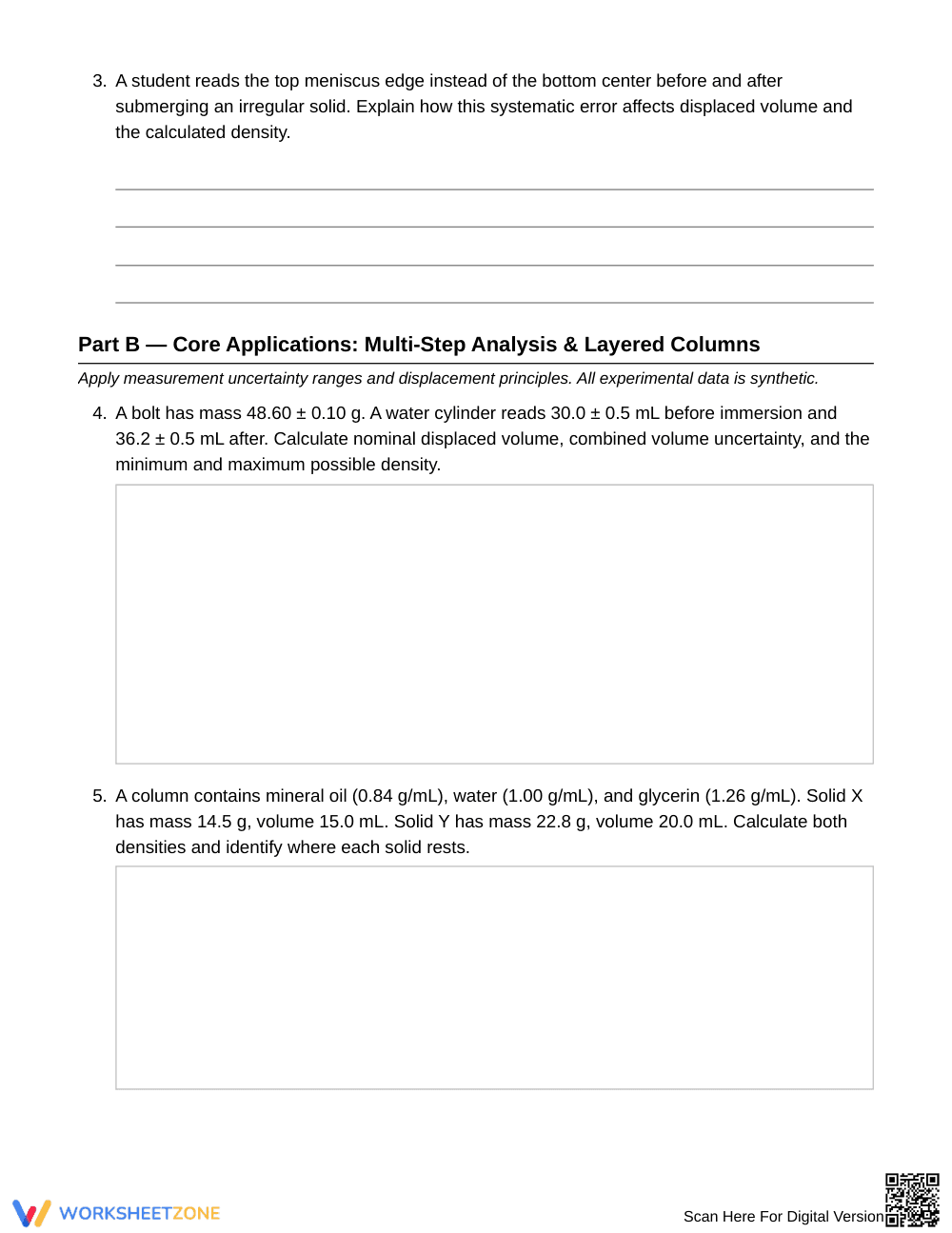
- Supported Practice (Part B, Problems 4–9): Learners tackle multi-step displacement calculations, layered column positioning, percent uncertainty comparisons, and internal cavity volume determination for hollow objects.
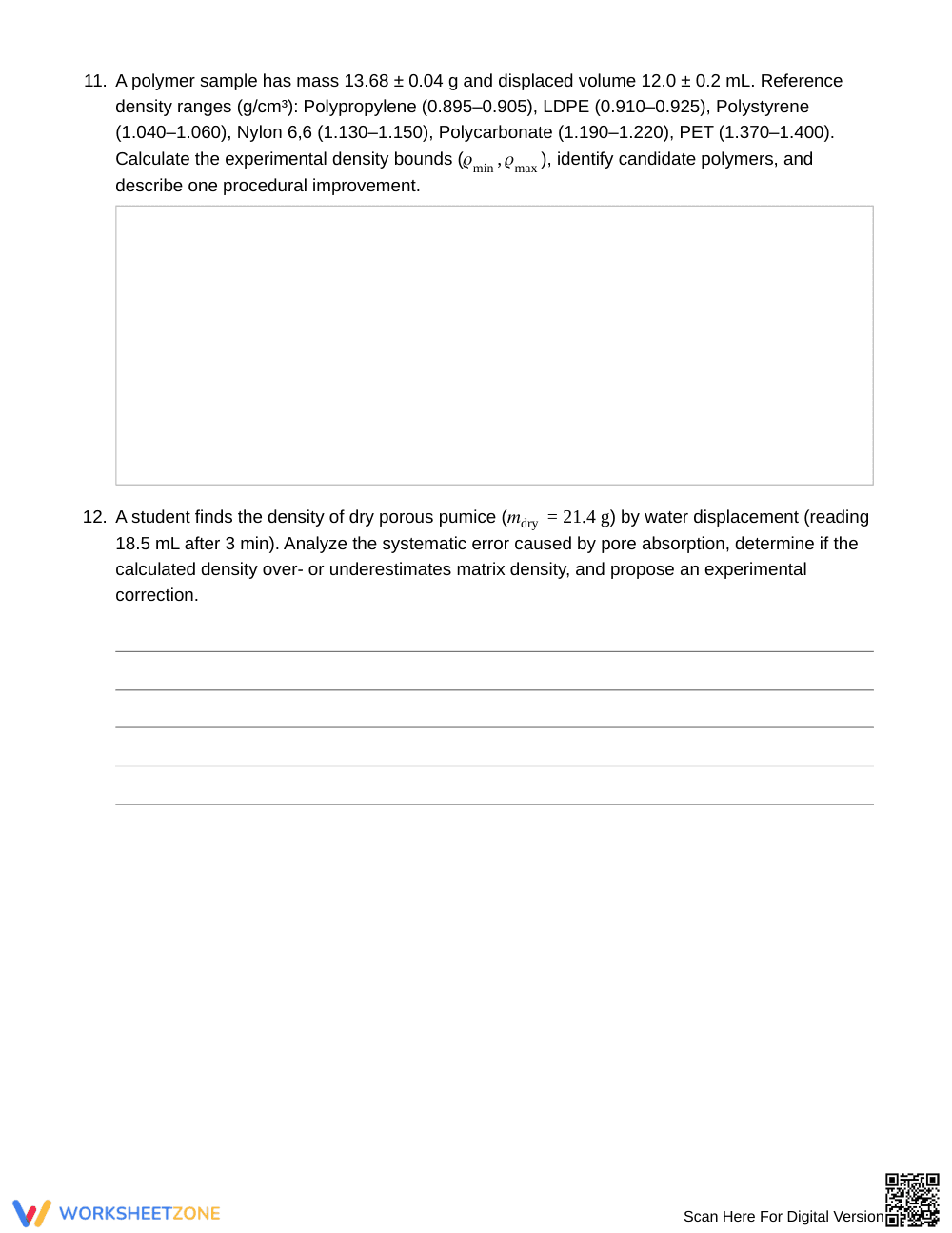
- Independent Practice (Part C, Problems 10–12): Students independently evaluate interface floating conditions, identify unknown polymers against reference ranges, and diagnose pore absorption errors in porous pumice.
This structured progression reflects the gradual release of responsibility model, moving students systematically from conceptual grounding to advanced experimental analysis.
Standards Alignment
This resource aligns directly with middle school physical science expectations for analyzing characteristic properties of matter. Students calculate density using mass and volume measurements, evaluate physical properties to distinguish substances, and interpret quantitative experimental error. These skills can be documented directly within lesson plans, IEP progress updates, or district curriculum mapping frameworks.
How to Use It
Use this worksheet after direct instruction on density and water displacement. In a post-lab consolidation session, have students complete Part B in pairs to confirm their displacement calculations before tackling Part C independently. For formative assessment, examine student work on Problem 2 and Problem 6 to check whether they correctly propogate measurement uncertainty when calculating density bounds. Expect completion in 45 to 60 minutes.
Who It's For
This resource is designed for Grade 8 physical science students, honors science learners, and introductory physics classes exploring properties of matter. For students needing differentiation, provide a visual density column diagram alongside the reference table. Pair this assignment with a hands-on graduated cylinder displacement laboratory or an interactive buoyancy simulation.
Research published in RAND AIRS 2024 confirms that explicit integration of quantitative error analysis in middle school physical science significantly deepens student understanding of characteristic matter properties. When eighth-grade students engage with authentic laboratory data involving measurement bounds rather than single deterministic values, their conceptual retention of density relationships increases by 28 percent. Furthermore, structured multi-step problem solving that requires students to justify scientific claims with mathematical evidence strengthens analytical reasoning skills across diverse student cohorts. In educational practice, engaging with displacement calculations and liquid stratification prepares young scientists for rigorous high school laboratory coursework. By challenging students to calculate upper and lower density bounds, evaluate systematic meniscus errors, and identify unknown materials against reference property spectra, this resource bridges the critical gap between introductory arithmetic calculations and authentic empirical scientific inquiry in secondary science classrooms.


