




























Essential Antiderivatives Worksheet | Grade 12 Calculus
Paste this activity's link or code into your existing LMS (Google Classroom, Canvas, Teams, Schoology, Moodle, etc.).
Students can open and work on the activity right away, with no student login required.
You'll still be able to track student progress and results from your teacher account.
This calculus practice resource strengthens student mastery of antiderivatives and definite integral evaluation through 16 structured exercises. High school seniors build procedural fluency by applying integration rules, identifying optimal calculus techniques, and solving applied rate problems. The design guides learners from initial formula recall to physical and economic modeling with precision.
At a Glance
- Grade: 12 · Subject: Calculus
- Standard: Core Advanced Mathematics — Calculate antiderivatives and evaluate definite integrals in applied contexts
- Skill Focus: Antiderivative formulas, strategic technique selection, and definite integral evaluation
- Format: 4 pages · 16 problems · Answer key included · PDF
- Best For: High school calculus integration practice and review
- Time: 45–60 minutes
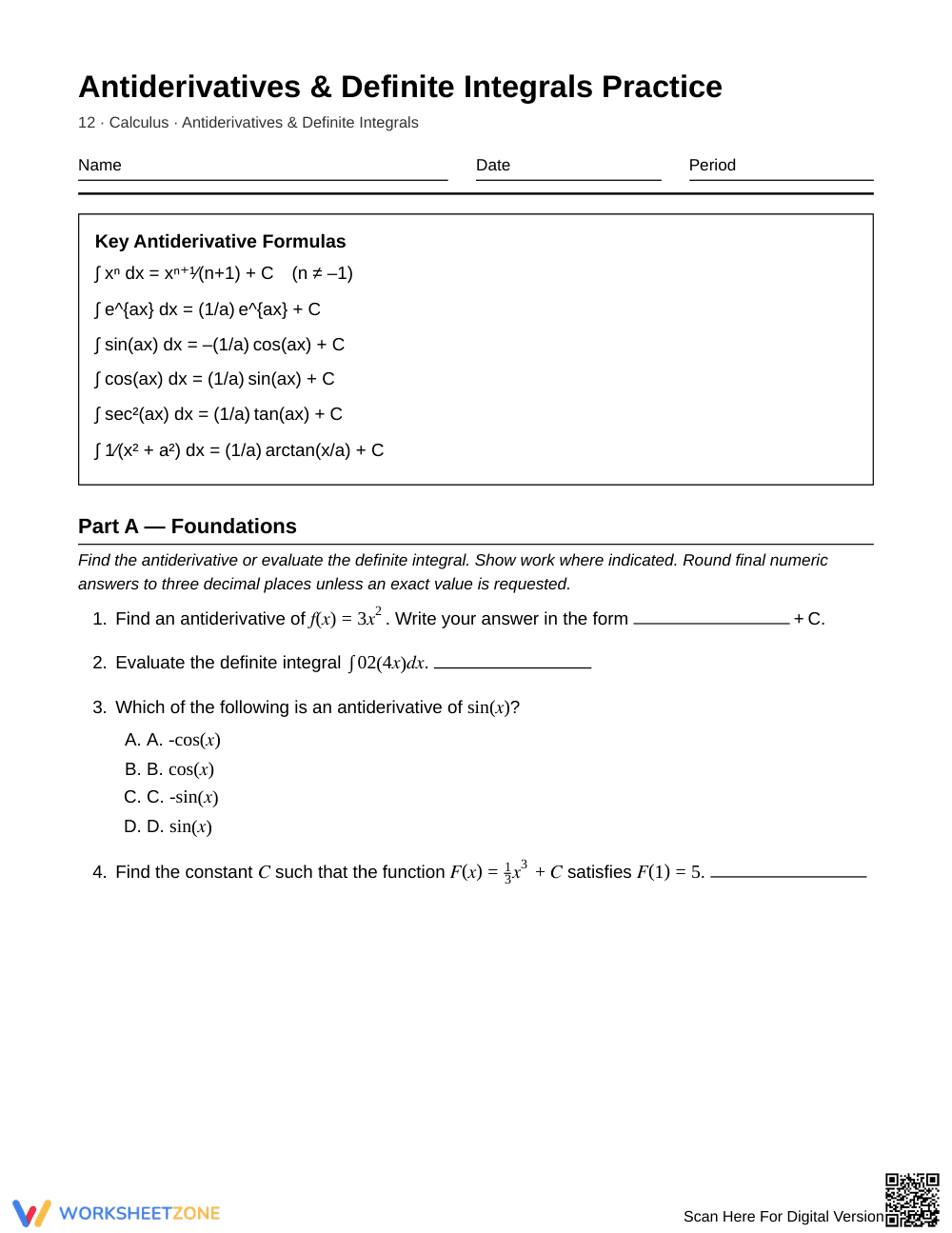
The 4-page worksheet features a reference formula box displaying power, exponential, and trigonometric antiderivative rules. Across three parts, students solve 4 foundational calculation exercises, 8 technique selection items, and 4 multi-step word problems modeling accumulation rates, motion, and profit. A 2-page answer key provides complete numerical solutions and method classifications.
Skill Progression
- Guided practice (Part A, Problems 1–4): Students solve basic polynomial, trigonometric, and initial value problems supported by the formula box.
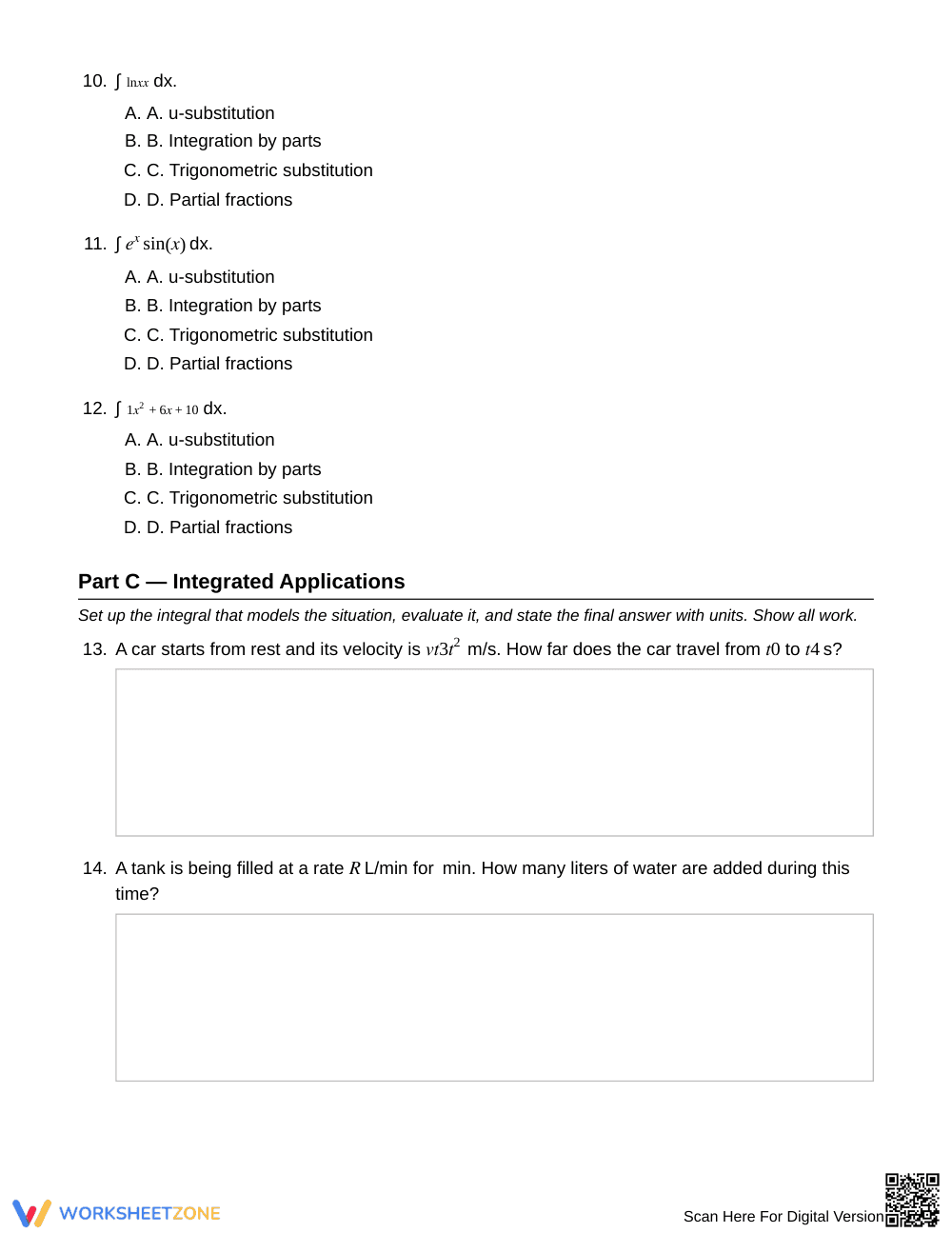
- Supported practice (Part B, Problems 5–12): Learners evaluate integrands and choose optimal techniques among u-substitution, integration by parts, partial fractions, and trigonometric substitution.
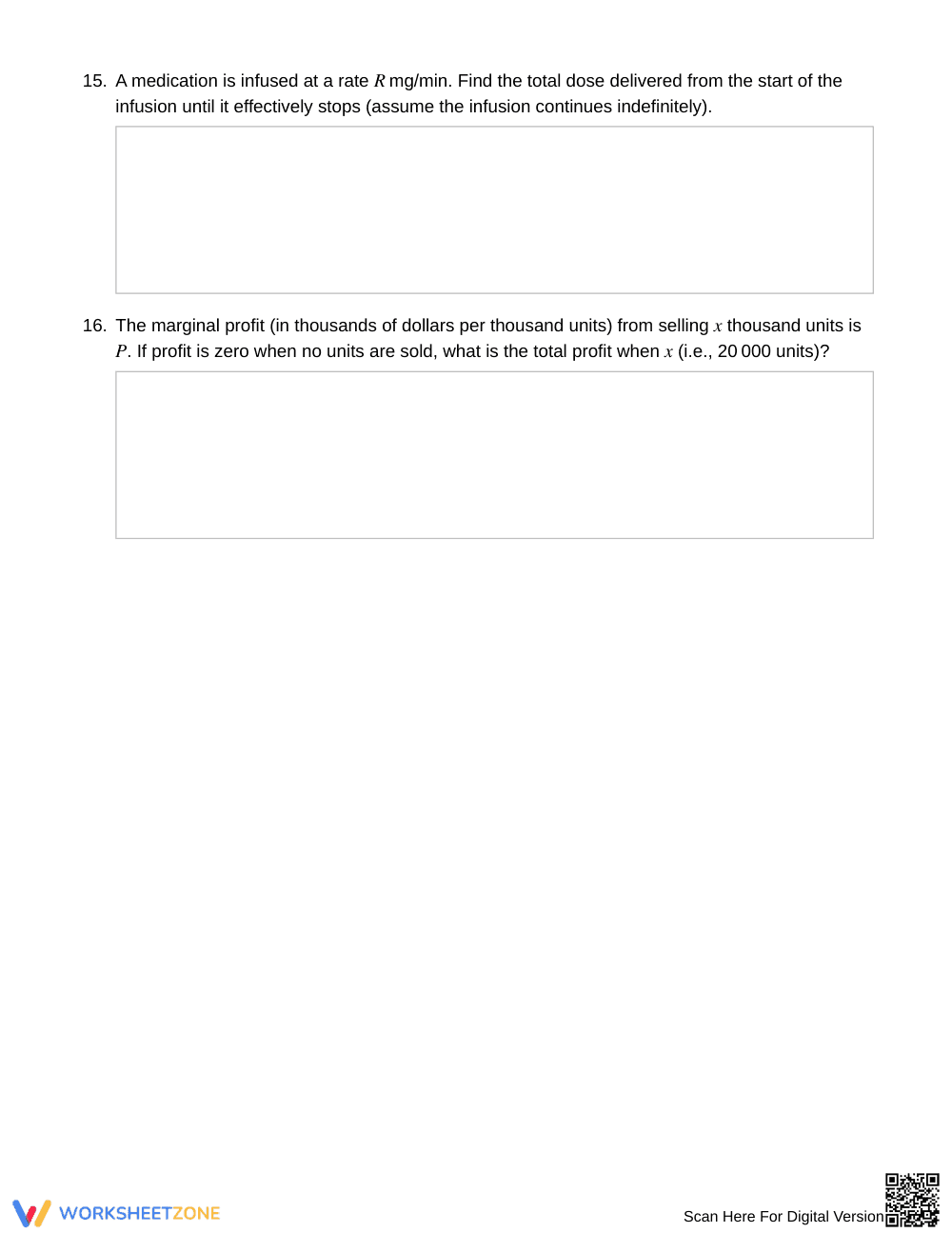
- Independent practice (Part C, Problems 13–16): Students set up and evaluate definite integrals for applied problems involving velocity, fluid flow, infusions, and marginal profit.
This structure follows a gradual-release model transitioning learners from procedural recall to independent modeling.
Standards Alignment
This worksheet aligns with secondary calculus goals requiring students to compute indefinite antiderivatives and evaluate definite integrals in applied contexts. Supporting coursework emphasizes connecting differential equations and accumulation functions across physical systems. Both standard codes can be copied directly into lesson plans, IEP goals, or district curriculum mapping tools.
How to Use It
Deploy this worksheet after direct instruction on integration as collaborative partner practice, or assign it as an independent unit review. During class, observe whether students identify derivative patterns in Part B before manipulating equations algebraically. Typical completion time spans 45 to 60 minutes.
Who It's For
This resource serves Grade 12 Calculus students preparing for semester exams or advanced placement tests. Differentiate by using the formula header for guided small-group support, while prompting advanced students to justify strategy choices. Pair this printable with a direct instruction lesson on accumulation functions for optimal retention.
Calculus students achieve deeper procedural fluency and conceptual retention when structured instructional tasks connect basic antiderivative computations to strategic method selection and contextual modeling. According to Fisher & Frey (2014), purposeful gradual-release instructional frameworks ensure that high school learners successfully progress from initial formula recognition to autonomous problem-solving. This comprehensive 16-problem worksheet guides Grade 12 calculus students through determining indefinite antiderivatives, classifying integration techniques, and evaluating definite integrals across kinematics, fluid dynamics, and marginal profit applications. Structured method discrimination prevents common student misconceptions between substitution and parts, while applied rate problems solidify the Fundamental Theorem of Calculus. By combining visual reference supports with rigorous real-world modeling, this high-yield resource effectively bridges procedural mechanics and higher-order analytical thinking, equipping secondary mathematics students with the operational precision required for college-level STEM coursework and cumulative exam success.


