





























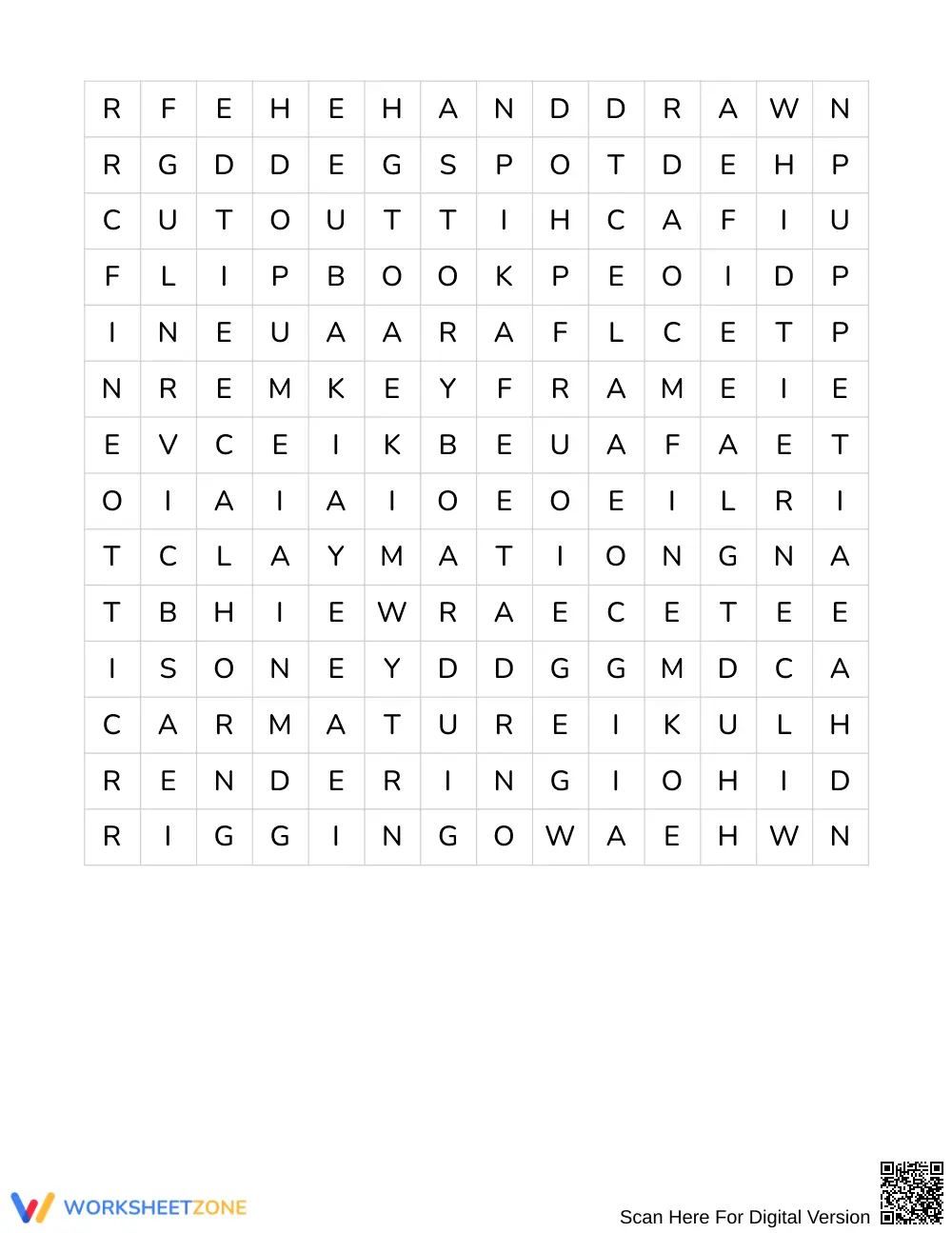


Essential Animation Techniques Word Search | Grades 3–4 ELA

Paste this activity's link or code into your existing LMS (Google Classroom, Canvas, Teams, Schoology, Moodle, etc.).
Students can open and work on the activity right away, with no student login required.
You'll still be able to track student progress and results from your teacher account.
This animation techniques word search introduces third- and fourth-grade students to foundational filmmaking and visual media terms. Learners discover and identify twelve vocabulary targets connected to traditional and modern screen arts while reinforcing spelling patterns, directional scanning skills, and media literacy concepts in an engaging print activity.
At a Glance
- Grade: Grades 3–4 · Subject: ELA
- Standard: Not standards-assessed — vocabulary enrichment
- Skill Focus: Animation techniques vocabulary
- Format: 2 pages · 12 words · Answer key included · PDF
- Best For: Vocabulary building and fast finishers
- Time: 15–25 minutes
What's Inside
This 2-page printable activity features a clean 14-by-14 letter grid alongside a categorized word bank that organizes terminology into hand-drawn, stop-motion, and computer-generated methods. Clear definitions accompany every entry, providing context for terms like armature, storyboard, and rigging, backed by a complete answer key for rapid checking.
Puzzle Structure & Mechanics
The word search challenges students across a 14-by-14 letter matrix containing 12 target words hidden in three accessible directions: horizontally left to right (East), vertically downward (South), and diagonally downward (Southeast). Grouping terms under three distinct media categories gives students conceptual anchors before they locate letter strings in the grid.
Standards Alignment
This resource serves as targeted vocabulary enrichment rather than a formal standards-based assessment. It strengthens domain-specific language acquisition in visual arts and English language arts by introducing technical cinema terminology in an accessible format without requiring formal alignment reporting.
How to Use It
Use this puzzle as an introductory hook prior to a media literacy lesson or assign it as an independent fast-finisher activity after reading informational texts about movie production. During seatwork, observe whether students scan systematically by initial letter clusters or cross-reference the category list to reinforce word meanings. Most students complete the full 12-word search within 15 to 25 minutes.
Who It's For
Designed specifically for learners in Grades 3–4, this puzzle supports emerging readers, visual arts classes, and upper-elementary media studies units. Pair this activity directly with a short informational passage about classic animation history or a video demonstration showing behind-the-scenes claymation techniques to deepen conceptual comprehension.
Explicit exposure to specialized academic vocabulary strengthens reading comprehension and domain-specific knowledge across elementary disciplines. Research synthesized by Fisher & Frey (2014) highlights that intentional vocabulary acquisition routines, particularly those connecting words to categorical concepts, help intermediate elementary students internalize multi-syllabic terms and technical language. When students encounter words like armature, rendering, and flipbook through organized themes rather than isolated word lists, they build cognitive networks that support both content-area literacy and fluent orthographic mapping. Engaging with structured word searches also promotes visual discrimination and pattern recognition, reinforcing correct letter sequencing in complex words. This enrichment activity provides Grades 3–4 classrooms with an accessible bridge between visual arts media and foundational vocabulary acquisition, ensuring that young learners develop practical familiarity with informational language without instructional friction or extensive testing overhead across diverse classroom learning settings.


