




























Views
Downloads
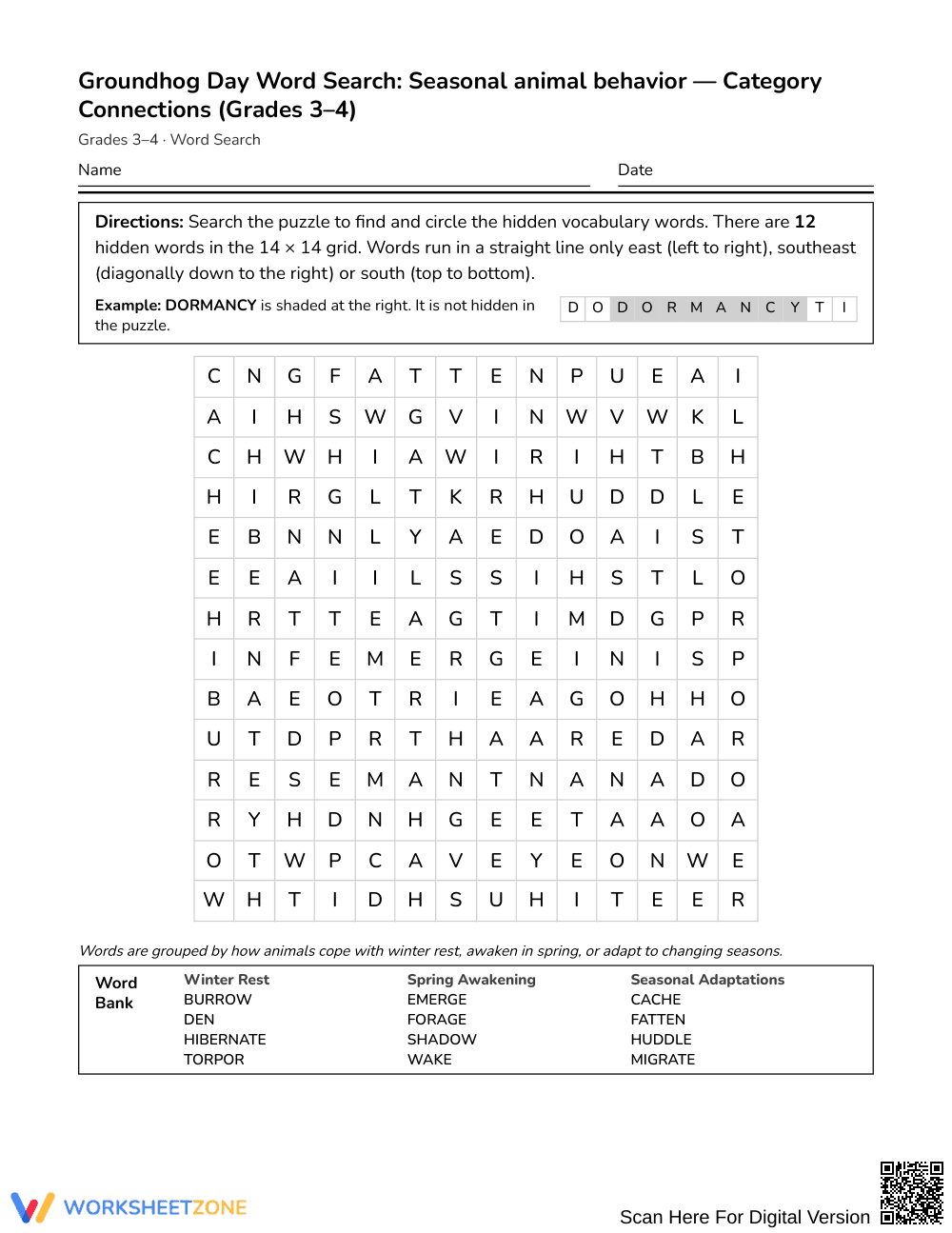

Essential Animal Behavior Word Search | Grades 3–4 Science

Paste this activity's link or code into your existing LMS (Google Classroom, Canvas, Teams, Schoology, Moodle, etc.).
Students can open and work on the activity right away, with no student login required.
You'll still be able to track student progress and results from your teacher account.
This science word search reinforces seasonal animal behavior vocabulary for elementary learners. Students locate and identify twelve key terms connected to seasonal cycles, dormancy, and survival strategies, building precise science literacy while exploring how living organisms respond to changing winter and spring environments.
At a Glance
- Grade: Grades 3–4 · Subject: Science
- Standard: Not standards-assessed — vocabulary enrichment
- Skill Focus: seasonal animal behavior
- Format: 1 pages · 12 words · Answer key included · PDF
- Best For: Groundhog Day or seasonal science review
- Time: 15–25 minutes
What's Inside: A clean, student-facing 1-page puzzle containing a 12-word hidden vocabulary bank paired with student-friendly definitions. The resource includes a full 3-page solution key clearly highlighting word placements to support independent checking or quick teacher verification.
How the Puzzle Works: The activity uses a 14 x 14 letter grid designed specifically for intermediate elementary readers. All 12 hidden terms run in three forward-facing directions: East (horizontal left-to-right), Southeast (diagonal downward), and South (vertical downward), avoiding reverse orientations that cause visual frustration. The vocabulary bank organizes words into three thematic categories: Winter Rest (hibernate, torpor, burrow, den), Spring Awakening (emerge, shadow, forage, wake), and Seasonal Adaptations (migrate, cache, fatten, huddle).
Standards Alignment: This resource is designed strictly for vocabulary enrichment and thematic engagement; it is not aligned to a formal performance standard.
How to Use It: Deploy this puzzle as an introductory hook prior to direct instruction on winter survival adaptations, or assign it after reading a Groundhog Day informational text to consolidate seasonal concepts. Formatively observe whether learners associate terms with their functional groups as they search, noting any confusion between dormancy terms such as torpor and hibernation. Expected completion time is 15 to 25 minutes.
Who It's For: This activity supports students in Grades 3–4 exploring life science units on animal habitats and adaptations. Pair the puzzle with an informational reading passage on Groundhog Day or an animal adaptation anchor chart illustrating winter shelter types.
Fisher & Frey (2014) emphasize that structured vocabulary acquisition thrives when domain-specific terminology is intentionally grouped by conceptual relationships rather than presented as isolated word lists. By categorizing seasonal animal behavior terms into thematic clusters such as winter dormancy, spring awakening, and environmental adaptations, this puzzle builds meaningful associative networks for developing readers. The 12 selected vocabulary targets connect concrete animal actions with underlying biological adaptations, reinforcing science literacy through print engagement. Learners actively process terminology while scanning the 14 x 14 grid in structured directional paths, transforming a familiar puzzle format into targeted academic reinforcement. The included reference clues provide immediate semantic support, ensuring intermediate elementary students anchor each science term to its real-world seasonal meaning.


