




























Views
Downloads



Essential Acid Naming Worksheet | Grades 9-12 Science

Paste this activity's link or code into your existing LMS (Google Classroom, Canvas, Teams, Schoology, Moodle, etc.).
Students can open and work on the activity right away, with no student login required.
You'll still be able to track student progress and results from your teacher account.
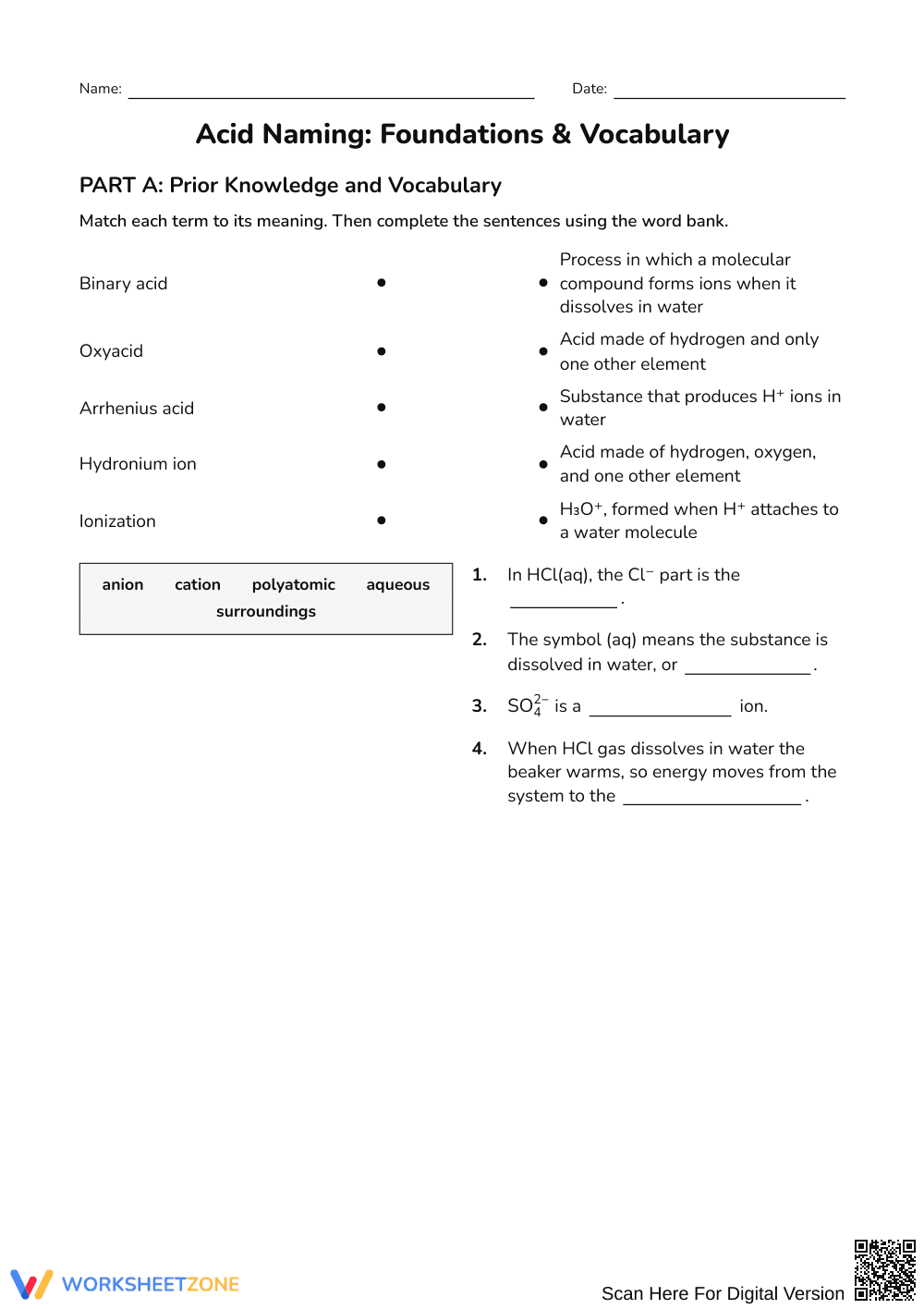
This high school chemistry worksheet develops student mastery of acid nomenclature through explicit vocabulary acquisition, rule-based flowcharts, and empirical evidence. High school chemistry students examine chemical formulas, distinguish binary acids from oxyacids, and explain ionization behavior using particle models and electrical conductivity data to build deep conceptual and procedural fluency.
At a Glance
- Grade: 9–12 · Subject: Science
- Standard: High School Physical Science — Construct chemical formulas and names for binary acids and oxyacids
- Skill Focus: Acid nomenclature, anion identification, and ionization models
- Format: 4 pages · 45 problems · Answer key included · PDF
- Best For: First-time chemistry instruction or review
- Time: 45–60 minutes
What's Inside
This 4-page worksheet contains 45 discrete tasks organized across three core sections. Students encounter vocabulary matching, sentence completion with a targeted word bank, and an explicit nomenclature flowchart. The resource includes systematic formula-to-name conversion tables, formula evidence checks, conductivity data analysis, and an explicit misconception analysis. A complete 4-page answer key provides worked-out reasoning for every exercise.
Skill Progression
- Guided practice (Tasks 1–10): Students define essential terminology such as hydronium and oxyacid, using a focused word bank to reinforce how ions interact in aqueous environments.
- Supported practice (Tasks 11–25): Learners apply a step-by-step decision flowchart to trace anion stems from formula to correct suffix, systematically distinguishing hydro- prefixes from oxygen-containing polyatomic acids.
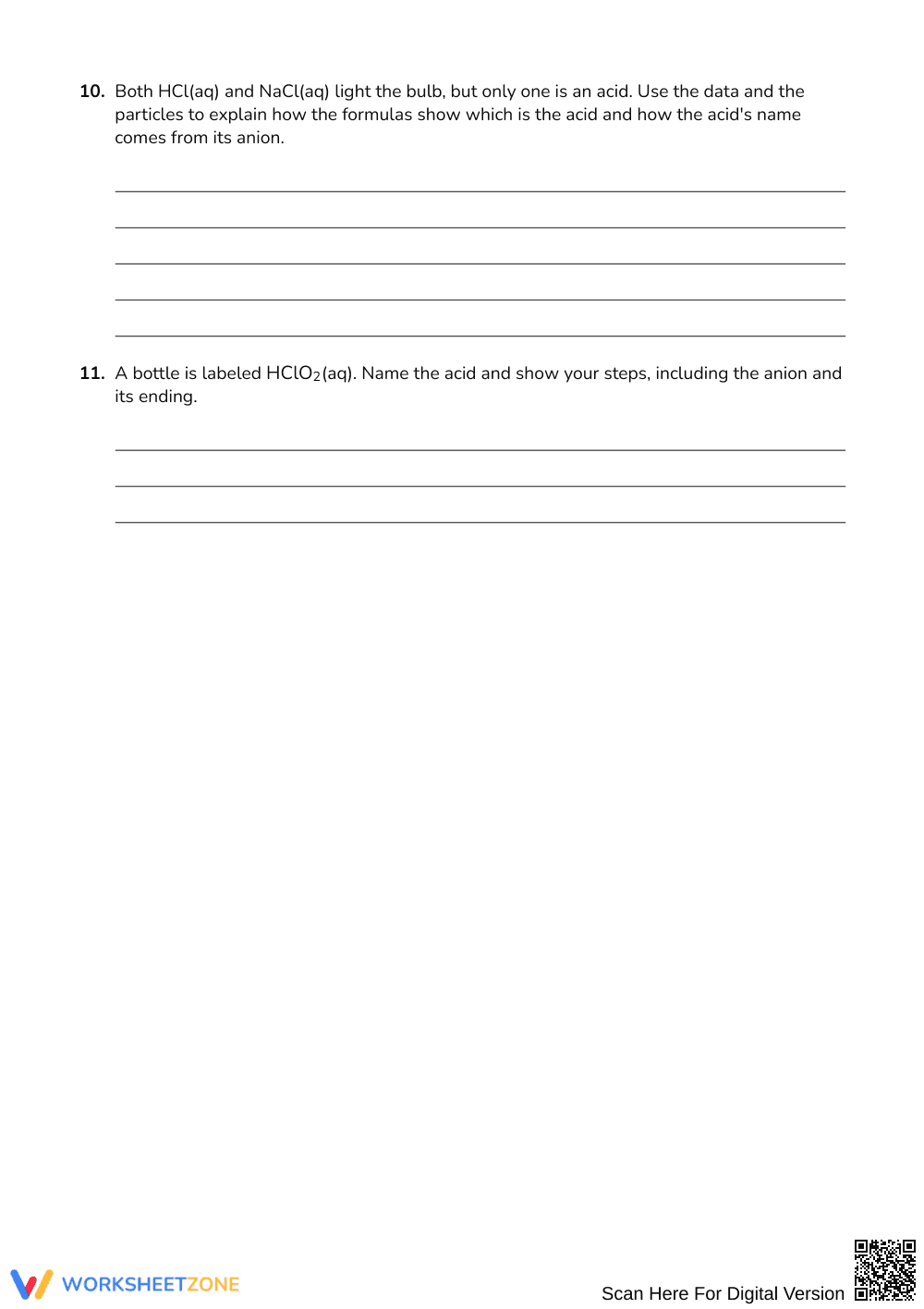
- Independent practice (Tasks 26–45): Students evaluate non-examples, interpret electrical conductivity evidence, and draft written justifications correcting widespread naming fallacies.
This sequence embodies the gradual-release model, transitioning students from foundational definitions to self-directed scientific reasoning.
Standards Alignment
Aligned with high school physical science standards for chemical reactions and nomenclature, this worksheet targets the ability to name and write formulas for ionic compounds, binary acids, and oxyacids using IUPAC rules. Supporting standards address particulate models of matter and aqueous ionization. Both standard codes can be copied directly into lesson plans, IEP goals, or district curriculum mapping tools.
How to Use It
Deploy this worksheet directly after direct instruction introducing Arrhenius acids and polyatomic ions. For a formative assessment checkpoint, examine Part C where students differentiate HCl and NaCl conductivity to verify whether they attribute acidity to hydrogen ions rather than generalized electrolyte mobility. Most high school chemistry students will finish all 45 tasks in 45 to 60 minutes.
Who It's For
This assignment serves introductory high school chemistry students, honors chemistry pupils, and students needing structured remediation before AP Chemistry. Scaffolded flowchart cues provide accessible entry points for English language learners and students with IEP accommodations. Pair this resource with a laboratory investigation measuring aqueous solution pH or an interactive polyatomic ion reference chart.
Structured chemistry nomenclature practice grounded in systematic rule application and particulate representations directly accelerates student acquisition of complex chemical concepts. According to Fisher & Frey (2014), the gradual-release framework equips learners to transfer procedural decoding skills into autonomous reasoning by deliberately bridging guided modeling, scaffolded schema formation, and independent conceptual justification. By walking secondary chemistry students from foundational vocabulary and flowchart-driven anion identification to evidence-based misconception analysis, this 4-page worksheet solidifies mental models of chemical species and solution chemistry. Secondary learners move past rote memorization by articulating why prefix conventions like hydro- depend strictly on oxygen presence in the anion rather than general acidity. This explicit integration of naming routines alongside physical conductivity observations ensures students develop durable procedural accuracy and robust conceptual frameworks essential for stoichiometry and advanced solution equilibria.


