




























Essential Accumulation & Sums Worksheet | Grade 12 Calculus
Paste this activity's link or code into your existing LMS (Google Classroom, Canvas, Teams, Schoology, Moodle, etc.).
Students can open and work on the activity right away, with no student login required.
You'll still be able to track student progress and results from your teacher account.
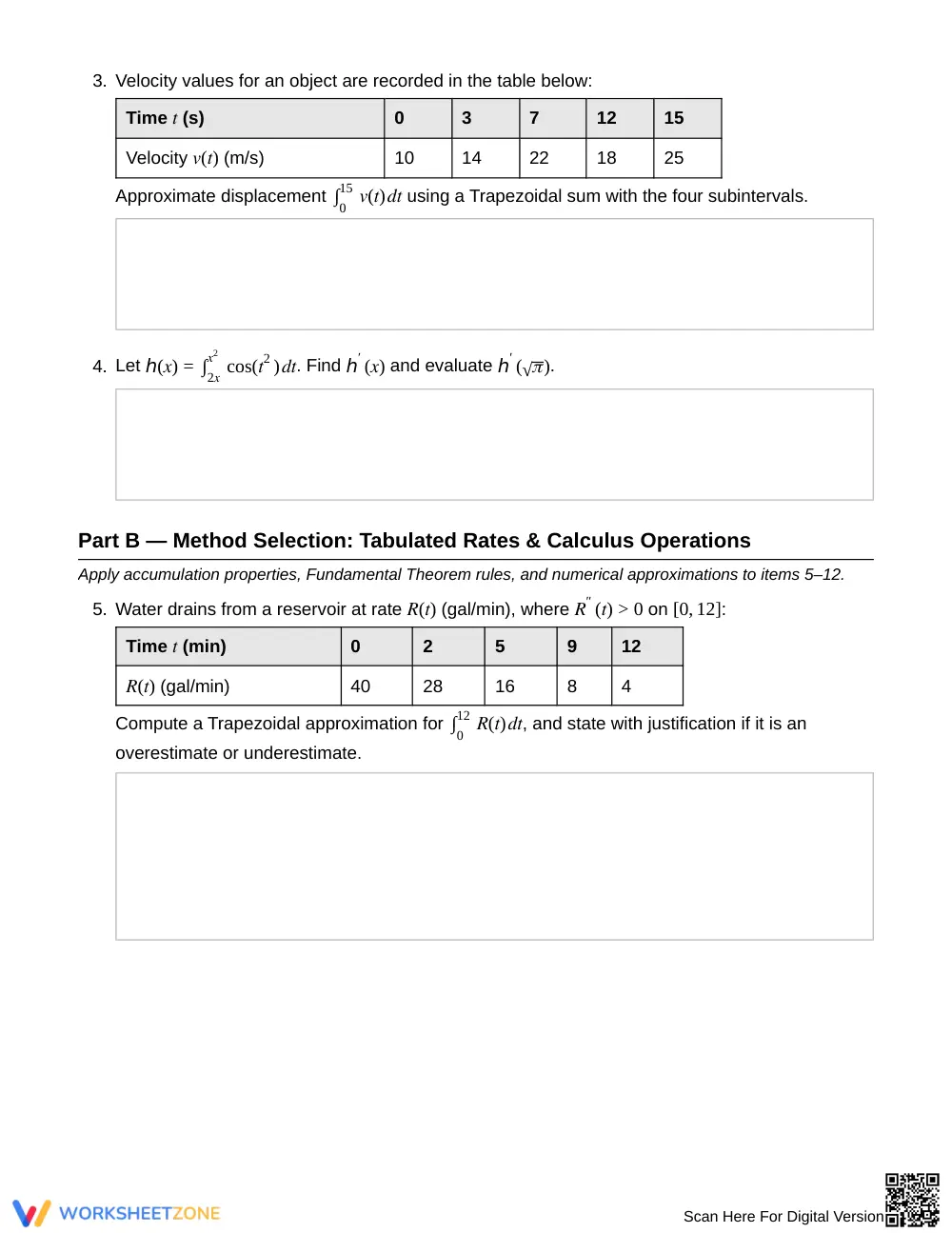
Mastering calculus requires connecting numerical approximations with accumulation functions. This comprehensive five-page worksheet targets numerical approximation and accumulation derivatives across 16 rigorous exercises. High school seniors analyze tabulated velocity data, apply the Fundamental Theorem of Calculus with chain rule extensions, and evaluate Riemann sums to build deep conceptual mastery.
At a Glance
- Grade: 12 · Subject: Calculus
- Standard: Approximate definite integrals numerically and compute accumulation function derivatives using the Fundamental Theorem
- Skill Focus: Mix Numerical Approximation and Accumulation Derivatives
- Format: 5 pages · 16 problems · Answer key included · PDF
- Best For: Advanced placement exam review
- Time: 60–75 minutes
What's Inside
The assignment delivers 16 multi-step problems across five student-facing pages, supported by a 3-page fully worked answer key. Students reference formula definitions for the Trapezoidal Rule and Leibniz notation for the Fundamental Theorem of Calculus. Problems feature tabular rates, concavity evaluations, piecewise geometric accumulation graphs, and limit calculations using L'Hôpital's Rule.
Skill Progression
- Guided Practice (Part A, Items 1–4): Focuses on foundational accumulation derivatives, concavity inequalities, and trapezoidal displacement approximations from tabular velocity data.
- Supported Practice (Part B, Items 5–12): Requires method selection across tabulated drainage rates, graphical accumulation graphs, tangent lines, and Riemann sum limits.
- Independent Practice (Part C, Items 13–16): Demands autonomous calculus synthesis, covering initial value kinematics, higher-order accumulation derivatives, Candidates Test optimization, and integral bounds.
This sequence follows the gradual-release framework, transitioning students from guided computation to rigorous calculus synthesis.
Standards Alignment
This instructional resource aligns with advanced calculus standards covering definite integrals, Riemann approximations, and the Fundamental Theorem of Calculus. Students demonstrate how accumulation functions define antiderivatives while interpreting rates of change from discrete numerical tables. Both standard codes can be copied directly into lesson plans, IEP goals, or district curriculum mapping tools.
How to Use It
Deploy Part A during mid-unit instruction as guided practice following lessons on the First Fundamental Theorem of Calculus. Assign Parts B and C after completing numerical integration for partner practice across 60 to 75 minutes. For formative assessment, examine Item 5 responses to ensure students justify trapezoidal overestimates using second-derivative concavity rather than slope direction.
Who It's For
This worksheet is designed for Grade 12 students in AP Calculus AB, BC, or dual-enrollment college calculus. Educators can support emerging learners by reviewing the reference box formulas on page 1, while challenging advanced students to complete Part C without prompts. Pair this resource with graphical accumulation anchor charts.
According to research synthesized by Fisher & Frey (2014), academic achievement accelerates when secondary mathematics instruction integrates deliberate scaffolded transitions from structured reference rules to open-ended analytical synthesis. This Grade 12 calculus worksheet implements that pedagogical architecture across 16 rigorous tasks, requiring high school students to bridge discrete numerical approximations with the analytical Fundamental Theorem of Calculus. Learners actively manipulate tabular velocity values, piecewise geometric curves, and composite accumulation functions, reinforcing that integration represents both net accumulation and an inverse differential process. Empirical findings confirm that combining multiple mathematical representations—symbolic formulas, tabulated rates, and graphical piecewise areas—deepens procedural fluency while preventing persistent conceptual misconceptions regarding concavity and Riemann sum overestimates. By systematically pairing foundational computational drills with complex integrated models, this instructional tool solidifies student readiness for college-level STEM coursework and standardized calculus examinations.


