




























Views
Downloads

Erioluwu Awarien Name Tracing | Essential Grade 1-2 Practice

Paste this activity's link or code into your existing LMS (Google Classroom, Canvas, Teams, Schoology, Moodle, etc.).
Students can open and work on the activity right away, with no student login required.
You'll still be able to track student progress and results from your teacher account.
This Erioluwu Awarien name tracing worksheet provides a structured path for early learners to master the specific letter sequences of their name. By focusing on consistent letter height and spacing, students build the muscle memory required for legible penmanship. This resource ensures that children transition from simple tracing to independent writing with confidence and precision.
At a Glance
- Grade: 1-2 · Subject: Handwriting
- Standard:
CCSS.ELA-LITERACY.L.1.1.A— Print all upper- and lowercase letters correctly- Skill Focus: Name tracing and letter formation
- Format: 3 pages · 6 problems · Answer key included · PDF
- Best For: Daily morning work and fine motor practice
- Time: 10–15 minutes
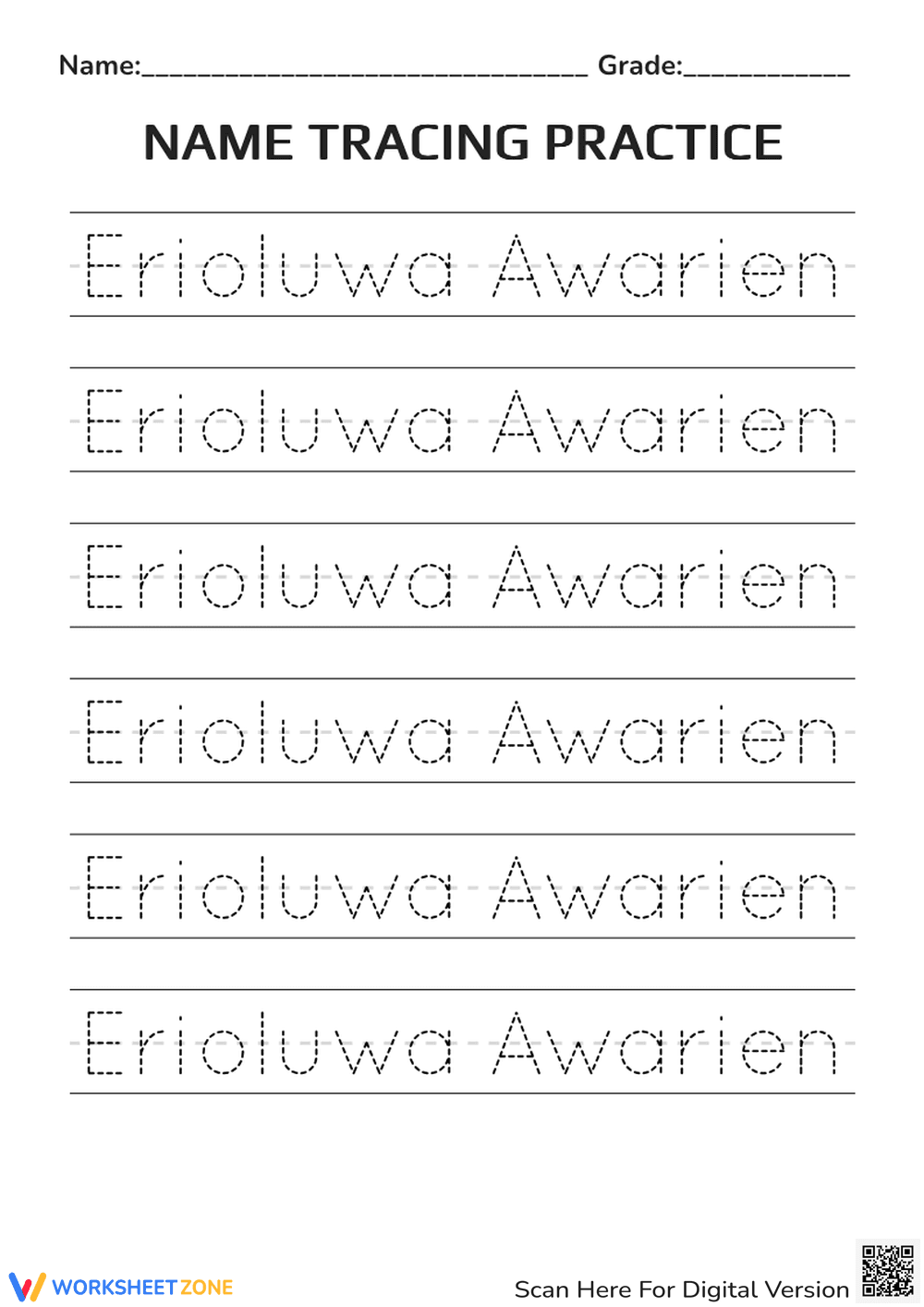
The packet contains three distinct pages designed to facilitate a gradual release of responsibility. The first page features six rows of the name "Erioluwu Awarien" for direct tracing. The second page offers a full sheet of primary ruled lines for repetitive practice. The final page provides a blank canvas with a single guide line to encourage spatial awareness and creative application.
- Guided Practice: Students begin by tracing the name six times on the first page, focusing on the specific strokes required for capital letters and lowercase counterparts.
- Supported Practice: Using the second page, students attempt to replicate the name without a trace-guide, utilizing the primary lines to maintain consistent letter sizing.
- Independent Practice: The third page allows for free-form writing, where students can apply their handwriting skills in a less structured environment.
This resource is primarily aligned with CCSS.ELA-LITERACY.L.1.1.A, which requires students to print all upper- and lowercase letters. By practicing a specific name, students engage with a high-frequency set of characters in a meaningful context. Both standard codes can be copied directly into lesson plans, IEP goals, or district curriculum mapping tools.
Assign this worksheet during the first ten minutes of the school day as a "settling-in" activity. It serves as an excellent formative assessment tool; observe the student's pencil grip and stroke direction during the tracing phase. Expected completion time is approximately 12 minutes depending on the student's fine motor development.
This is ideal for first and second-grade students who need additional support with name recognition and penmanship. It is particularly useful for students with occupational therapy goals. Pair this with a tactile alphabet anchor chart or a sand tray for a multi-sensory handwriting lesson.
Research by Fisher & Frey (2014) emphasizes the importance of the gradual release of responsibility in literacy instruction, particularly when developing foundational motor skills like handwriting. This worksheet applies those principles by moving students from highly scaffolded tracing to independent production. According to the RAND AIRS 2024 report, consistent daily practice of high-utility words—such as a student's own name—significantly improves letter recognition and overall writing fluency in early childhood education. By aligning with CCSS.ELA-LITERACY.L.1.1.A, this resource ensures that students are meeting national benchmarks for printing upper- and lowercase letters. The inclusion of primary ruled lines supports the development of spatial awareness and proportional letter sizing, which are critical precursors to more complex writing tasks. This structured approach reduces cognitive load, allowing students to focus on the physical mechanics of writing while building the confidence needed for academic success in primary grades.


