


























Views
Downloads
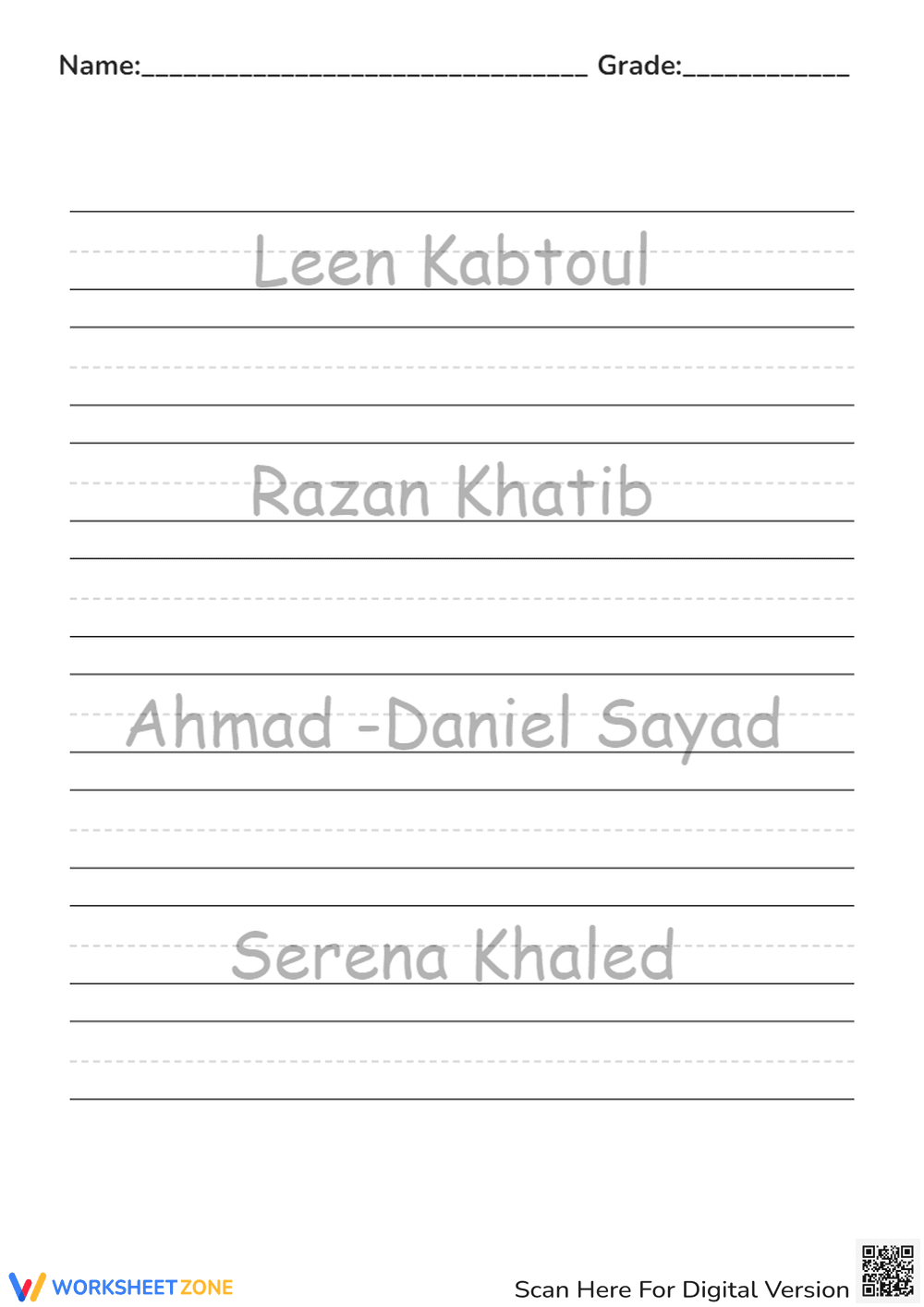

Printable Name Tracing Worksheet | Grade 1
Paste this activity's link or code into your existing LMS (Google Classroom, Canvas, Teams, Schoology, Moodle, etc.).
Students can open and work on the activity right away, with no student login required.
You'll still be able to track student progress and results from your teacher account.
This Grade 1 handwriting worksheet provides focused practice on proper letter formation through structured name tracing. Students develop essential fine motor skills and spatial awareness as they trace four distinct names on primary dashed lines. This foundational activity reinforces consistent letter sizing and spacing for early writers.
At a Glance
- Grade: 1 · Subject: Handwriting
- Standard:
CCSS.ELA-LITERACY.L.1.1.A— Print all upper- and lowercase letters- Skill Focus: Name Tracing and Letter Formation
- Format: 1 page · 4 tasks · No answer key · PDF
- Best For: Morning work or literacy centers
- Time: 10–15 minutes
Inside this single-page resource, educators will find four distinct name tracing exercises formatted on standard primary writing lines. The worksheet features a clear, easy-to-read font with dashed midlines to guide students in distinguishing between tall, small, and fall letters. Each line provides ample space for students to trace the provided names, focusing on the transition between uppercase and lowercase characters without the need for an answer key.
This print-and-go resource requires zero teacher preparation.
- Print (1 minute): Simply download the PDF and print the required number of copies. The black-and-white design ensures minimal ink usage.
- Distribute (1 minute): Hand out the worksheets during morning routines or transition periods. The instructions are self-evident, requiring no complex explanation.
- Review (Ongoing): Monitor student grip and stroke direction as they work, providing immediate corrective feedback on letter formation.
With a total setup time of under two minutes, this worksheet is perfect for emergency sub plans or spontaneous skill reinforcement.
This tracing activity is aligned to primary standard CCSS.ELA-LITERACY.L.1.1.A, which requires students to print all upper- and lowercase letters accurately. By practicing specific names, learners apply this standard in a practical context, mastering the spatial constraints of primary lined paper. The standard code can be copied directly into lesson plans, IEP goals, or district curriculum mapping tools.
Teachers can utilize this worksheet as a calming morning work activity to help students settle into the school day while practicing fine motor control. Alternatively, it serves as an excellent independent station during literacy centers. While students trace, educators should observe pencil grip and stroke sequence, using this formative assessment to identify learners who may need targeted intervention with specific letter shapes. Expect students to complete this task within 10 to 15 minutes.
This resource is designed for Grade 1 and Grade 2 students who are refining their basic handwriting and letter formation skills. It is particularly beneficial for occupational therapy sessions or for learners requiring additional fine motor scaffolding. Pair this tracing sheet with a tactile alphabet anchor chart or a direct instruction mini-lesson on proper pencil grasp to maximize student success.
Developing automaticity in handwriting is a critical component of early literacy that directly impacts a student's ability to produce written text. This worksheet supports CCSS.ELA-LITERACY.L.1.1.A by helping students print all upper- and lowercase letters accurately through guided name tracing. According to Fisher & Frey (2014), explicit instruction and repeated practice in foundational skills like letter formation reduce cognitive load, allowing young learners to eventually focus on complex composition and idea generation rather than the mechanics of writing. By providing structured, dashed-line practice, this resource builds the muscle memory required for fluent handwriting. Consistent engagement with tracing activities strengthens fine motor pathways, ensuring that students can meet grade-level expectations for written expression. This targeted practice builds the stamina necessary for long-term academic achievement.


