


























Views
Plays


English Sight Words Worksheet | Grade 1 Essential
Paste this activity's link or code into your existing LMS (Google Classroom, Canvas, Teams, Schoology, Moodle, etc.).
Students can open and work on the activity right away, with no student login required.
You'll still be able to track student progress and results from your teacher account.
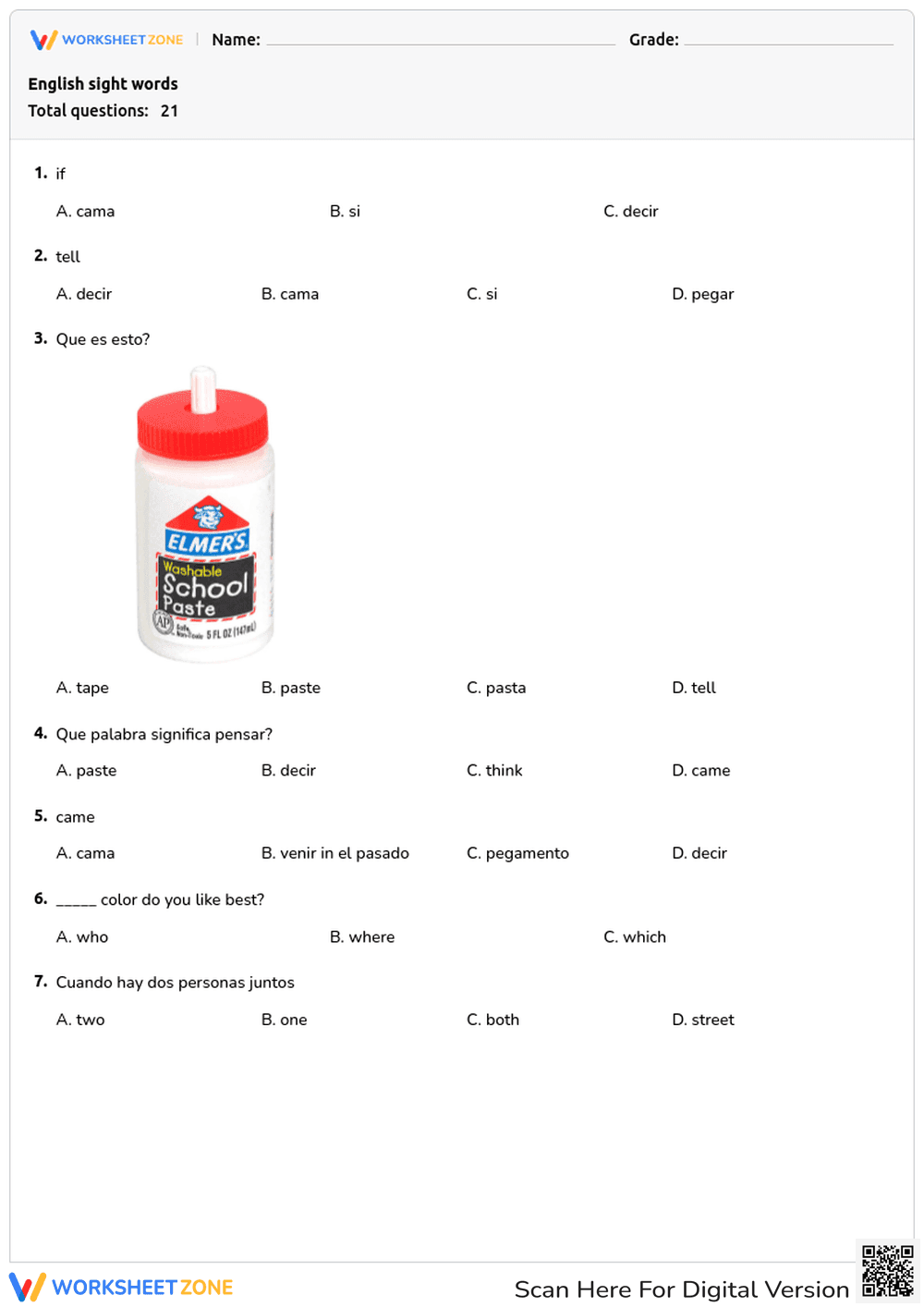
This Grade 1 English sight words worksheet provides students with 21 high-frequency vocabulary challenges designed to bridge the gap between Spanish and English literacy. By utilizing bilingual prompts and visual cues, students develop the ability to recognize and read irregularly spelled words in context. This resource ensures that early readers build the fluency necessary for complex text comprehension.
At a Glance
- Grade: 1 · Subject: English Language Arts
- Standard:
CCSS.ELA-LITERACY.RF.1.3.G— Recognize and read grade-appropriate irregularly spelled words- Skill Focus: Sight word recognition and bilingual translation
- Format: 4 pages · 21 problems · Answer key included · PDF
- Best For: ESL support and morning work
- Time: 15–20 minutes
This comprehensive 4-page PDF contains 21 multiple-choice questions. Each task presents a sight word or a sentence completion prompt, often paired with Spanish translations to support English Language Learners (ELL). The worksheet features clear typography and high-quality images, such as a glue bottle for "paste" and a street scene for "street," to provide essential context for emerging readers.
This resource is designed for immediate classroom implementation with a total teacher prep time of under 2 minutes. First, print the 4-page document (30 seconds). Second, distribute the packets to students for independent practice or small group instruction (30 seconds). Finally, use the included answer key to review responses or allow students to self-correct during a whole-class wrap-up (1 minute). It serves as an ideal sub plan or transition activity.
The primary focus is CCSS.ELA-LITERACY.RF.1.3.G, which requires students to recognize and read grade-appropriate irregularly spelled words. Additionally, it supports CCSS.ELA-LITERACY.L.1.6 by encouraging the use of words and phrases acquired through reading and responding to texts. Both standard codes can be copied directly into lesson plans, IEP goals, or district curriculum mapping tools.
Assign this worksheet during the "You Do" phase of a gradual release model to assess individual mastery of high-frequency words. It is particularly effective as a formative assessment tool; teachers should observe if students rely on the Spanish translations or the visual cues to identify the correct English term. Completion typically ranges from 15 to 20 minutes depending on student proficiency.
This resource is tailored for Grade 1 and Grade 2 students, specifically those in dual-language programs or receiving ESL services. The inclusion of Spanish prompts makes it a perfect pairing for bilingual anchor charts or introductory phonics lessons. It provides the necessary scaffolding for students who are still building their English vocabulary while maintaining grade-level rigor.
According to the RAND AIRS 2024 report on foundational literacy, the integration of bilingual supports in high-frequency word practice significantly accelerates English acquisition for primary-grade students. This worksheet targets CCSS.ELA-LITERACY.RF.1.3.G by presenting 21 distinct opportunities for students to recognize and read grade-appropriate irregularly spelled words. By combining visual stimuli with cross-linguistic prompts, the resource aligns with evidence-based practices for dual-language learners. Research indicates that structured, repetitive exposure to sight words in multiple contexts—such as the sentence completion and translation tasks found here—leads to higher retention rates and improved reading fluency. Educators can utilize this tool to provide the systematic practice required for students to move from phonetic decoding to automatic word recognition, a critical milestone in early childhood literacy development.


