


























Views
Downloads

'My Dog Max' Reading Worksheet | Grade 1 Essential
Paste this activity's link or code into your existing LMS (Google Classroom, Canvas, Teams, Schoology, Moodle, etc.).
Students can open and work on the activity right away, with no student login required.
You'll still be able to track student progress and results from your teacher account.
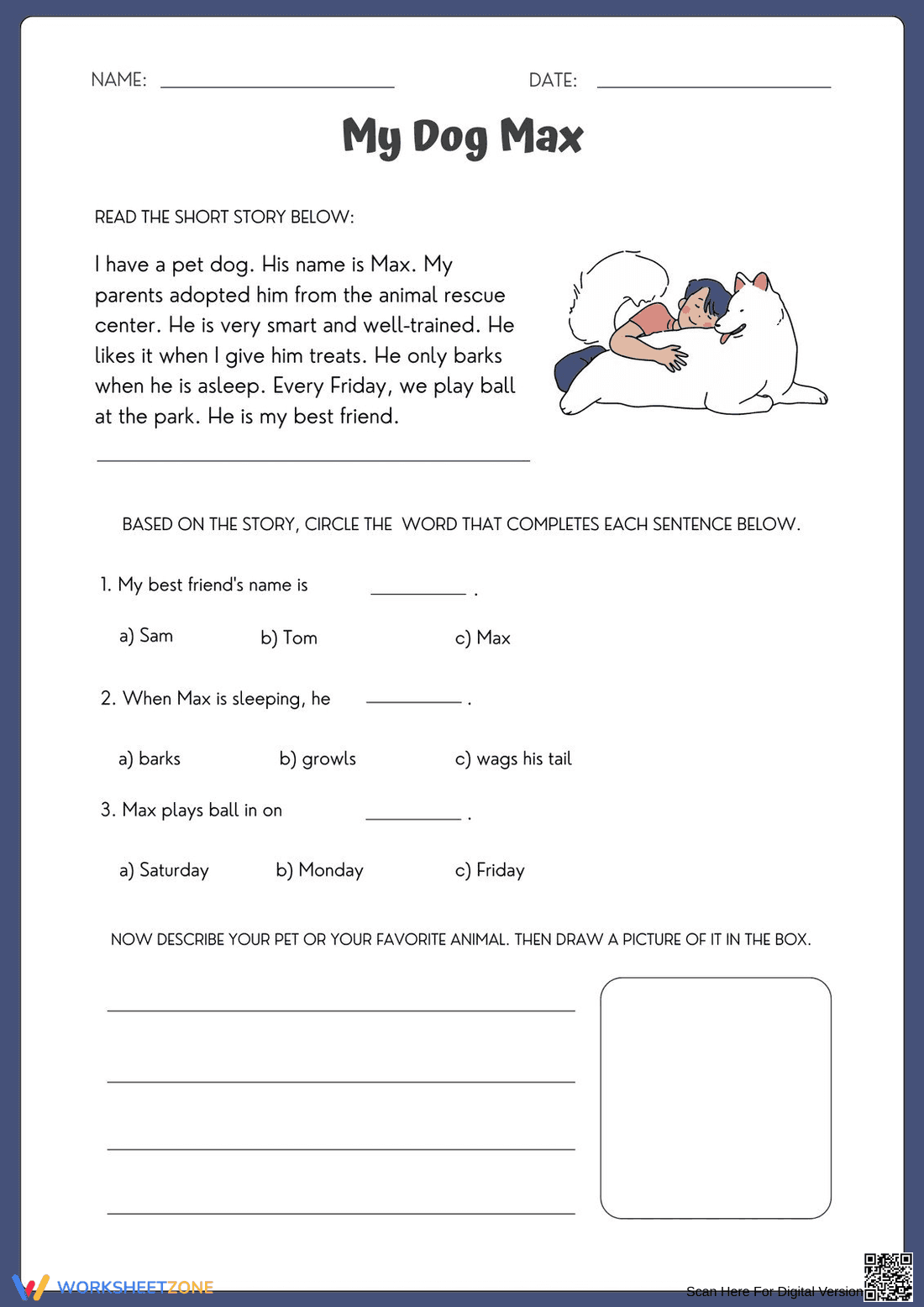
This Grade 1 reading comprehension worksheet helps students master the skill of identifying key details within a short narrative text. By reading about 'My Dog Max,' learners practice extracting specific information to answer multiple-choice questions before transitioning to a creative writing and drawing prompt that connects the story to their own lives.
At a Glance
At a Glance
- Grade: 1 · Subject: ELA
- Standard:
CCSS.ELA-LITERACY.RL.1.1— Ask and answer questions about key details in a text- Skill Focus: Reading comprehension and key details
- Format: 1 page · 4 problems · Answer key included · PDF
- Best For: Independent practice or morning work
- Time: 15–20 minutes
What's Inside
This single-page PDF features a 60-word narrative passage titled 'My Dog Max,' written with high-frequency words suitable for early readers. It includes three multiple-choice questions focused on literal comprehension and a multi-modal extension activity where students describe and illustrate their own pet or favorite animal, reinforcing the connection between reading and personal expression.
Zero-Prep Workflow
Teachers can implement this resource in three simple steps. First, print the single-page PDF (30 seconds). Second, distribute the sheets to students for independent or guided reading (1 minute). Third, review the multiple-choice answers as a whole group or use the drawing section for a quick formative check (1 minute). Total teacher preparation time is under two minutes, making it an ideal sub-plan or emergency filler.
Standards Alignment
The primary focus is `CCSS.ELA-LITERACY.RL.1.1`, which requires students to ask and answer questions about key details in a text. Additionally, the writing prompt supports `CCSS.ELA-LITERACY.W.1.3` by encouraging students to write about a sequence of events or personal experiences. Both standard codes can be copied directly into lesson plans, IEP goals, or district curriculum mapping tools.
How to Use It
Use this worksheet during the 'You Do' phase of a gradual release lesson on informational or narrative text. It serves as an excellent formative assessment tool; observe if students refer back to the text to find the dog's name or specific habits. Expect students to complete the reading and questions in approximately 15 to 20 minutes.
Who It's For
This resource is designed for first-grade students, though it provides excellent remedial support for second graders needing fluency practice. It pairs naturally with an anchor chart on 'Wh- questions' (Who, What, Where, When) or a direct instruction lesson on identifying the main character in a short story.
According to the RAND AIRS 2024 report, high-quality literacy instruction in early elementary grades relies on the integration of reading and writing tasks to solidify comprehension. This worksheet directly addresses CCSS.ELA-LITERACY.RL.1.1 by requiring students to locate and verify key details within a text, a foundational skill for reading proficiency. Research from Fisher & Frey (2014) emphasizes that 'text-dependent questions' are essential for moving students beyond surface-level reading toward deeper understanding. By combining literal comprehension questions with a creative drawing and writing extension, this resource supports multi-modal learning and helps students build a bridge between text analysis and personal narrative. The structured format ensures that 1st-grade learners can practice these skills independently, which is a critical component of the gradual release of responsibility model. This worksheet provides a measurable way to track student progress in identifying specific textual evidence, supporting long-term literacy goals and state-mandated assessment readiness.


