


























Views
Plays



Synonyms & Collocations Worksheet | Grade 1 Essential
Paste this activity's link or code into your existing LMS (Google Classroom, Canvas, Teams, Schoology, Moodle, etc.).
Students can open and work on the activity right away, with no student login required.
You'll still be able to track student progress and results from your teacher account.
This Grade 1 English worksheet focuses on vocabulary expansion through synonyms and collocations. Students engage with 35 high-quality problems designed to improve reading comprehension and linguistic precision. By identifying word meanings in context and completing common phrases, learners develop the foundational skills necessary for advanced literacy and effective communication.
At a Glance
- Grade: 1 · Subject: English Language Arts
- Standard:
CCSS.ELA-LITERACY.L.1.4— Use sentence-level context clues to determine the meaning of unknown words- Skill Focus: Synonyms and Collocations
- Format: 3 pages · 35 problems · Answer key included · PDF
- Best For: Vocabulary enrichment and context clue practice
- Time: 30–45 minutes
What's Inside
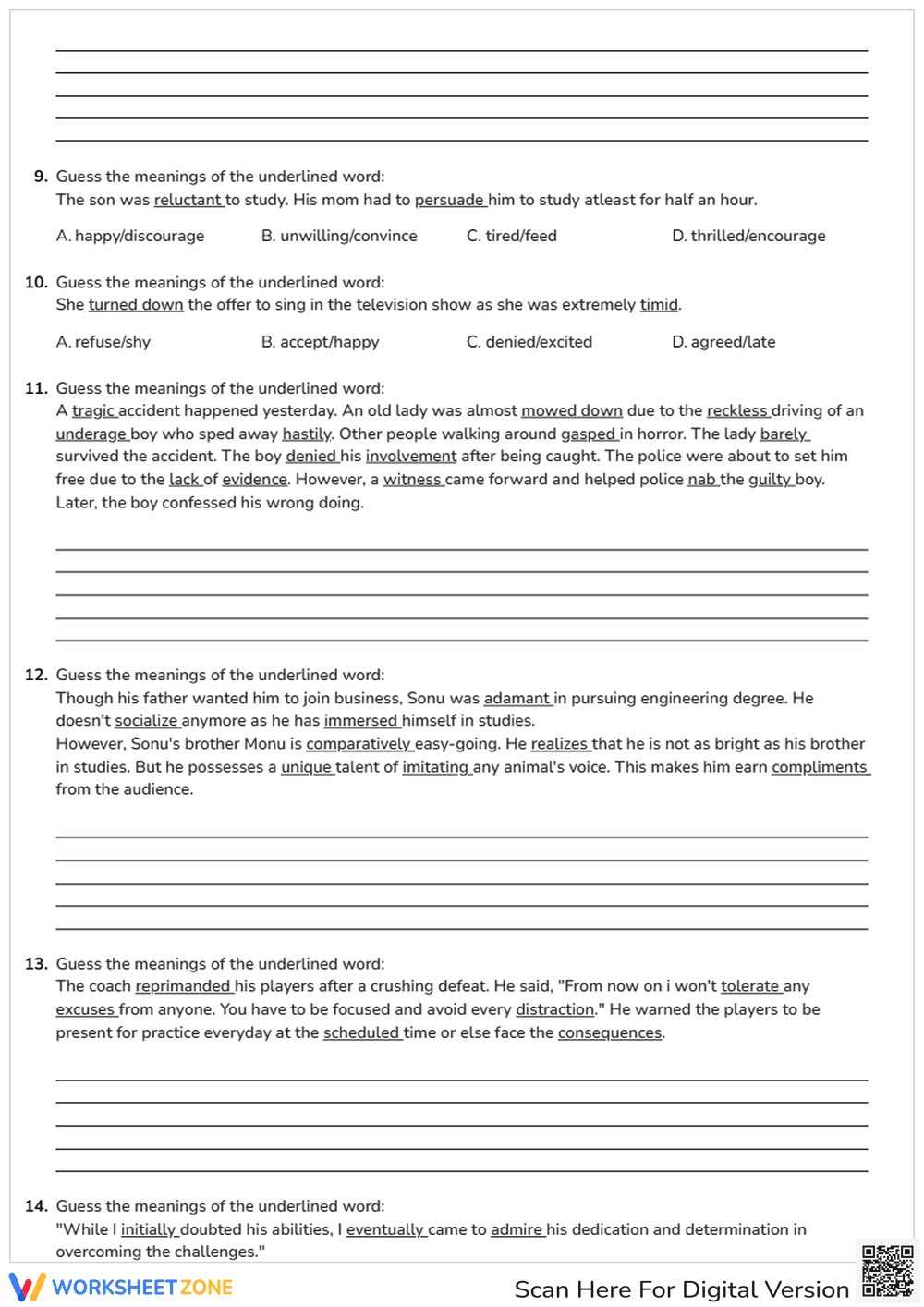
This comprehensive 3-page PDF contains 35 distinct tasks. The first section features multiple-choice and open-ended questions where students must identify the meaning of underlined words like "despised" and "ransacked" using context clues. The final page transitions to collocation practice, providing 21 fill-in-the-blank sentences that require students to select the correct verb-noun pairings for natural English usage.
Skill Progression
- Guided Practice: The worksheet begins with short, single-sentence prompts where students identify synonyms from a list of multiple-choice options, providing immediate feedback loops.
- Supported Practice: Students transition to longer narrative paragraphs where they must infer the meanings of multiple underlined words, requiring deeper synthesis of the surrounding text.
- Independent Practice: The final section challenges students to apply their knowledge of collocations by completing sentences without a word bank, fostering authentic language production.
This sequence follows a gradual-release model, moving from recognition to application.
Standards Alignment
This resource is primarily aligned with `CCSS.ELA-LITERACY.L.1.4`, which requires students to determine or clarify the meaning of unknown and multiple-meaning words and phrases. It specifically addresses sub-standard A by using sentence-level context as a clue. Additionally, it supports `CCSS.ELA-LITERACY.L.1.5` by exploring word relationships and nuances. Both standard codes can be copied directly into lesson plans, IEP goals, or district curriculum mapping tools.
How to Use It
Use this worksheet during a dedicated vocabulary block after introducing the concept of context clues. It serves as an excellent formative assessment to gauge student ability to infer meaning before moving to more complex texts. For best results, allow 30 to 45 minutes for completion. Teachers should observe if students are looking for specific clue words in the sentences to justify their synonym choices.
Who It's For
This resource is ideal for Grade 1 students ready for vocabulary enrichment or Grade 2 students needing a review of context clues. It is particularly effective for English Language Learners (ELL) focusing on collocations. Pair this worksheet with a short informational text or a classroom anchor chart on context clue strategies to reinforce the learning objective.
Research by Fisher & Frey (2014) emphasizes that vocabulary instruction is most effective when students encounter words in meaningful contexts rather than in isolation. This worksheet implements that evidence-based approach by requiring students to analyze 35 specific sentence environments to determine word meanings. By aligning with `CCSS.ELA-LITERACY.L.1.4`, the resource targets the Matthew Effect in reading, where early vocabulary acquisition predicts long-term academic success. The inclusion of collocations further supports linguistic fluency, as identified in the NAEP framework for reading proficiency. This structured practice ensures that Grade 1 learners move beyond simple decoding to active meaning-making. Educators can utilize these tasks to provide the high-volume, high-quality word exposure necessary for closing achievement gaps in early literacy and ensuring students are prepared for more rigorous informational texts.


