


























Views
Downloads


Comparative Adjectives Worksheet | Grade 3 ELA Printable
Paste this activity's link or code into your existing LMS (Google Classroom, Canvas, Teams, Schoology, Moodle, etc.).
Students can open and work on the activity right away, with no student login required.
You'll still be able to track student progress and results from your teacher account.
This Grade 3 grammar worksheet helps students master comparative and superlative adjectives by applying -er and -est suffixes. Before jumping into practice, learners review essential spelling rules for modifying base words. By completing these targeted exercises, students build the vocabulary skills needed to compare nouns accurately in their own writing.
At a Glance
- Grade: 3 · Subject: ELA
- Standard:
CCSS.ELA-LITERACY.L.3.1.G— Form and use comparative and superlative adjectives- Skill Focus: Suffixes -er and -est
- Format: 2 pages · 5 problems · Answer key included · PDF
- Best For: Independent practice
- Time: 10–15 minutes
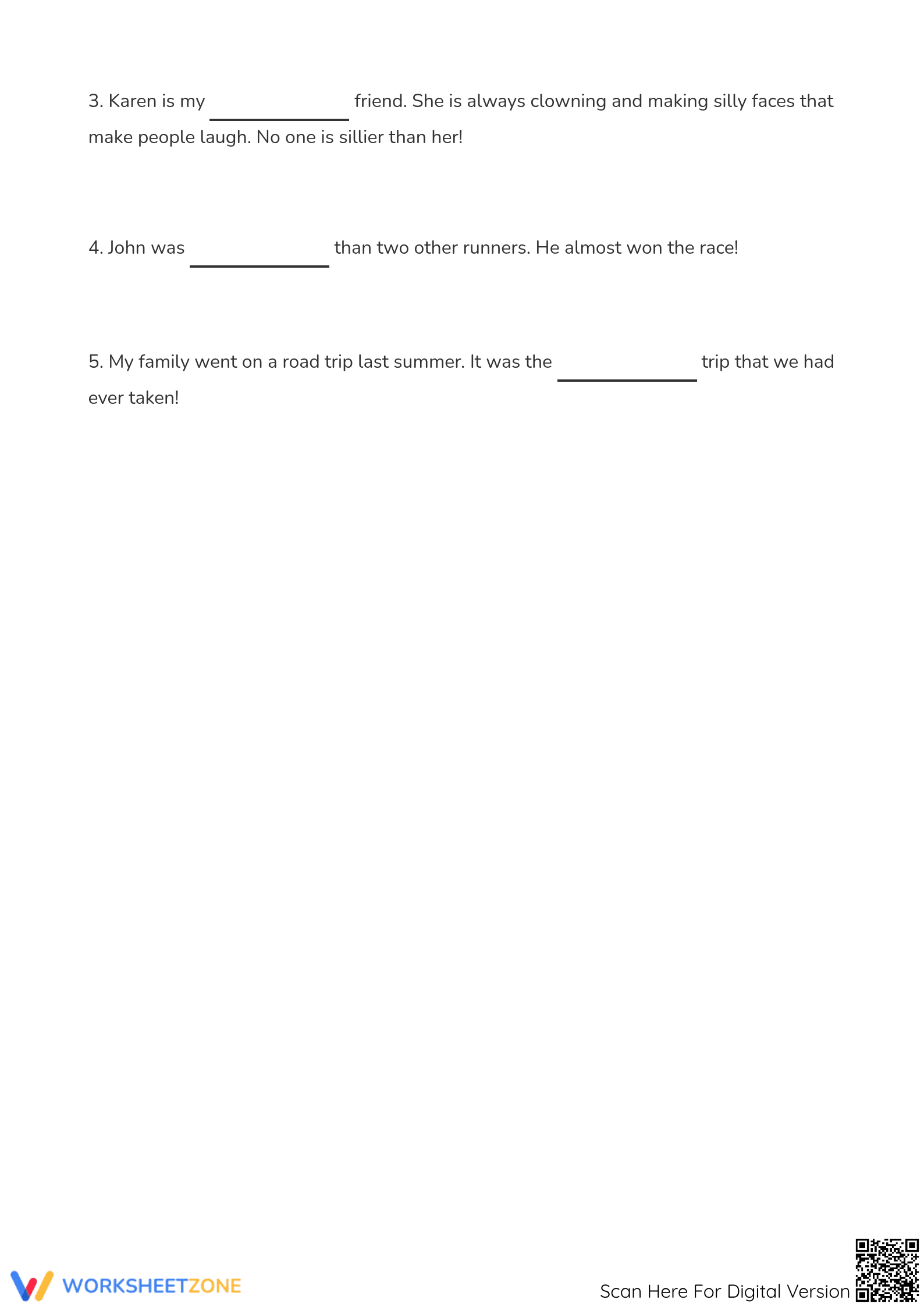
This two-page printable features a clear instructional header that outlines standard spelling patterns, including rules for words ending in "y" and CVC words. Following the instructional guide, students will find a helpful word bank containing eight base adjectives. The core activity consists of five fill-in-the-blank sentences where learners must choose the correct word and apply the appropriate suffix based on context clues. A complete answer key is provided for quick grading.
- Guided practice: The worksheet opens with explicit spelling rules and a worked example, showing exactly how to transform a base word into its superlative form.
- Supported practice: A provided word bank narrows down the choices, allowing students to focus on applying the correct suffix rather than guessing the vocabulary word.
- Independent practice: Students read five distinct sentences and rely on context clues to determine whether a comparative (-er) or superlative (-est) ending is required.
This structure follows a gradual-release model, moving from explicit rule review to independent application.
This resource is aligned to primary standard CCSS.ELA-LITERACY.L.3.1.G: Form and use comparative and superlative adjectives and adverbs, and choose between them depending on what is to be modified. It also supports foundational spelling skills by reinforcing how suffixes change base words. Both standard codes can be copied directly into lesson plans, IEP goals, or district curriculum mapping tools.
Teachers can deploy this worksheet during the "You Do" phase of a grammar lesson, immediately following direct instruction on comparative adjectives. It also serves as an excellent morning work assignment or homework task for extra reinforcement. While students work, educators can use this as a formative assessment by observing whether learners remember to drop the "e" or double the consonant before adding their endings. Expect most third graders to complete the activity within 10 to 15 minutes.
This resource is designed for third-grade general education students, though it works well for second graders needing a challenge or fourth graders requiring review. The explicit spelling rules at the top make it highly accessible for English Language Learners (ELLs) and students with IEPs who benefit from visual reminders. Pair this worksheet with a classroom anchor chart detailing suffix rules for maximum instructional impact.
Mastering the rules for CCSS.ELA-LITERACY.L.3.1.G, which requires students to form and use comparative and superlative adjectives, is a critical step in early elementary language development. According to a recent EdReports 2024 analysis, explicit instruction in morphology and spelling patterns significantly improves both reading comprehension and written expression. When students understand how suffixes like -er and -est modify meaning, they become more precise communicators. This worksheet provides the exact type of targeted, context-based practice recommended by literacy experts. By combining clear spelling rules with sentence-level application, educators can ensure learners internalize these grammatical structures rather than simply memorizing them. Providing immediate opportunities to apply new morphological rules in context helps solidify these essential language skills for long-term retention, reading fluency, and overall academic success across all subject areas.


