


























Views
Downloads
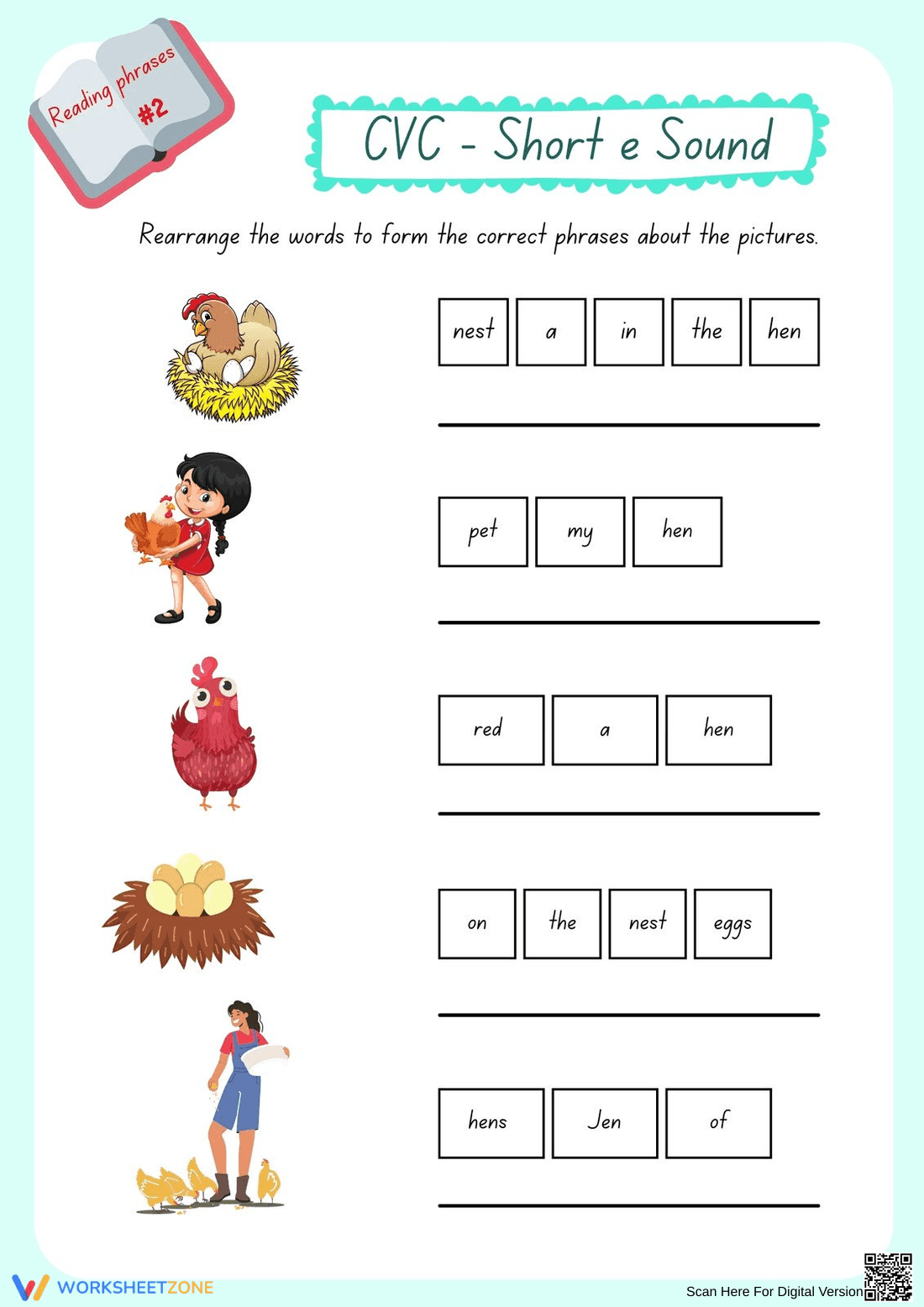

Grade 1 Short E CVC Phrases — Printable No-Prep Worksheet
Paste this activity's link or code into your existing LMS (Google Classroom, Canvas, Teams, Schoology, Moodle, etc.).
Students can open and work on the activity right away, with no student login required.
You'll still be able to track student progress and results from your teacher account.
This Grade 1 phonics worksheet gives students targeted practice with short E CVC words by having them unscramble simple phrases. Students look at colorful illustrations and rearrange scrambled word boxes to form correct, meaningful phrases, reinforcing both decoding skills and basic sentence structure in one activity.
At a Glance
- Grade: 1 · Subject: ELA
- Standard:
CCSS.ELA-LITERACY.RF.1.3.B— Decode regularly spelled one-syllable words- Skill Focus: Short E CVC Words & Phrase Building
- Format: 1 page · 5 problems · Answer key included · PDF
- Best For: Independent practice and literacy centers
- Time: 10–15 minutes
Inside this resource, educators will find a single-page activity featuring five distinct phrase-building tasks. Each problem includes a vibrant picture cue alongside scrambled word boxes. Students read the CVC and sight words, determine the correct order, and write the complete phrase. A complete answer key is included.
This worksheet is designed for a zero-prep workflow.
- Print (1 min): Download the PDF and print copies.
- Distribute (1 min): Hand out worksheets. Visual cues make instructions clear.
- Review (2 mins): Use the answer key to check work quickly.
With teacher prep under two minutes, this is perfect for sub plans.
This activity is strictly aligned to CCSS.ELA-LITERACY.RF.1.3.B: Decode regularly spelled one-syllable words. By requiring students to read and sequence short E CVC words alongside high-frequency words, it also supports early syntax and comprehension skills. Both standard codes can be copied directly into lesson plans, IEP goals, or district curriculum mapping tools.
This worksheet is an excellent independent activity after direct instruction on the short E sound. Place it in a literacy center or assign as morning work. Formative assessment tip: observe if students rely on picture cues or actively sound out CVC words before writing. Expected completion time is 10 to 15 minutes.
This resource is primarily designed for first-grade students mastering short vowel sounds and basic sentence construction. It also serves as an effective intervention tool for second-grade students who need additional support with CVC decoding and phrase sequencing. For differentiation, teachers can provide letter tiles for students to physically manipulate the words before writing them down. This worksheet pairs naturally with a direct instruction lesson on short E word families or a decodable reading passage featuring similar vocabulary.
Developing early literacy requires explicit practice in both decoding and syntax. This resource targets CCSS.ELA-LITERACY.RF.1.3.B, helping students decode regularly spelled one-syllable words within a meaningful context. According to Fisher & Frey (2014), providing students with structured, visual scaffolds during independent practice significantly increases their ability to transfer isolated phonics skills into connected reading and writing tasks. By combining picture cues with scrambled CVC words, this worksheet reduces cognitive load while maintaining rigorous decoding expectations. Students are prompted to actively engage with the short E sound, moving beyond rote memorization to practical application. This dual focus on phonemic awareness and phrase construction builds a stronger foundation for reading fluency. The targeted nature of this activity ensures that early readers receive the exact repetition needed to master short vowel sounds and improve overall literacy outcomes.


