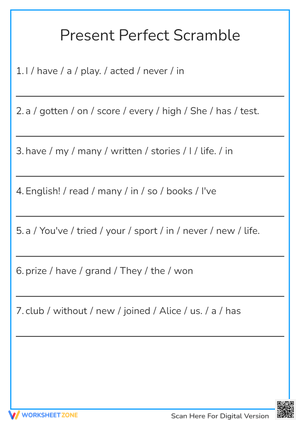
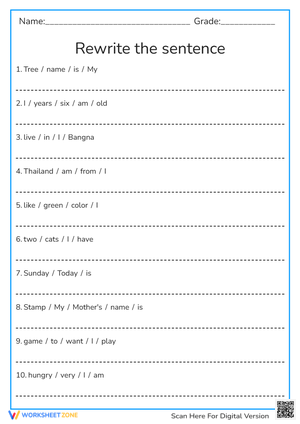
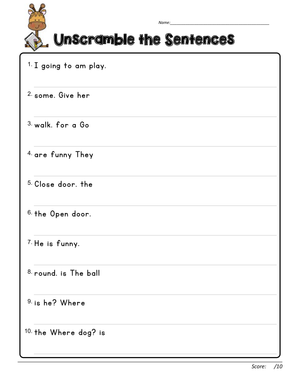
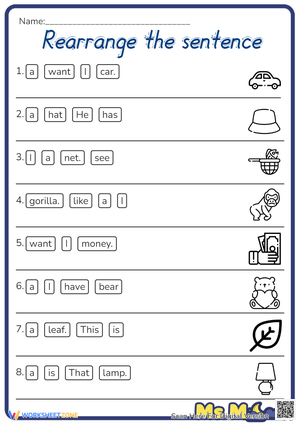
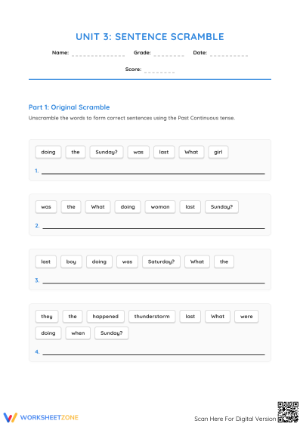
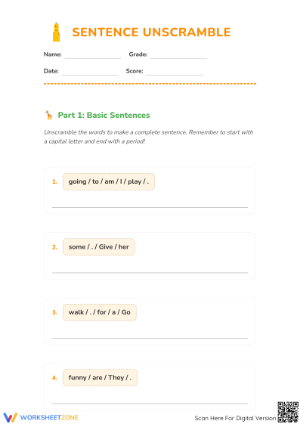
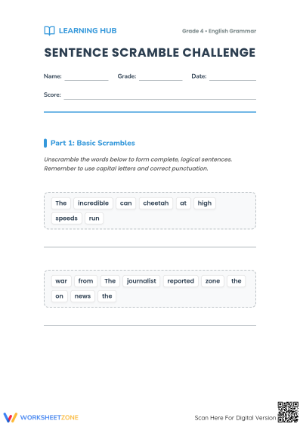
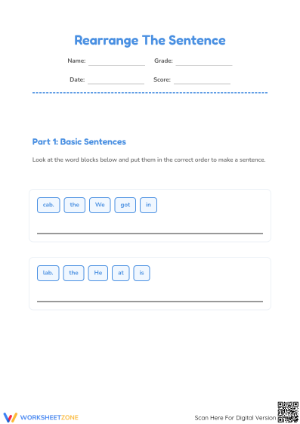
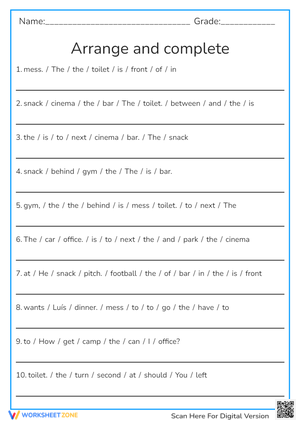
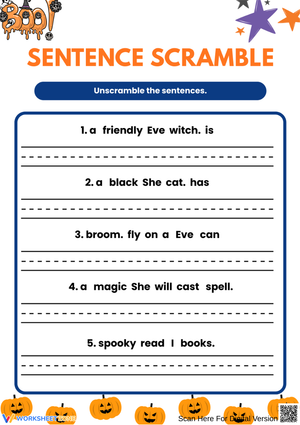
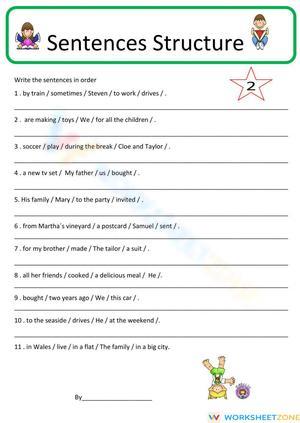
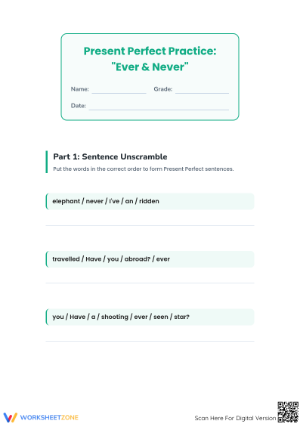
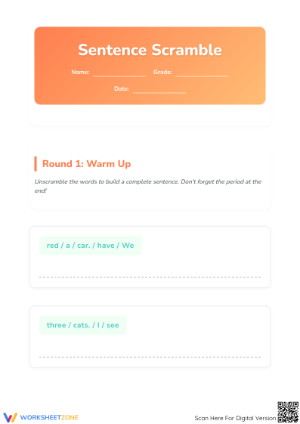
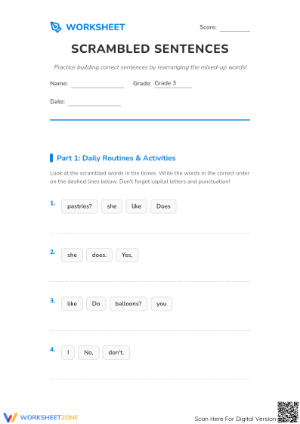
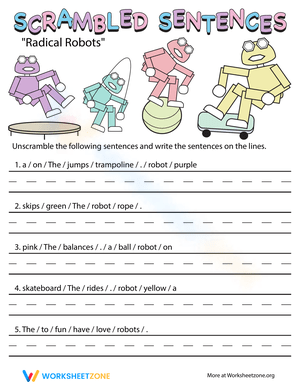
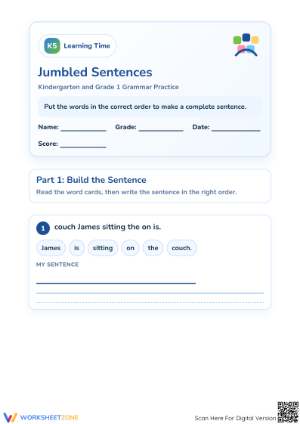
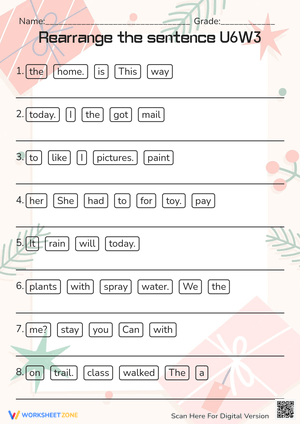
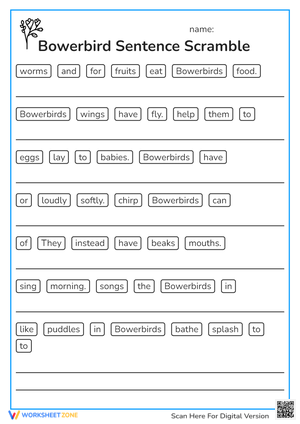
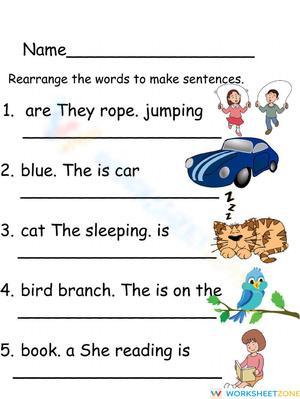
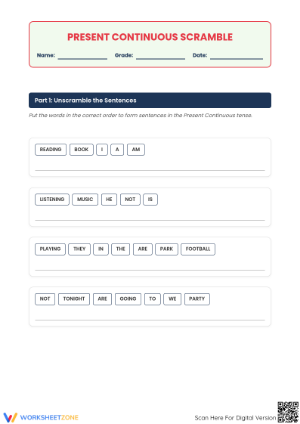
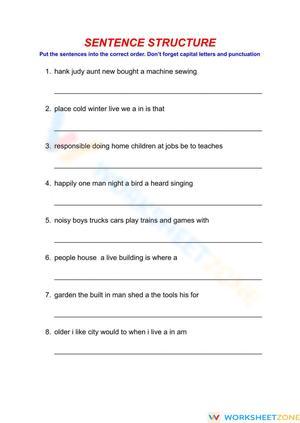
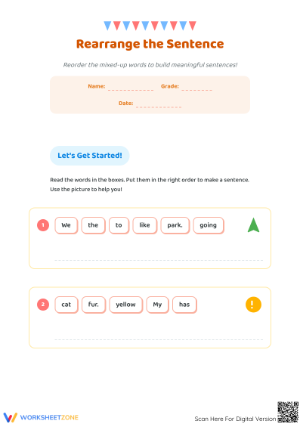
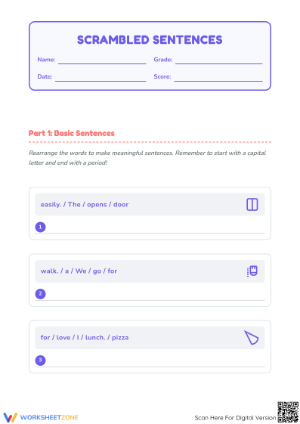
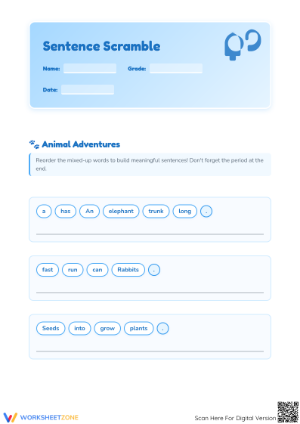
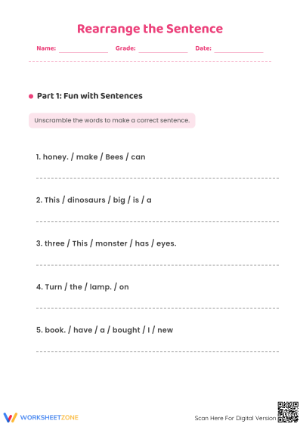
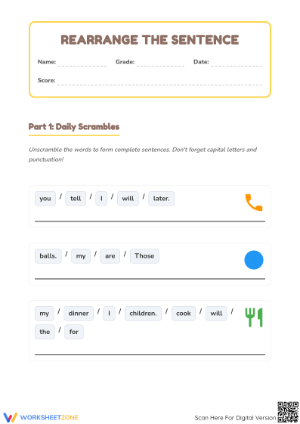
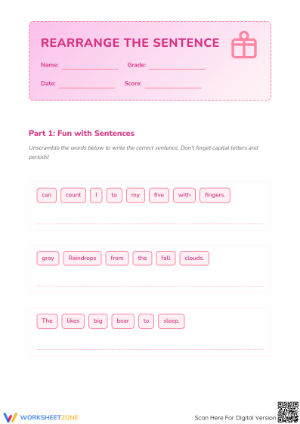
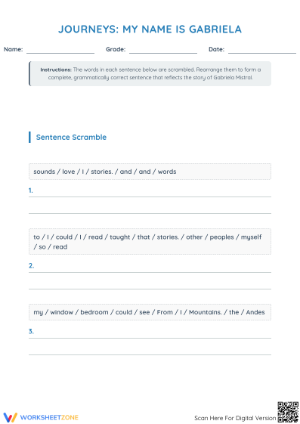
These sentence scramble pdf worksheets give students a concrete entry point into English syntax — the vocabulary is provided, the task is to arrange it correctly, and that constraint keeps the cognitive work focused on word order rather than word retrieval. The set covers declarative, interrogative, and exclamatory sentence types, progressing from simple three-word combinations to longer structures that include adjectives, adverbs, and prepositional phrases. Teachers report using them across grades K–3, though the format adapts readily for ELL instruction at higher grade levels.
What Each Worksheet Targets
The central skill is recognizing and applying the Subject-Verb-Object pattern that governs most English sentences. Students read each jumbled word group, identify structural anchors — the capitalized word signals the start, the word carrying terminal punctuation signals the end — and then test arrangements for the words in between. Completing that process for a dozen sentences in a single sitting gives students more deliberate contact with sentence architecture than a typical writing lesson does, because here they cannot default to formulaic sentence starters or repeated patterns from their own writing.
Beyond word order, each worksheet reinforces punctuation recognition. Students must distinguish between a period, a question mark, and an exclamation point as they determine how the sentence ends — and that distinction matters, because a sentence that works grammatically as a statement reads differently if the terminal word carries a question mark. The decision is not cosmetic. It shapes how the final sentence gets read aloud, which is a useful comprehension check.
Student Errors That Show Up Consistently in This Work
The most common error is what might be called the anchor-and-guess pattern. A student correctly places the capital-letter word at the front and the punctuated word at the end, then writes the remaining words in the order they appear on the page — left to right, as printed — without testing whether the result makes sense. The word group "jumped / the / fence / over / dog / the" becomes "the jumped the dog fence over" because the student stops reasoning after the anchors are placed. Catching this in a literacy center is straightforward: ask the student to read the completed sentence aloud. They almost always hear the error immediately.
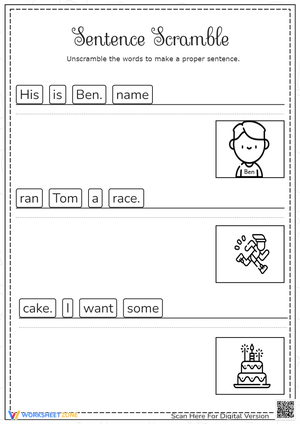
A second consistent error appears when picture cues accompany the words. Some students read the image, decide what the sentence "should" say, and then arrange the words to match that interpretation — even when the actual words given don't support it. A picture of a cat sleeping near a window might lead a student to write "the cat sleeps by the window" when the words supplied include "near" rather than "by." The word gets silently swapped. The worksheet reveals a reading habit worth addressing: inferring from context rather than attending to the text as given.
Building These Worksheets Into Your Instructional Week
The most effective placement is the first eight minutes of the literacy block — before the formal lesson begins and after students have settled. The task is self-directing enough that students start without prompting, and it generates written work the teacher can scan during the morning meeting transition. That immediate formative read tells you quickly whether a student is anchoring correctly or still guessing through the middle words.
In literacy center rotations, sentence scramble pdf worksheets run well as a partner task. One student arranges the words and reads the result aloud while the partner listens and confirms or challenges. That oral verification step catches most errors before the sentence gets written down. For whole-group instruction, projecting a scrambled sentence and thinking aloud — "I see a capital R, so 'Rabbits' is my first word; I see a period after 'hutch,' so that word is last; now what fits between?" — gives students a replicable strategy rather than a rule list to memorize.
Adjusting for the Range of Learners in Your Room
Emerging readers work best with three- or four-word sentences paired with picture cues. The image limits the semantic possibilities and lets students cross-check their arrangement before committing. Once students are reliably anchoring on the capital and punctuation word, remove the picture and extend sentence length to five or six words — the added words are typically an adjective or prepositional phrase, which introduces the question of where modifiers attach.
For students who move through the standard format quickly, remove the capitalization and punctuation cues entirely. These sentence scramble pdf worksheets, used this way, function as a grammar mechanics assessment — the written product reveals whether a student controls capitalization and punctuation conventions independently, not just when the answer is embedded in the word cards. That version also works as a mid-unit check before moving into independent paragraph writing.
Standard Alignment
These worksheets address CCSS.ELA-LITERACY.L.1.1j, which requires first graders to produce and expand complete simple and compound declarative, interrogative, imperative, and exclamatory sentences in response to prompts. Unscrambling activities build directly toward that standard because students must identify sentence type — based on terminal punctuation — before they can write the sentence correctly. At the kindergarten level, the worksheets support CCSS.ELA-LITERACY.L.K.1f, which addresses producing and expanding complete sentences in shared language activities. Teachers using the format with second graders can connect it to L.2.1f, which expects students to produce, expand, and rearrange complete simple and compound sentences. The instructional value is consistent across those grade bands: students practice the conventions of sentence construction in a format where the feedback loop is immediate and visible in their written work.
Frequently Asked Questions
How do I introduce unscrambling to kindergarteners who aren't reading independently?
Start with whole-group instruction using large word cards in a pocket chart. Model the anchor strategy aloud — capital letter first, terminal punctuation last — and invite the class to suggest arrangements for the middle words. After two or three whole-group sessions, students can work in pairs on printed sheets, with one student reading the words aloud and the other arranging them. Reserve fully independent practice until students demonstrate the anchor strategy reliably on their own.
Are these useful for ELL students who have strong oral English but struggle with written conventions?
They work particularly well for that profile. Students who understand English syntactically but haven't internalized written conventions — especially capitalization and end punctuation — benefit from seeing those mechanics embedded in every item. The constraint of working with given words also removes the anxiety of vocabulary retrieval, which frequently causes ELL students to freeze during open writing tasks. A student who hesitates to write freely because of spelling uncertainty can engage fully with sentence scramble pdf worksheets since no new words need to be generated.
How do I handle answer-checking efficiently with 25 students and limited time?
The most efficient method is a class read-aloud at the end of center time. Project the answer key and have students read each completed sentence aloud together, then self-mark with a colored pencil. Errors become visible immediately, and the read-aloud reveals whether a wrong arrangement "sounds right" or produces obvious nonsense — both are useful diagnostic data. For students who need individual feedback, collect one worksheet per week rather than every session and focus written comments on the specific error pattern you observe, not just whether the answer was correct.












 Interactive Worksheet Maker
 Quiz Maker
 Word Search Maker
 Crossword Puzzle Maker
 Word Scramble Generator
 Sentence Scramble Generator
 Handwriting Worksheet Generator
 Name Tracing Generator
 Fill In The Blank Generator